
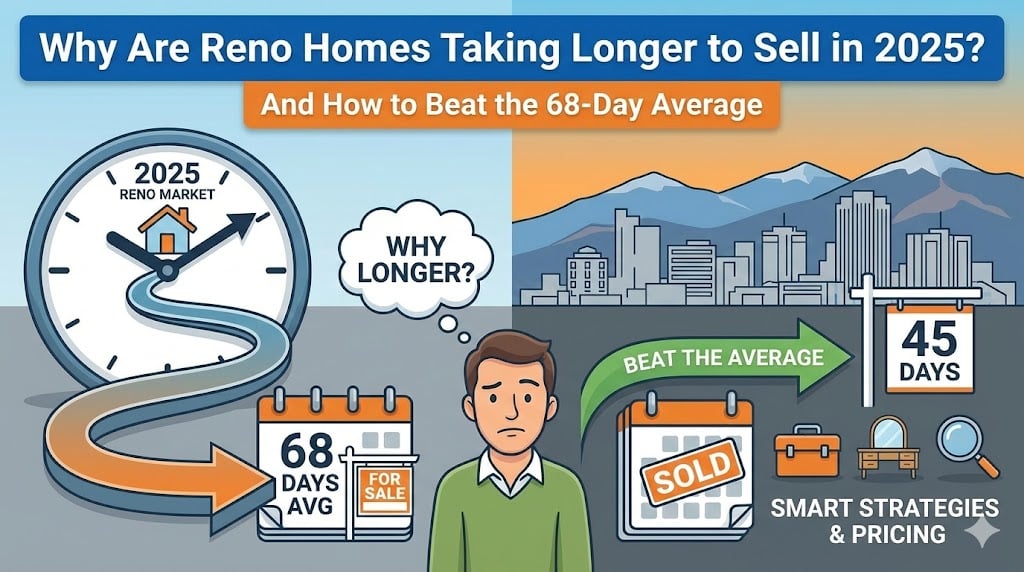
If you've been watching the Reno-Sparks real estate market lately, you might have noticed something: homes are sitting longer. The data tells a clear story—average days on market have climbed from 55 days last year to 68 days in October 2025 Redfin, a 24% increase that's catching many sellers off guard. Even more concerning, 48.8% of Reno homes sold below asking price in June 2025, with only 22% selling above asking Rocket.
So what changed? And more importantly, how do you position your home to sell faster and for more money when half the market is accepting less than they hoped for?
The answer isn't what most agents will tell you. It's not about staging every room or waiting for spring. It's about understanding exactly why the market shifted—and using strategic positioning that most sellers completely overlook.
The Real Reason Reno Homes Are Sitting Longer
The Reno market isn't experiencing a collapse. November's median price hit $585,000, up 5.7% year-over-year Renorealtyblog, and inventory remains relatively tight at just 867 units. But three specific factors have created a challenging environment for unprepared sellers:
Inventory is up 25% year-over-year. While current inventory sits at 867 units, down 6.2% from last month, it's up 25.3% compared to last year Renorealtyblog. Translation: your home now competes with significantly more listings than it would have 12 months ago. More options mean buyers can be choosier—and slower to commit.
Buyer behavior has shifted fundamentally. Post-election market activity is increasing as uncertainty clears and buyers come off the fence MyNews4, but these aren't the frenzied 2021-2022 buyers writing offers sight-unseen. Today's buyers tour multiple properties, negotiate harder, and walk away if something feels off. They're making calculated decisions, not emotional ones.
Pricing precision matters more than ever. In a market where average homes sell for 2-3% below list price Redfin and nearly half sell under asking, overpricing by even 5% can add weeks to your timeline. The homes beating the 68-day average? They're priced strategically from day one, not reactively after 30 days of no activity.
The Hidden Cost of Extra Days on Market
Here's what most sellers don't calculate: every additional week your home sits costs you real money, even if you eventually sell.
On a $600,000 Reno home, carrying costs typically run $4,000-5,000 per month when you factor in mortgage payments, property taxes, insurance, utilities, and maintenance. If your home takes 68 days instead of 34 days (the timeframe for "hot homes" in Reno that sell quickly), that's an extra month of carrying costs—$4,000-5,000 out of your pocket.
But it gets worse. Homes that linger develop a perception problem. Buyers wonder: "What's wrong with it? Why hasn't anyone made an offer?" Even if nothing is wrong, extended days on market often lead to lower offers. The psychological impact of a listing that's been active for 60+ days is real, and it costs sellers negotiating leverage.
Strategy #1: Price to Sell in the First 14 Days
The data on Reno's current market is unambiguous: homes priced correctly from the start are still moving quickly. Hot homes that sell around list price go pending in approximately 34 days Redfin—exactly half the current market average.
What separates these properties? Aggressive comparative market analysis that accounts for three critical factors most CMAs ignore:
Current absorption rate by price range. In Reno's higher price tiers, homes in the $1,500,000+ range showed a 4-month supply, significantly reduced from the previous year Renoareahomebuyers. But in the $400,000-700,000 range—where most Reno inventory sits—competition is fierce. Your pricing strategy must reflect your specific price band's absorption rate, not just recent comparable sales.
Neighborhood-specific days on market trends. In Double Diamond, average homes sit on the market for 56 days before selling and typically sell for about 2% below list price SoFi. Meanwhile, in Somersett, the average home stays on the market around 73 days before selling, typically for 1% below asking SoFi. Generic citywide averages don't tell your story—your neighborhood's specific velocity does.
Seasonal velocity patterns. The homes listing now face different competitive dynamics than those listing in February. Understanding how your neighborhood performs during each season—and pricing accordingly—is the difference between 34 days and 68 days on market.
Here's the strategic approach: Price your home at the absolute top of what comparable sold data supports, but not a dollar above. Many sellers add 5-10% "negotiation room." In today's Reno market, that strategy backfires. Buyers are comparing your home to 25.3% more inventory than last year. If you're priced above market, they'll simply move to the next listing.
Strategy #2: Front-Load Your Marketing Impact
In a market where 62% of homes sell within 30 to 90 days and 28% take over 90 days Rocket, the first two weeks determine everything. This is when your listing gets maximum exposure—new listing notifications, top placement in search results, and the most buyer attention.
The homes beating the 68-day average share one common trait: they launched with professional marketing that captured attention immediately. Here's what that actually means:
Professional photography that highlights what makes Reno valuable. Your listing isn't just competing with other Reno homes—it's competing with perfect lighting, expert angles, and strategic staging in every competing listing. Homes with subpar photos get scrolled past in 2-3 seconds. 98% of NAR members believe that great curb appeal and presentation can accelerate your home sale Houzeo, and online photos are the new curb appeal.
Listing descriptions that speak to specific buyer motivations. California relocators care about different features than local Reno move-up buyers. Remote workers prioritize different spaces than families with school-aged children. Generic listing descriptions don't convert serious buyers into showings—specificity does.
Strategic showing availability in the first 14 days. If buyers have to wait three days to see your home, they've already scheduled tours of five competing properties. The homes selling in 34 days make it easy to show during the critical first two weeks, even if it's inconvenient for the seller.
Strategy #3: Choose an Agent Based on Market-Specific Performance Metrics
Who you select as your real estate agent can play a big role in how fast your house sells, with top agents averaging significantly lower days on market than their peers HomeLight. But in Reno's current environment, generic agent credentials don't predict results. You need an agent whose specific skill set matches today's market challenges.
Ask potential listing agents three questions that most sellers never think to ask:
What's your average days on market compared to MLS average in the past 12 months? If an agent's listings are sitting longer than market average, they're not pricing correctly, marketing effectively, or negotiating strategically. You want an agent whose personal stats beat the 68-day average—ideally significantly.
How many of your listings in the past year required price reductions? This reveals pricing discipline. Agents who consistently price homes correctly from the start avoid the price reduction cycle that adds weeks to timelines and costs sellers thousands.
What's your specific strategy for the first 14 days of marketing? Vague answers about "social media" and "open houses" aren't enough. You want a detailed plan for how they'll capture attention when your listing has maximum visibility—because after two weeks, algorithmic placement drops and fewer buyers see your home.
The right agent understands that selling a Reno home in 40-50 days instead of 68 days isn't about luck. It's about market intelligence, pricing discipline, and marketing execution that most agents simply don't provide. Learn how to evaluate agents based on performance metrics rather than personality.
Strategy #4: Address the "Why Isn't It Selling?" Problem Before It Starts
Once your home crosses the 45-day threshold without an offer, buyer perception shifts. They assume something is wrong. Even if you eventually get an offer at day 60 or 70, it's likely coming in lower than offers would have been at day 20.
The homes beating the market average eliminate potential objections before they become listing liabilities:
Deferred maintenance becomes a deal-killer in slower markets. When buyers have more options, they're less willing to overlook issues. In 2021-2022, buyers accepted homes with aging HVAC systems, worn carpeting, and dated fixtures because inventory was scarce. Today, these same issues cause buyers to move to the next listing. Strategic repairs before listing—not extensive remodeling, just addressing obvious maintenance concerns—prevent the "we'll pass" response.
Lifestyle features that worked for you might not translate to buyers. A home office converted from a bedroom makes sense for remote workers but eliminates a bedroom for families. Highly personalized landscaping reflects your taste but doesn't necessarily appeal broadly. Understanding which features enhance value and which create friction for typical Reno buyers prevents your home from sitting while similarly-sized properties move quickly.
Offer terms matter as much as price. In a market where 30% of homes sell at asking price and 22% sell over asking Rocket, strategic offer structuring—seller-paid rate buydowns, closing cost assistance, extended closing timelines—can differentiate your listing from competing properties without reducing your net proceeds.
The Timing Decision: List Now or Wait?
Many sellers watching the 68-day average wonder if they should wait for spring when buyer activity traditionally increases. Here's the strategic calculus:
Inventory continues climbing. Available inventory has been steadily increasing since April 2024 Renorealtyblog. If you wait until spring to list, you'll compete with even more inventory than exists today—and spring inventory is traditionally the highest of the year. More competition means longer days on market and more pressure on pricing.
Today's buyers are motivated. Post-election, the market is seeing increased activity as buyers who were sitting on the fence make decisions MyNews4. The buyers active right now aren't casually browsing—they have compelling reasons to purchase before year-end or early 2026. These are exactly the buyers most likely to move quickly on a well-positioned home.
Carrying costs accumulate daily. If you're already planning to sell in the next 3-6 months, every month you wait costs $4,000-5,000 in carrying expenses. Waiting for "perfect timing" often costs more than the potential benefit of slightly increased buyer activity.
The Bottom Line: Market Averages Don't Determine Your Outcome
The Reno market's 68-day average tells you what's happening to most sellers. It doesn't dictate what happens to your home.
The properties selling in 34-40 days instead of 68 days share common strategic elements: precise pricing based on current absorption rates, professional marketing that launches with maximum impact, agents whose personal stats beat market averages, and proactive elimination of potential objections before buyers encounter them.
In a market where nearly half of all homes sell below asking and days on market continue climbing, the cost of generic advice and average execution is measurable—in both time and money. Strategic positioning isn't about tricks or gimmicks. It's about understanding exactly what today's Reno buyers respond to, and giving it to them from day one.
Ready to beat the 68-day average and position your Reno home strategically for faster sale and maximum value? Contact Kevin Kinney at 775-391-8402 or Robin Renwick at 775-813-1255 to schedule a comprehensive listing consultation. We'll analyze your home's competitive position, discuss strategic pricing based on current neighborhood-specific data, identify preparation priorities that impact days on market, and create a marketing approach designed to capture serious buyers in the critical first 14 days. Let's turn current market challenges into your competitive advantage.
The Kinney & Renwick Team
Kevin Kinney – 775-391-8402
Robin Renwick – 775-813-1255
[email protected]
kinneyandrenwickteam.com
3. FAQs (8 Questions)
Why are homes in Reno taking longer to sell in 2025 compared to last year?
Homes in Reno are taking longer to sell primarily due to three factors: inventory has increased 25.3% year-over-year, giving buyers significantly more options; buyer behavior has shifted from emotional to calculated decision-making; and pricing precision matters more than ever in a market where 48.8% of homes sell below asking price. The combination of more competition and more selective buyers means homes that aren't strategically positioned and priced correctly from day one sit longer on the market.
What is the current average days on market for Reno homes?
As of October 2025, the average days on market for Reno homes is 68 days, up from 55 days the previous year—a 24% increase. However, this average masks significant variation: "hot homes" that are priced correctly and marketed professionally go pending in approximately 34 days, while homes that require price reductions or have positioning issues can sit for 90+ days. Your specific days on market will depend primarily on pricing accuracy, presentation quality, and neighborhood dynamics.
How much below asking price are Reno homes currently selling for?
The data shows significant variation. In June 2025, 48.8% of Reno homes sold below asking price, 30% sold at asking price, and only 22% sold above asking. On average, typical homes sell for 2-3% below list price. However, homes that are priced strategically from the beginning and positioned correctly often sell at or near asking price, while overpriced homes that require reductions can end up 5-7% or more below their original asking price after extended market time.
What's the difference between hot homes and average homes in the Reno market right now?
Hot homes in Reno—those that sell quickly and at or above asking price—go pending in approximately 34 days and typically sell at or near their list price. Average homes take 68 days and sell for 2-3% below asking. The key differences are pricing precision based on current absorption rates rather than outdated comparables, professional marketing that launches with maximum impact in the first 14 days, and proactive elimination of potential buyer objections before they become deal obstacles.
Should I wait until spring to list my Reno home or sell now?
Waiting until spring means competing with even more inventory, as spring traditionally brings the year's highest listing volume. Available inventory in Reno has been steadily increasing since April 2024, and spring will only intensify competition. Additionally, current post-election market activity is bringing motivated buyers who have compelling reasons to purchase before year-end or early 2026. If you're carrying monthly costs of $4,000-5,000 on a vacant property or planning to move anyway, waiting typically costs more than the potential benefit of slightly increased buyer activity in spring.
What carrying costs should I factor in if my home sits on the market longer than expected?
On a $600,000 Reno home, monthly carrying costs typically total $4,000-5,000 when you factor in mortgage payments, property taxes, insurance, utilities, and ongoing maintenance. This means the difference between selling in 34 days versus 68 days costs you an additional month of expenses—roughly $4,000-5,000 out of pocket. Extended days on market also impact your negotiating position, as buyers perceive listings that sit longer as having potential issues, often leading to lower offers that further reduce your net proceeds.
How do I choose a real estate agent who can actually sell my home faster than the market average?
Focus on performance metrics rather than personality or generic credentials. Ask potential agents three specific questions: What's your average days on market compared to MLS average in the past 12 months? How many of your listings required price reductions in the past year? What's your detailed strategy specifically for the first 14 days of marketing? The right agent will have personal stats that beat the 68-day market average, demonstrate pricing discipline through low price-reduction rates, and articulate a specific plan for capturing attention when your listing has maximum visibility.
Which Reno neighborhoods are seeing the longest days on market in 2025?
Days on market vary significantly by neighborhood. Somersett homes average around 73 days on market before selling, typically at 1% below asking. Double Diamond homes sit for approximately 56 days before selling, usually at 2% below list price. Northwest Reno and other established neighborhoods each have distinct velocity patterns based on price range, school districts, and current inventory levels. Understanding your specific neighborhood's absorption rate—not just citywide averages—is critical for pricing and timeline expectations.
Check out this article next