
Disclaimer: Market conditions change. Consult directly with Kevin Kinney (775-391-8402) or Robin Renwick (775-813-1255) for guidance specific to your property and goals.
Introduction
Selling a home in Reno or Sparks represents one of the most significant financial decisions you will ever make. With the median sale price in Reno reaching $549,000 in December 2025 and properties averaging 66 days on market before going under contract, the stakes of getting your listing strategy right have never been higher. According to the National Association of Realtors' 2025 Profile of Home Buyers and Sellers, a record 91% of home sellers used a real estate agent to represent them—the highest percentage ever recorded—while For Sale By Owner transactions dropped to just 5% of all sales, an all-time low.
These numbers tell a clear story: in a market defined by complexity, serious sellers recognize that the right listing agent isn't an expense to minimize but an investment that directly impacts their final outcome. The difference between an agent who simply puts your home on the MLS and one who strategically positions your property for qualified demand can translate to tens of thousands of dollars in your pocket at closing. For homeowners in neighborhoods like Somersett, Damonte Ranch, Caughlin Ranch, and throughout Washoe County, understanding what separates a strategic listing agent from an average one is the first step toward achieving the results your property deserves.
The Numbers Behind Agent-Assisted Sales
The data supporting agent representation has never been more compelling. NAR's 2025 Profile reveals that FSBO homes sold for a median price of $360,000, compared to $425,000 for agent-assisted sales—an 18% gap representing $65,000 in additional value for sellers who worked with representation. While some of this difference reflects the types of properties typically sold without agents, the pattern holds consistent year over year: professional representation correlates with stronger outcomes.
What drives this difference? It begins with pricing precision. According to industry analysis, roughly 41% of all listings receive a price reduction before receiving an offer. Each price cut signals to the market that the original strategy missed the mark, often leading buyers to wonder what else might be wrong with the property or to assume there is additional negotiating room. A skilled listing agent understands the Reno-Sparks market at the neighborhood level—knowing that homes in Southwest Reno move differently than those in Spanish Springs, or that properties in the $700,000 to $900,000 range in Somersett face competition from new construction that requires specific positioning strategies.
The cost of overpricing extends beyond the eventual price reduction itself. Homes that sit on market longer accumulate carrying costs—mortgage payments, property taxes, insurance, utilities, and the ongoing stress of keeping a property in showing condition. Research consistently shows that properties receive their strongest buyer interest during the first two weeks of listing. An agent with genuine local expertise prices correctly from day one, capturing that critical initial window rather than chasing the market downward.
Jessica Lautz, NAR's deputy chief economist, summarized the current environment clearly: "Real estate agents remain indispensable in today's complex housing market. Beyond guiding buyers and sellers through what is often the largest financial decision of their lives, agents provide critical expertise, negotiation skills and emotional support during an increasingly challenging process."
What Separates Strategic Listing Agents from Average Ones
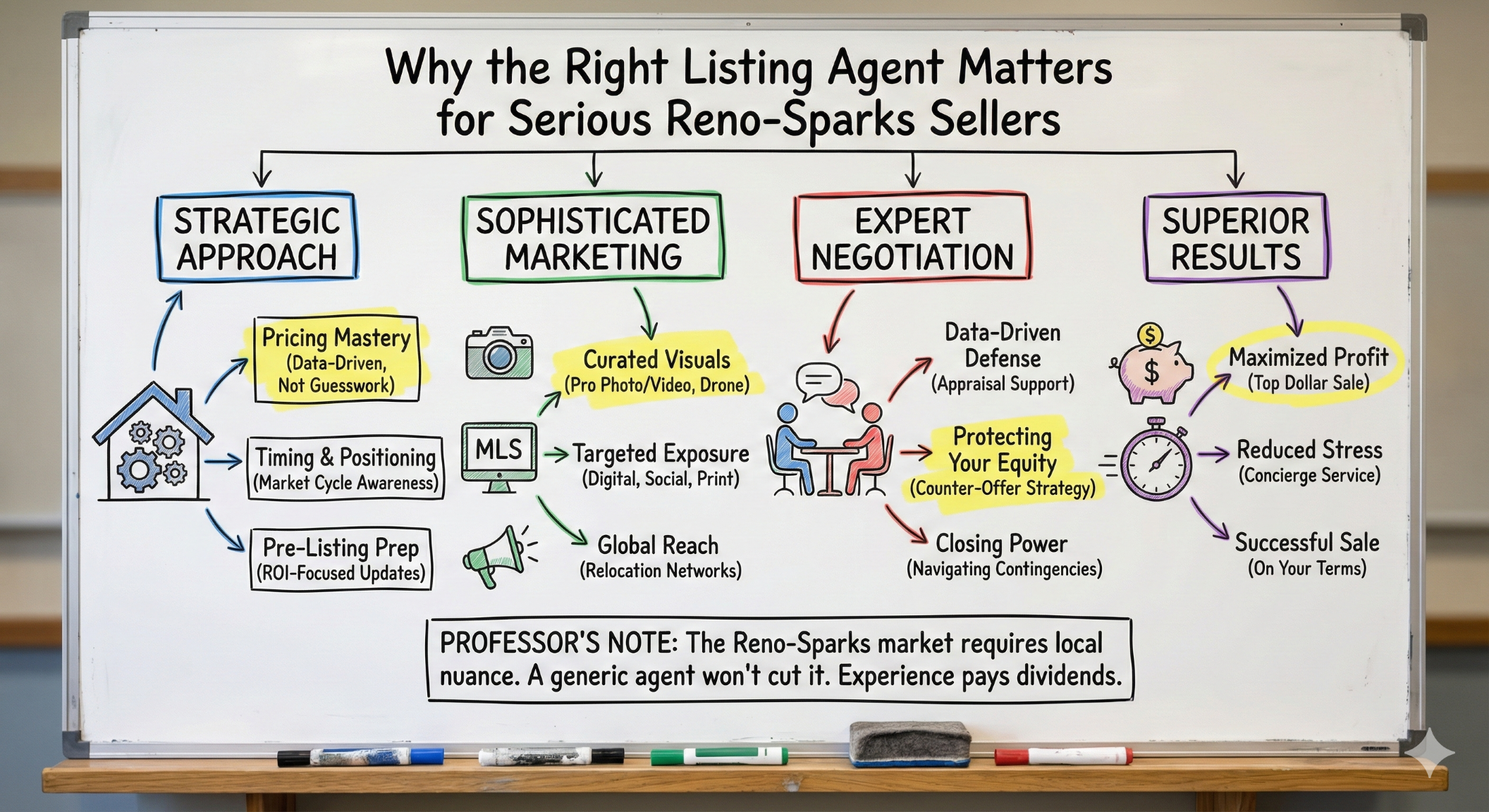
Not all real estate agents approach listing representation the same way. Understanding what distinguishes a strategic listing agent helps serious sellers identify the right fit for their property.
Pricing as Strategy, Not Guesswork
Average agents often start with what the seller hopes to achieve, then work backward to justify that number. Strategic listing agents approach pricing as the foundation of the entire selling strategy. They analyze comparable sales at the neighborhood and street level, understand how current mortgage rates affect buyer purchasing power, and factor in competitive inventory to position your home for maximum interest.
In the Reno-Sparks market specifically, this means understanding that a $650,000 home in Damonte Ranch faces different dynamics than a similarly priced property in Northwest Reno or the Truckee Meadows. It means knowing that California relocators—who account for substantial buyer activity in our market—often arrive with significant equity and different priorities than local move-up buyers. According to EDAWN, Northern Nevada continues attracting substantial investment, with 22 companies relocating to the region in 2024 alone, representing nearly $3 billion in total investment and creating over 1,900 jobs with an average salary of $85,000. This economic strength supports housing demand, but translating that macro picture into a pricing strategy for your specific property requires granular local knowledge.
Marketing That Attracts Qualified Buyers
Listing a home on the MLS is table stakes—every licensed agent can accomplish that. What matters is how your property is presented to attract serious, well-qualified demand.
Strategic listing agents invest in professional photography, understanding that buyers scroll through dozens of listings and make split-second decisions about which properties warrant closer attention. They craft listing descriptions that highlight features meaningful to specific buyer segments rather than generic language that could apply to any home. For a property positioned to attract Bay Area relocators, this might emphasize features like dedicated home office space, proximity to outdoor recreation, or how the floor plan accommodates remote work lifestyles. For a home likely to appeal to local move-up buyers with children, school district information and neighborhood amenities take priority.
The post-NAR settlement landscape has also shifted how buyer agent compensation is handled. Rather than creating uncertainty, a strategic listing agent navigates these changes with clarity, advising sellers on how to position their property competitively while protecting their interests. In Washoe County, where the market has adapted to new rules while maintaining transaction fluidity, working with an agent who understands both the letter and spirit of current practices matters significantly.
Negotiation Expertise That Protects Your Position
When offers arrive, the real work begins. Strategic listing agents don't simply relay numbers back and forth—they interpret what each offer represents, identify areas of negotiation beyond price, and advocate for outcomes that align with your goals.
This includes evaluating the strength of financing behind each offer, understanding which contingencies create genuine risk versus standard protection, and knowing when to push back versus when to close efficiently. In a market where 18% of homes still sell above asking price while others require multiple price reductions, the ability to navigate offers skillfully can mean the difference between achieving your objectives and leaving value unrealized.
For sellers in upper-mid to higher price points—properties in Caughlin Ranch, the foothills of Southwest Reno, or Somersett communities—negotiation expertise becomes even more critical. These transactions involve longer timelines, more discerning buyers, and often more complex terms. An agent who has successfully represented quality listings in these price ranges brings pattern recognition that simply cannot be replicated by agents who primarily work in different segments.
The Real Cost of the Wrong Representation
While the FSBO statistics provide stark illustration, the more subtle risk involves working with an agent who isn't well-matched to your property and goals.
Some agents prioritize volume over outcomes—taking any listing regardless of whether their expertise aligns with the property's positioning requirements. A seller with a distinctive contemporary home in Midtown Reno faces fundamentally different marketing challenges than someone selling a production-built property in Spanish Springs. An agent whose experience centers on one property type may approach the other with strategies that underperform.
Other agents over-promise on price to win listings, knowing they will recommend reductions later. This pattern—industry professionals sometimes call it "buying a listing"—creates frustration for sellers who invested time and emotional energy based on unrealistic expectations. The NAR data showing that 81% of sellers contacted only one agent before hiring suggests many sellers skip the comparison process entirely, which can leave them vulnerable to this dynamic.
The consequences extend beyond immediate transaction outcomes. Homes that sit on market too long develop what industry participants call "stigma"—buyers begin assuming something must be wrong, even when the only issue was initial overpricing. Recovery from this position typically requires a more significant price adjustment than would have been necessary had the property been priced correctly from the start.
For serious Reno-Sparks sellers—those with quality properties who value strategic execution—the question isn't whether to work with an agent, but how to identify one whose approach genuinely aligns with their interests.
What Serious Sellers Should Look for in Listing Representation
The seller's decision about representation shapes every subsequent step of the transaction. Here's what matters when evaluating potential listing agents.
Demonstrated Local Expertise
Generic knowledge about "the Reno market" isn't sufficient. Look for evidence that an agent understands your specific neighborhood: How do homes in your price range typically move? What buyer profiles most commonly purchase in your area? How does your property compare to current and recently sold competition?
An agent who can speak specifically about Damonte Ranch's appeal to families prioritizing Galena High School, or explain why properties in the $600,000-$750,000 range in certain Northwest Reno neighborhoods compete with Somersett inventory, demonstrates the granular knowledge that translates into effective positioning. This level of insight comes from consistent, focused experience rather than occasional transactions scattered across the entire market.
Transparent Communication About Market Position
Beware of agents who tell you only what you want to hear. Quality representation involves honest assessment, even when that means discussing aspects of your property that may limit buyer appeal or price potential.
A strategic agent explains their pricing recommendation with data—not aspirational comparisons to unlike properties, but realistic analysis of how your home fits within current market conditions. They discuss what preparation work will genuinely impact your outcome versus recommendations that create activity without corresponding value. When the timing of your sale represents a strategic choice, they help you evaluate options rather than simply pushing for an immediate listing.
Track Record of Representation, Not Just Transaction Volume
Transaction count alone doesn't indicate quality of representation. An agent who sells 100 homes per year but achieves below-market sale-to-list ratios or takes longer than average to close serves their clients less effectively than one with fewer transactions but stronger per-property outcomes.
Ask about specific metrics: What is their average sale-to-list price ratio? How does their typical days-on-market compare to the broader market? What percentage of their listings sell without price reductions? These quantifiable measures reveal more about representation quality than testimonials alone.
The qualities that define excellent representation translate directly to your experience as a seller. Clarity, responsiveness, strategic thinking, and advocacy distinguish agents who genuinely serve their clients' interests from those who prioritize convenient transactions.
Alignment of Focus and Approach
Some agents specialize in working with buyers; others focus primarily on listings. Some excel with first-time purchasers navigating entry-level properties; others concentrate on upper-mid to luxury transactions with different dynamics.
Seek alignment between an agent's focus and your situation. A seller with a well-maintained home in the $700,000 to $1,000,000 range benefits from representation by an agent whose experience centers on that market segment—someone who understands what motivates buyers at that price point, knows how to position against new construction competition, and has established relationships with agents who regularly represent qualified buyers in that range.
The Reno-Sparks Market Context
The broader dynamics of Northern Nevada's real estate market underscore why representation quality matters now more than ever.
The Reno-Sparks housing market continues demonstrating resilience supported by fundamental economic strength. Tesla employs approximately 8,000 people at the Gigafactory within the Tahoe-Reno Industrial Center, where total daily employment reaches 22,000 workers—70% of whom live in Reno or Sparks. Mass production of Tesla Semi trucks is scheduled to begin in 2026, suggesting continued employment stability. Beyond Tesla, the data center sector continues expanding, with companies investing in significant Northern Nevada facilities.
California migration remains a defining feature of buyer demand. Roughly 50,000 California residents relocate to Nevada annually, with many targeting the Reno-Sparks area specifically. These buyers typically arrive with substantial equity from California property sales, enabling larger down payments that cushion mortgage rate impact. According to Redfin data, 37% of Reno homebuyers searched to move out of Reno in late 2025, while 63% looked to stay within the metropolitan area—suggesting a market with both departures and arrivals, creating transaction opportunities on both sides.
Current market metrics show homes selling at approximately 98% of asking price with median sale prices around $549,000. Days on market averaging 66 days indicates a relatively balanced environment—neither the frenetic pace of 2021-2022 nor the stagnation some markets experienced in 2023. In this context, small advantages in positioning and execution translate directly to outcomes.
For sellers evaluating their options, the 2026 market outlook provides additional context. NAR forecasts 14% national sales growth in 2026 as rates stabilize and inventory gradually expands. In Reno-Sparks specifically, the combination of continued economic development, sustained California migration, and more normalized market conditions suggests opportunity for well-positioned sellers to achieve strong outcomes.
The Psychology of Selling
Beyond the numbers, selling a home involves significant emotional dimensions that quality representation addresses.
NAR's research indicates the typical seller has owned their home for a record 11 years before deciding to sell. Over that timeframe, a house becomes a repository of memories, modifications made to suit personal preferences, and accumulated attachment. Translating that personal relationship into objective market positioning requires a skilled intermediary who can advocate for value while remaining clear-eyed about buyer perspectives.
Many sellers have been considering their move for extended periods before taking action. Research from Realtor.com suggests that two in three sellers have been thinking about moving for over a year. The gap between contemplation and action often reflects psychological barriers as much as market conditions—concerns about finding the next home, uncertainty about timing, reluctance to disrupt established routines.
A thoughtful listing agent recognizes these dynamics and provides both practical guidance and appropriate support throughout the process. They understand that for many sellers, particularly those who have lived in their homes for a decade or more, the transaction represents not just a financial event but a significant life transition.
For sellers navigating concurrent decisions—selling one property while purchasing another, timing a sale to coordinate with job relocation, or downsizing after children have launched—representation that accounts for these interconnected considerations proves invaluable. The listing decision doesn't exist in isolation; it connects to mortgage qualification for the next purchase, timing considerations for school districts or employment start dates, and the logistics of potentially carrying two properties temporarily.
Making the Right Choice
Selecting listing representation deserves the same careful consideration you would apply to any significant financial decision. Here's how to approach it thoughtfully.
Begin by clarifying your own priorities. Are you optimizing for speed, price, or certainty? Do you have flexibility on timing, or does your situation require sale within a specific window? Understanding your own constraints and preferences helps you evaluate whether a particular agent's approach aligns with your needs.
Meet with potential agents in person, at your property. Their observations about your home—what they notice, what questions they ask, what recommendations they offer—reveal both their expertise and their communication style. An agent who walks through your property pointing out specific features that will resonate with buyer segments versus one who provides generic assessments demonstrates meaningfully different levels of sophistication.
Ask about their approach to your specific situation. How would they position your property? Who do they see as the likely buyer? What preparation work do they recommend, and what is the rationale for each suggestion? Answers that reflect genuine thought about your particular circumstances indicate engagement at a level that will serve you throughout the process.
Review their marketing materials from recent listings. Quality of photography, effectiveness of written descriptions, and overall presentation standards provide tangible evidence of how they would represent your property. In a market where buyers encounter listings primarily through online channels, visual and written presentation quality directly impacts which properties receive serious consideration.
Finally, trust your assessment of fit. You will be working closely with your listing agent through a process that can span weeks or months. Communication style, responsiveness, and the sense that someone genuinely understands your goals matter beyond credentials alone.
Strategic Representation for Quality Properties
The choice of listing representation ultimately reflects what you value and expect from the selling process. Some sellers prioritize minimizing costs, accepting whatever trade-offs that approach involves. Others recognize that strategic representation represents an investment that typically returns multiples of its cost through stronger outcomes.
For homeowners with quality properties in Reno and Sparks—those who have maintained their homes thoughtfully, positioned in desirable neighborhoods, and ready to engage a strategic selling process—the caliber of representation directly determines results.
The Kinney & Renwick Team provides a sophisticated, two-pronged approach to the Northern Nevada market. Kevin serves as the Listing Strategist and On-Site Execution Lead, focusing on ensuring every home is perfectly positioned before it ever hits the market. With a professional background in advocacy and negotiation, he brings a calm, analytical presence to the strategic preparation of a sale—coordinating inspections, specialists, and the details that protect your position from day one. Robin serves as the Operational Anchor and Contract Lead, managing complex timelines and contractual details with over 20 years of local market intelligence. Her approach is built on patience, precision, and clear communication that removes uncertainty and allows clients to move forward with confidence.
Many of our clients are relocating from out of state—often from California, Washington, or Oregon—and value having an experienced team that can manage the process efficiently from a distance. Whether you're local or coordinating a sale while living elsewhere, our approach remains the same: listen first, understand your priorities thoroughly, then apply clear strategy to connect your well-positioned home with serious, qualified demand.
For sellers who expect clarity, strategic execution, and genuine advocacy, this is what quality representation looks like.
Moving Forward
If you're considering selling your Reno or Sparks home and want to understand how strategic representation might apply to your situation, we welcome the opportunity for a thoughtful conversation about your goals. Whether your timeline is near-term or you're evaluating options for later in 2026, beginning with a clear picture of your property's competitive position and market context helps you make informed decisions.
Contact Kevin Kinney at 775-391-8402 or Robin Renwick at 775-813-1255 to discuss your specific situation. Kevin can walk through how your home would be strategically prepared and positioned for market, while Robin can address timeline considerations, contractual questions, and process management. We'll listen first, then provide honest assessment of how your property fits within current market conditions and what strategic approach aligns with your priorities.
For sellers ready to position their property correctly and engage a process built on clarity, expertise, and genuine advocacy, we're here to advise clearly and execute thoughtfully. Let's talk about what's possible.
3. FAQs (8 Questions)
1. How much more do agent-assisted homes sell for compared to FSBO properties in 2025? According to NAR's 2025 Profile of Home Buyers and Sellers, agent-assisted homes sold for a median price of $425,000 compared to $360,000 for FSBO properties—an 18% gap representing $65,000 in additional value. While some of this reflects different property types, the consistent pattern across years indicates professional representation correlates with stronger sale prices.
2. What percentage of Reno-Sparks home sellers work with a real estate agent? Nationally, a record 91% of sellers used an agent in 2025—the highest ever recorded. FSBO sales dropped to just 5%, an all-time low. The Reno-Sparks market reflects similar patterns, with most quality properties being represented by listing agents who understand the local market dynamics and buyer demographics.
3. How do I know if my listing agent has overpriced my home in Reno? Warning signs include minimal showing activity during the first two weeks, feedback indicating price concerns, and substantially longer days on market compared to similar properties. Industry data shows approximately 41% of listings receive price reductions before selling. A skilled listing agent prices correctly from the start, capturing peak buyer interest rather than chasing the market downward.
4. What's the difference between a listing agent and a selling agent in Reno-Sparks? A listing agent (seller's agent) represents the homeowner selling the property, handling pricing strategy, marketing, negotiations, and transaction management. A selling agent (buyer's agent) represents the purchaser. Each has fiduciary duties to their respective client. In Reno-Sparks, where California relocators represent significant buyer activity, effective listing agents understand both sides of this dynamic.
5. How long are Reno homes sitting on market in early 2026? According to Redfin data from December 2025, homes in Reno averaged 66 days on market before going under contract. Properties priced correctly and well-presented typically move faster, while those requiring price reductions often exceed these averages. Market timing and seasonal factors also influence days on market.
6. Should I interview multiple listing agents before choosing one in Reno? NAR data shows 81% of sellers contacted only one agent before hiring—a pattern that may leave sellers vulnerable to mismatched representation or inflated pricing designed to win listings. Meeting with two or three qualified agents, ideally at your property, allows comparison of expertise, communication style, and strategic approach before making this important decision.
7. How important is local neighborhood expertise when selecting a listing agent? Critical. An agent with specific experience in your neighborhood—understanding how Somersett differs from Damonte Ranch, or why Northwest Reno properties compete with different inventory than Southwest Reno homes—positions your property more effectively than one applying generic city-wide knowledge. Ask potential agents about their recent activity in your specific area.
8. What should I ask a listing agent about their pricing strategy for my Reno-Sparks home? Request specific comparable sales analysis at the neighborhood level, not just city-wide statistics. Ask how they account for current mortgage rates affecting buyer purchasing power, how your property compares to active competition, and what specific data supports their recommended price. Beware of agents who tell you only what you want to hear rather than providing honest market assessment.
Check out this article next