

Market data as of December 2025. Strategic insights based on current market conditions. Verify specific costs and timelines with Kevin Kinney (775-391-8402) or Robin Renwick (775-813-1255).
Selling your Reno or Sparks home isn't just about putting a sign in the yard and hoping for the best. In November 2025, sellers who properly prepared their homes captured 98.5-98.9% of asking price and sold in just 33-38 days. Sellers who didn't? They watched their listings linger while properly prepared homes in the same neighborhoods sold quickly at full price.
The difference between maximizing your sale price and leaving thousands of dollars on the table often comes down to preparation. But here's what overwhelms most sellers: preparation isn't one task—it's dozens of interconnected decisions about what to fix, what to update, what to stage, and what to leave alone. Make the wrong calls, and you either overspend on improvements that don't generate returns, or under-prepare and watch buyers use every flaw as negotiation leverage.
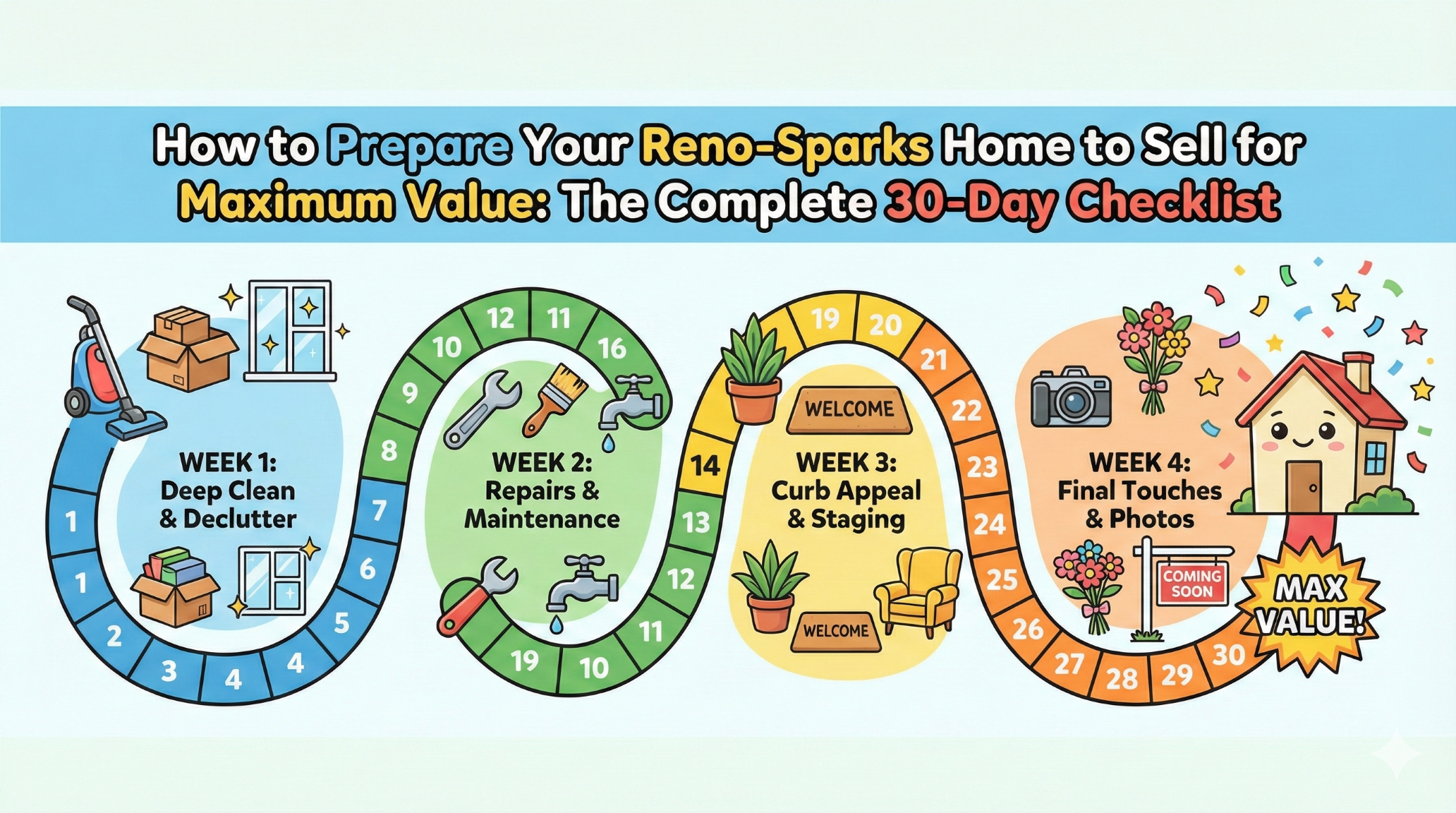
This comprehensive 30-day preparation guide breaks down exactly what to do, when to do it, and why it matters for your specific Reno-Sparks market. We'll show you which improvements generate measurable returns, which projects waste money, and how to execute a strategic preparation timeline that gets your home market-ready efficiently. Whether you're listing in January to capture winter's limited competition or preparing for spring, this roadmap ensures you're investing time and money where it actually counts.
Week 1: Strategic Planning & Assessment (Days 1-7)
The first week isn't about swinging hammers or painting walls—it's about making strategic decisions that will guide every dollar and hour you invest over the next month. Rush past this planning phase, and you'll waste money on improvements that don't matter to buyers while overlooking issues that will cost you thousands in negotiations.
Day 1-2: Honest Property Assessment
Walk through your home as if you're a buyer seeing it for the first time. This requires brutal honesty—you need to see flaws you've grown accustomed to over years of living there.
Start outside and work systematically inward. On the exterior, note peeling paint, overgrown landscaping, cracked concrete, dated fixtures, and anything that signals deferred maintenance. Buyers judge homes within seconds of pulling up, and exterior condition drives their entire mindset walking through the front door.
Inside, evaluate each room for three specific issues: cleanliness (including things you no longer notice like pet odors, smoke smells, or mildew), updates needed (dated fixtures, worn finishes, malfunctioning systems), and depersonalization requirements (family photos, collections, bold paint colors, niche décor).
Take photos of every room from multiple angles. You've seen your home thousands of times—photos reveal what buyers will see with fresh eyes. Notice background clutter you typically ignore. Observe how lighting actually looks rather than how you remember it. Identify furniture arrangements that make rooms feel cramped.
Critical Reno-Sparks consideration: If your home was built before 2000, pay special attention to systems that Northern Nevada's climate stresses—HVAC equipment working hard through 100°F summers and cold winters, sun-damaged exterior paint and roofing materials, and desert landscaping that may look tired or damaged.
Day 3-4: Competitive Market Analysis
You can't prepare strategically without understanding what you're competing against. Search active listings in your neighborhood within $50,000 of your expected price range. Tour 3-5 comparable properties currently on the market—these are the homes buyers will compare yours against.
Pay attention to their condition and preparation level. Note what's been updated, how they've staged spaces, exterior presentation quality, and asking prices relative to features. If competing homes show significantly better than yours, you need to close that gap. If yours will show comparably or better, you have pricing flexibility.
For Reno-Sparks specifics, understand neighborhood expectations. Somersett and Damonte Ranch buyers expect modern finishes and meticulous presentation—homes showing dated here sit longer and require price reductions. Northwest Reno and Southwest Reno buyers are more forgiving of some age-appropriate wear, but serious deferred maintenance still kills deals. Spanish Springs and South Meadows emphasize newer construction, so older homes in these areas need to show exceptionally well to compete.
Day 5: ROI Decision Framework
Not all improvements generate equal returns. Here's what actually matters in the Reno-Sparks market based on current data:
High-ROI improvements (100%+ return):
- Deep cleaning (3,650% ROI - costs $300-500, adds $10,000+ in perceived value)
- Professional staging (200-550% ROI - costs $2,000-4,000, generates $10,000-20,000+ in price improvement and faster sale)
- Fresh neutral paint ($1,500-3,000 whole home, generates $3,000-6,000+ return)
- Landscaping refresh ($500-1,500, generates $2,000-5,000+ curb appeal impact)
- Minor kitchen updates - cabinet painting, hardware, fixtures ($2,000-5,000, generates 96% ROI)
Moderate-ROI improvements (60-95% return):
- Bathroom updates - new fixtures, paint, tile work ($3,000-8,000, generates 74% ROI)
- Garage door replacement ($4,000-5,000, generates 194% ROI but limited upside in price)
- Entry door replacement ($2,000-3,000, generates 188% ROI)
- Carpet replacement in bedrooms ($1,500-3,000, typically returns 70-80%)
Low-ROI improvements (less than 60% return):
- Major kitchen remodel ($40,000-85,000, returns only 38-54%)
- Bathroom addition ($25,000-50,000, returns 50-63%)
- Master suite addition ($75,000-150,000, returns 48-56%)
- Swimming pool addition ($40,000-80,000, returns 30-40% in Reno-Sparks climate)
The strategic insight: Focus budget on high-ROI cosmetic improvements that help your home show better than competition. Avoid major remodels unless absolutely necessary to make the home functionally sellable.
Day 6-7: Budget Allocation & Vendor Scheduling
Based on your assessment and ROI framework, create your preparation budget. For most Reno-Sparks homes, expect to invest 1-3% of home value in preparation—a $600,000 home might require $6,000-18,000 depending on condition.
Prioritize spending ruthlessly:
- Tier 1 (must-do): Deep cleaning, decluttering, basic repairs, fresh paint where needed
- Tier 2 (strong ROI): Professional staging, landscaping refresh, minor updates to kitchen/bathrooms
- Tier 3 (if budget allows): Flooring replacement, fixture upgrades, exterior improvements
Start scheduling vendors now. In Reno-Sparks, quality contractors book 2-4 weeks out, especially during busy spring-summer months. You'll likely need: professional cleaners (deep clean plus ongoing maintenance), painters (interior and potentially exterior), landscapers (cleanup, mulch, seasonal planting), handyman (minor repairs, fixture installation), potentially staging company, and potentially carpet/flooring contractor.
Get multiple quotes for any work exceeding $2,000. Verify licensing and insurance—Nevada requires contractors to be licensed, and you want protection if something goes wrong.
Week 2: Deep Preparation Work (Days 8-14)
Week two is where the heavy lifting happens—literally. This is when you execute major cleaning, decluttering, repairs, and updates that transform your home's showing condition. The work is intense, but it's also where you create the foundation for everything that follows.
Day 8-10: The Great Declutter
Decluttering is the single highest-ROI activity you'll undertake. It costs almost nothing (maybe $200-400 for storage pod rental or donation services) but transforms how buyers perceive space, cleanliness, and value.
The rule: Remove 50% of everything. That percentage feels extreme, but it's what creates the clean, spacious aesthetic buyers expect. They're not buying your stuff—they're buying the space to put their own stuff.
Kitchen: Clear countertops to bare essentials—maybe a coffee maker and decorative bowl. Nothing else. Empty cabinets by 50% so buyers can open them and see organizational space, not cramped storage. Remove refrigerator magnets, kids' artwork, cluttered message boards. Pack away small appliances you use infrequently.
Bathrooms: Remove all personal hygiene products from counters and shower/tub. Install cabinet organizers so what remains looks intentional. Replace mismatched towels with matching neutral sets (white, gray, or beige). Clear medicine cabinets completely—buyers will look.
Bedrooms: Closets must appear spacious, which means removing 50% of hanging clothes and clearing floor space entirely. Nightstands should have lamp, maybe clock, nothing else. Remove personal photos from walls and surfaces. Kids' rooms need toy purge—keep only enough to show the room's purpose without overwhelming the space.
Living spaces: Edit furniture ruthlessly. If rooms feel cramped, remove pieces even if it means temporary storage. Each room should have clear walkways and obvious focal points. Bookcases should be 50% empty or removed entirely. Clear coffee tables, end tables, and console surfaces almost completely.
Garage: This sells houses in Reno-Sparks. Buyers expect functional garage space, not storage units. Clear enough space to park at least one car (preferably two in a two-car garage). Organize remaining items on shelves with clear labels. Sweep floors until clean enough to eat off—grimy garage floors signal poor maintenance.
Storage pod strategy: Rent a PODS or similar container, load it with everything you're removing, and park it in your driveway initially for easy access. Once loading is complete, have it moved to storage facility until you're ready to move. This typically costs $200-300/month—money extremely well spent.
Day 11-12: Deep Cleaning Blitz
Professional deep cleaning typically costs $400-600 for a 2,000-3,000 square foot home in Reno-Sparks. This is money you absolutely must spend. Professional cleaners see dirt you've grown blind to and have equipment (steam cleaners, proper chemicals, extension tools) that achieve results DIY can't match.
What professionals should address:
Kitchen: Degrease inside oven, under burners, range hood interior. Clean inside microwave until spotless. Wipe down cabinet interiors and exteriors. Clean backsplash grout lines. Polish appliances until streak-free. Mop floors including under appliances if possible. Clean inside dishwasher.
Bathrooms: Scrub tile and grout (or re-grout/re-caulk if stained beyond cleaning). Shine all fixtures—faucets, showerheads, towel bars. Clean mirrors spotlessly. Scrub toilets inside and out including base and behind. Wax/polish floors. Remove any mildew from shower areas—buyers will notice and worry.
Throughout home: Dust ceiling fans, light fixtures, baseboards, window sills thoroughly. Wash all windows inside and out (hire window cleaning service if two-story). Vacuum/mop all floors including corners and under furniture. Wipe down all switch plates and outlet covers. Clean air vents and replace filters. Steam clean carpets (or hire carpet cleaning service for $150-300).
Exterior: Pressure wash driveway, walkways, porch, patio, and exterior siding if needed ($200-400 professional service). Clean gutters. Wash exterior windows. Wipe down outdoor light fixtures. Hose off any dust or cobwebs from eaves and corners.
Nevada-specific considerations: Desert dust infiltrates everything. Pay extra attention to window tracks, ceiling fans, and exterior surfaces. If you've had wildfires nearby recently, have HVAC system and ductwork professionally cleaned to address smoke residue ($300-500).
Day 13-14: Repair Blitz
Walk through your home with repair list in hand and address everything that signals deferred maintenance. Buyers perceive maintenance issues as negotiating leverage—they'll either demand credits at inspection or use visible problems to justify low-ball offers.
Quick fixes with high impact (DIY or handyman - $200-500 total):
- Replace any burned-out light bulbs with matching bulbs (use LED 3000-3500K for warm white appearance throughout home)
- Fix dripping faucets and running toilets
- Repair holes in walls and ceilings (patch, sand, paint to match)
- Replace cracked outlet covers and switch plates ($1-2 each at hardware store)
- Fix sticking doors and drawers with adjustment or lubrication
- Replace worn weatherstripping around doors
- Caulk gaps around tubs, sinks, baseboards
- Touch up paint nicks and scratches
- Tighten loose cabinet hardware
- Fix any broken blinds or torn window screens
Moderate repairs requiring professional (budget $500-2,000):
- Replace malfunctioning HVAC system components (buyers will test heating/cooling)
- Repair roof leaks or missing shingles (visible damage kills deals—get quotes)
- Fix plumbing leaks under sinks or behind walls
- Repair cracked tiles in bathrooms or kitchen
- Replace malfunctioning garage door openers
- Repair or replace damaged fence sections
- Fix inoperable windows or doors
Major repairs requiring serious consideration: If inspection or your own assessment reveals foundation issues, major roof damage, or significant systems failures (HVAC, plumbing, electrical), you face a strategic decision: repair before listing or disclose and price accordingly. Generally, if the repair costs less than 5% of home value, complete it before listing. If it exceeds 5%, consider selling as-is with appropriate pricing discount—major repairs rarely return 100% of cost, and projects often exceed initial estimates.
In Reno-Sparks market, functional HVAC is non-negotiable. Buyers won't pay full price for homes with AC that doesn't adequately cool during 100°F+ summers. If your system is 15+ years old and marginal, expect buyers to demand replacement or significant credit ($6,000-12,000 for new system). Consider whether pre-emptive replacement makes sense for marketing advantage and pricing power.
Week 3: Aesthetic Transformation (Days 15-21)
By week three, your home is clean, decluttered, and functionally sound. Now you're creating the visual presentation that makes buyers stop scrolling listings and say "we need to see this one." This week focuses on painting, staging, and aesthetic details that separate average showings from memorable properties that generate competitive offers.
Day 15-17: Strategic Painting
Fresh paint is the single most impactful aesthetic improvement you can make. Professionally painted homes photograph better, show cleaner, and signal care buyers reward with higher offers.
What to paint:
- Any room with bold/dark colors—repaint in neutral tones (buyers need to envision their furniture and style)
- Any room with damaged or dingy walls regardless of color
- All trim that's scuffed, chipped, or yellowed
- Front door if faded, chipped, or outdated color
- Kitchen cabinets if dated but structurally sound (cabinet painting: $2,500-4,500 for average kitchen, massive visual impact)
Color strategy for Reno-Sparks market: Stick with warm neutrals that complement Northern Nevada's natural desert tones while feeling modern and clean. Best choices include Sherwin-Williams Agreeable Gray (warm gray-beige, most popular neutral in US), Benjamin Moore Edgecomb Gray (slightly warmer, works well with wood tones common in Reno homes), Sherwin-Williams Accessible Beige (warm, inviting, complements earth tones), and Benjamin Moore Simply White for trim and ceilings (crisp but not stark).
Avoid pure white walls (feels sterile and shows imperfections), gray without warm undertones (reads cold in Reno's desert light), and any bold colors including accent walls (buyers either love or hate bold colors—neutral is always safe).
Professional painter pricing in Reno-Sparks: $2-4 per square foot including materials for interior painting. A 2,000 square foot home with 8-foot ceilings (approximately 5,000 square feet of wall/ceiling space) costs $2,500-4,500 for whole-home interior painting. Expect 3-5 days for complete project including drying time.
DIY considerations: Painting yourself saves money but costs time and rarely achieves professional finish quality. If attempting DIY, invest in proper prep (fill holes, sand smooth, prime stains), use quality paint (Sherwin-Williams or Benjamin Moore—cheap paint shows in finish), and paint full rooms rather than spot-painting (even same color shows patches in certain lights).
Day 18-19: Flooring Assessment & Treatment
Floors dramatically impact perceived value. Buyers notice flooring immediately and use condition as evidence of overall home maintenance.
Hardwood floors: If you have hardwood, showcase it properly. Clean thoroughly with hardwood-appropriate cleaner. Repair any deep scratches or gouges with wood filler and stain marker ($50-100 DIY). If floors are heavily worn, consider professional refinishing ($3-5 per square foot, typically $2,500-4,000 for average home). However, refinishing is expensive and messy—only pursue if floors are otherwise a significant selling point.
Carpet: Professionally clean all carpets ($150-300 for whole home steam cleaning). If carpets show stains, heavy wear, or pet damage that cleaning won't address, replacement is typically necessary. Budget $3-6 per square foot installed for builder-grade carpet in bedrooms. For a 1,500 square foot home with three bedrooms (approximately 800 square feet carpet), expect $2,400-4,800 for new carpet. Choose neutral tones (beige, light gray) that won't show dust and appeal broadly.
Tile floors: Deep clean including grout lines ($200-400 professional tile cleaning). If grout is stained beyond cleaning, re-grouting costs $3-5 per square foot ($300-800 for typical bathroom, $600-1,200 for kitchen). Consider grout sealing after cleaning to maintain appearance during listing period.
Vinyl/laminate: Clean thoroughly. If flooring is dated, scratched, or lifting, replacement with modern luxury vinyl plank (LVP) costs $4-8 per square foot installed and looks significantly better than old laminate. However, this is expensive ($3,000-6,000 for 1,000 square feet) and only worth pursuing if existing flooring is truly unsellable or if it elevates your home above competition.
Strategic decision: If your home will compete against newer construction in neighborhoods like Spanish Springs or Damonte Ranch, flooring must be current or you'll price at disadvantage. If competing against similarly-aged homes in established neighborhoods like Northwest Reno or Caughlin Ranch, clean, maintained original flooring is generally acceptable.
Day 20-21: Professional Staging Setup
Professional staging transforms vacant or poorly furnished spaces into aspirational environments buyers envision living in. National data shows staged homes sell 5-15% higher and 87% faster than non-staged equivalents. In Reno-Sparks' current market where homes sell at 98.5-98.9% of asking price in 33-38 days, staging's primary value is reducing days on market and preventing price reductions rather than driving prices above asking.
Staging costs in Reno-Sparks:
- Initial consultation (2 hours, working with your furniture): $200-300
- Vacant home full staging (furniture rental, setup, monthly fee): $2,500-4,500 first month, $500-800 monthly thereafter
- Occupied home staging (rearranging/enhancing your furniture, adding accessories): $1,000-2,500
- Partial staging (living room, master bedroom, dining room only): $1,500-3,000
ROI calculation: $600,000 home staged for $3,500: If staging reduces days on market by 15 days (from 45 to 30), you save approximately $3,000 in carrying costs (mortgage $3,000/month, insurance $100/month, utilities $300/month, maintenance $200/month = $3,600/month or $120/day). Staging pays for itself in carrying cost savings alone. If it also prevents a single $10,000 price reduction (common when homes sit), ROI is massive.
What professional stagers do: Furniture arrangement that maximizes space perception, strategically placed mirrors and artwork that create focal points, styling with accessories (throw pillows, plants, table settings) that add warmth without clutter, lighting optimization using lamps and fixtures to eliminate dark spaces, and removal or minimization of seller's personal items while keeping home lived-in feeling.
Key rooms to prioritize: Living room (46% of buyers say this is most important staged room), master bedroom (43% say most important—buyers need to envision peaceful retreat), and kitchen (35% say most important—staging here focuses on showcasing counter space and modern appliances, not adding furniture).
DIY staging if budget prohibits professional: Remove excess furniture to maximize space, arrange remaining furniture to create conversation areas (not pushed against walls), add neutral throw pillows and blankets in living room and bedrooms, place fresh flowers or high-quality artificial plants in kitchen and bathrooms, set dining table with simple place settings (white dishes, neutral linens), add task lighting in dark corners, and hang large mirror opposite windows to reflect light and create space.
Critical Reno-Sparks consideration: Northern Nevada's bright sunshine creates strong light/shadow contrasts. Staging needs to address dark spaces (common in homes with north-facing rooms or limited windows) through strategic lighting. Buyers touring during daytime will notice dark spaces—multiple light sources create warmth and openness.
Week 4: Final Details & Launch Preparation (Days 22-30)
The final week polishes details, optimizes curb appeal, prepares for photography, and ensures every buyer interaction showcases your home at its absolute best. This is also when you'll be working closely with your listing agent to finalize marketing strategy and set listing date.
Day 22-23: Curb Appeal Transformation
First impressions form in 7-10 seconds. Buyers pulling up to your home are making split-second judgments about whether this property is worth serious consideration. Poor curb appeal doesn't just reduce showing interest—it fundamentally alters how buyers perceive everything inside because they're already looking for problems.
Immediate-impact improvements:
Front entrance: Paint or stain front door in welcoming color that complements home ($100-200 materials for DIY, $300-500 professional). Popular Reno-Sparks choices include deep teal (coordinates with desert landscape), charcoal gray (modern, upscale), and black (classic, sophisticated). Add new house numbers if current ones are small, faded, or broken—modern 4-6 inch numbers cost $30-80 and dramatically update appearance. Replace doormat with new, appropriately sized option ($30-60). Add potted plants flanking door—choose seasonal flowers or evergreens depending on listing season ($50-100 for two large planters with plants). Ensure porch light is bright and clean (buyers often tour at dusk—good lighting matters).
Landscaping: Mow and edge lawn until crisp. Trim all shrubs and trees so they don't obstruct windows or walkways—Northern Nevada homes often have overgrown shrubs blocking views and making homes appear dark inside. Add 3 inches of fresh mulch to all beds ($150-300 for average home including materials and installation). Plant seasonal flowers for color (winter options include pansies, ornamental kale, snapdragons for Reno's climate—$100-200 for substantial plantings). Remove dead plants, weeds, and debris completely. Consider adding river rock or decorative stone to xeriscape areas showing wear ($200-400 for materials).
Hardscaping: Pressure wash driveway, walkways, porch, and patio to remove stains and desert dust buildup. Repair any cracked concrete (crack filler costs $20-40 for DIY temporary repair—major concrete replacement is expensive and rarely worth it unless damage is severe). Ensure all pavers are level and secure. Sweep all surfaces thoroughly before showings.
Exterior lighting: Replace any broken outdoor fixtures. Add landscape lighting along walkway or highlighting front landscaping ($200-500 for solar or low-voltage kit you can install yourself). Warm white LED bulbs (2700-3000K) in porch fixtures create welcoming glow.
Reno-Sparks specific consideration: Desert landscaping must look intentional and maintained, not neglected. If your xeriscape shows substantial dead zones, exposed weed barrier, or cactus/succulent damage from cold winters, consider refreshing with new plantings and decorative rock. For mountain-view properties, ensure your landscaping doesn't obstruct views buyers expect.
Day 24-25: Interior Finishing Touches
At this point your home is clean, decluttered, and freshly prepared. Final touches create the polished presentation that photographs beautifully and shows like a model home.
Lighting optimization: Replace any remaining burned-out bulbs. Ensure all rooms have adequate lighting—add floor or table lamps in dark corners ($30-80 each at Target/HomeGoods). Use consistent bulb temperatures throughout home (3000-3500K warm white). Open blinds and curtains to maximize natural light for showings.
Bathroom spa treatment: Stage master bathroom like a hotel—rolled white towels in basket, small plant or flowers, decorative soap dispenser, fresh hand towels (these get changed before each showing). Remove all personal items completely. Ensure bath mat is pristine or remove it entirely.
Kitchen counter staging: Counters should be almost bare—perhaps decorative bowl with fruit, coffee station if high-end machine, nothing else. Remove all dish racks, sponges, cleaners, and utilitarian items. Under-sink storage should contain these essentials for quick access when needed but out of sight for showings.
Bedroom presentation: Make beds with hotel-quality presentation—smooth, wrinkle-free, decorative pillows arranged (4-6 pillows creates luxury feel). Nightstands should have lamp, maybe clock or small plant, nothing else. Closets should appear spacious with remaining clothes color-coordinated on matching hangers (this detail matters—buyers notice).
Scent strategy: Eliminate ALL odors (pet, smoke, cooking, mildew) through deep cleaning, not masking with fragrances. Once odors are eliminated, subtle scent is acceptable—plug-in with very light fresh scent, or bake cookies 30 minutes before showing (cliché but effective). Strong fragrances signal hidden odors to buyers.
Temperature control: Home should be comfortable temperature for showings regardless of outside conditions. In Reno's 100°F+ summers, buyers touring multiple properties will notice immediately if your home isn't adequately cooled. In winter, 68-70°F creates comfortable showing environment.
Day 26-27: Professional Photography Preparation
Professional real estate photography isn't optional—it's the foundation of all your marketing. Approximately 90% of buyers begin searching online, and professional photos dramatically increase showing requests. Professional photography costs $200-400 in Reno-Sparks for standard home, $400-700 for luxury property with aerial drone footage.
Pre-photography checklist (complete day before shoot):
Every room: Remove all visible personal items (family photos, kids' artwork, memorabilia). Clear all surfaces except intentional staging items. Ensure all light fixtures work. Hide all trash cans and pet items completely. Straighten all furniture, pillows, accessories. Close toilet lids. Remove all visible cleaning supplies, toiletries, soaps. Hide kitchen sponges, dish soap, paper towels. Remove shoes from all visible floor spaces. Hide laundry baskets. Put fresh towels in bathrooms. Make all beds perfectly with decorative pillows arranged. Vacuum visible carpet and mop floors. Wipe down all mirrors and glass surfaces to eliminate smudges/fingerprints.
Exterior: Mow lawn day before photography. Hide trash cans, hoses, garden tools, children's toys completely. Park no vehicles in driveway (needs to appear spacious and clean). Add fresh pot of flowers on porch if not already present. Ensure no visible cobwebs or debris in corners/eaves.
Special considerations: Turn on all lights throughout home (including lamps, under-cabinet lighting, ceiling fans with lights). Photographers typically want a well-lit home even during daylight. Open some blinds to show windows, but photographer will direct specifics. Remove all visible cords, chargers, router/modems if possible. Set dining table with simple place settings. Fluff all pillows and throw blankets.
Day of shoot: Vacate property along with all family members and pets. Photographer needs 1.5-3 hours without interruption. Trust their direction—they understand lighting and angles.
Day 28-29: Marketing Materials Review & Final Systems Check
Your agent will prepare MLS listing description, online marketing, social media promotion, and print materials using professional photos. Review everything carefully:
MLS listing description: Verify accuracy of all details (square footage, bedrooms, bathrooms, lot size, age). Confirm all amenities and features are mentioned. Check for typos or incorrect information. Ensure description highlights Reno-Sparks specific selling points: views, proximity to Tahoe, neighborhood amenities, school ratings, access to outdoor recreation.
Photo review: Ensure photos showcase your home's best features and strongest rooms. Verify no personal items are visible. Confirm exterior shots show home in best light with proper landscaping. Check that any required disclaimers or agent information are included correctly.
Virtual tour/video (if included): Review for accuracy and quality. Ensure smooth transitions between rooms. Verify any voiceover or text overlays are error-free.
Final systems check: Test all appliances to ensure working order. Verify HVAC heats/cools properly in all rooms. Confirm all plumbing fixtures work without leaks. Test garage door opener. Ensure all light fixtures operate properly. Verify smoke and carbon monoxide detectors are functional (buyers will check).
Day 30: Launch Day & Ongoing Showing Readiness
Your home is now market-ready and listings have gone live across MLS, Zillow, Realtor.com, and other platforms. The showing phase begins.
Showing preparation system: Create a checklist you execute before every showing (15-20 minutes):
- Quick vacuum high-traffic areas
- Wipe down bathroom counters and mirrors
- Open all blinds to maximize light
- Turn on all lights throughout home
- Adjust temperature to comfortable level (68-70°F winter, 72-74°F summer)
- Hide any personal items that have reappeared
- Remove trash
- Put away dishes and clean kitchen counters completely
- Make beds perfectly
- Hide pet food/water bowls and litter boxes
- Remove any odors through air circulation or light scent
- Turn on soft background music if showing is agent-accompanied
- Vacate property with family and pets
Handling feedback: After each showing, your agent will contact buyer's agent for feedback. Listen carefully to consistent themes—if multiple buyers mention the same issue (dark rooms, pet odor, dated kitchen), address it if possible even after listing has launched.
Maintenance during listing: Weekly deep clean to maintain fresh condition. Daily quick clean and tidy. Address any new issues immediately (burned-out bulbs, landscaping maintenance, seasonal changes). Keep home in showing-ready condition until offer is accepted—you never know when showing request will come.
Flexibility matters: In Reno-Sparks' current market with 33-38 day median days to contract, expect multiple showings weekly. Maximum showing flexibility leads to maximum offers. Saying yes to every reasonable showing request (even if inconvenient) directly impacts success.
Ready to execute this preparation strategy with expert guidance? Contact Kevin Kinney at 775-391-8402 or Robin Renwick at 775-813-1255 to schedule a comprehensive pre-listing consultation. We'll walk through your home to assess specific preparation needs for your property and neighborhood, provide current comparable sales analysis so you understand competitive positioning, recommend trusted local vendors (cleaners, painters, stagers, handymen) we've worked with successfully, develop a realistic preparation timeline and budget tailored to your situation, and discuss optimal listing timing based on market conditions and your goals. Let's create a preparation strategy that maximizes your sale price while minimizing wasted time and money.
The Kinney & Renwick Team
Kevin Kinney – 775-391-8402
Robin Renwick – 775-813-1255
[email protected]
kinneyandrenwickteam.com
Frequently Asked Questions
How much should I expect to spend preparing my Reno-Sparks home for sale?
Budget 1-3% of your home's value for preparation, with actual spend depending on current condition. A $600,000 home typically requires $6,000-18,000. Minimum investment (deep cleaning, decluttering, minor repairs, paint touch-ups) runs $3,000-6,000. Moderate preparation (plus professional staging, landscaping refresh, carpet cleaning) costs $8,000-15,000. Comprehensive preparation (adding flooring replacement, significant updates, exterior improvements) can reach $15,000-25,000. However, ROI varies dramatically by project—focus budget on high-return improvements like cleaning (3,650% ROI), staging (200-550% ROI), and strategic painting (100%+ ROI) rather than expensive remodels that rarely return full cost.
Should I replace old appliances before listing my home?
Only if they're malfunctioning or extremely dated relative to competition. Cosmetically worn but functional appliances are acceptable in most Reno-Sparks price ranges below $800,000—buyers often want to choose their own styles. If appliances are 15+ years old and showing age, or if competing homes in your neighborhood have updated appliances creating comparison disadvantage, strategic replacement might make sense. Focus on refrigerator and range/oven as most visible. Stainless steel remains most marketable finish. Budget $2,500-5,000 for refrigerator, range, dishwasher, and microwave package at big-box retailers. Expected ROI is 50-70%, so this rarely pays for itself in sale price—pursue only if necessary to be competitive or if appliances are deal-breakers.
Is professional staging worth the cost?
Yes, particularly in competitive price ranges and neighborhoods. Data shows staged homes sell 5-15% higher and 87% faster than non-staged equivalents. In Reno-Sparks where properly prepared homes sell at 98.5-98.9% of asking price in 33-38 days, staging's primary value is reducing days on market and preventing price reductions. Calculate ROI through carrying cost savings: if staging ($3,000-4,500 typically) helps your home sell 15 days faster, you save approximately $1,800-2,400 in carrying costs (mortgage, insurance, utilities, maintenance). Additionally, staged homes photograph dramatically better, increasing showing requests. For vacant homes, staging is virtually essential—empty rooms photograph poorly and feel cold during showings. For occupied homes, even rearrangement consultation ($200-300) often provides significant value.
What if my home needs major repairs I can't afford to fix?
You have three strategic options depending on severity and cost. First option is pricing adjustment: disclose issues honestly, obtain repair quotes, and price home to reflect needed repairs plus reasonable buyer discount (typically repair cost plus 10-20%). This works for issues under $15,000. Second option is repair credit negotiation: list home as-is, allow buyers to inspect, and negotiate repair credits at contract stage. Buyers often request more than actual repair costs, so this usually costs more than fixing pre-sale. Third option is requesting contractor bids before listing: get multiple quotes for needed repairs, present to buyer if they want verification of costs, or consider using proceeds from sale to complete repairs pre-closing. For Reno-Sparks market, functional HVAC is non-negotiable in any price range—buyers won't accept broken AC given summer heat. Foundation issues and major roof damage typically require disclosure and significant pricing adjustments. Cosmetic issues can often be sold as-is if priced correctly.
How do I prepare my home if I'm listing in winter?
Winter preparation requires some adjustments to the standard checklist but focuses on the same fundamentals. Since landscaping won't show peak condition, provide professional spring/summer photos showing your yard's potential—include these in listing materials and display them during showings. Keep walkways and driveways meticulously clear of snow and ice, which signals maintenance care. Focus showing attention on interior warmth and comfort through cozy staging elements (throws, working fireplace if you have one, warm lighting). Highlight winter-specific selling points in marketing like energy efficiency, quality insulation, new furnace, low heating costs. Address any systems that can't be fully inspected in winter (roof, AC, pool) by providing documentation: recent inspection reports, service records, condition disclosures. Consider minor seasonal touches like evergreen wreath on door or winter-friendly potted plants, but avoid over-decorating. Most importantly, ensure home is warm during showings (68-70°F minimum) and well-lit since daylight hours are limited.
Should I complete repairs before listing or let buyers negotiate credits?
Generally complete repairs before listing if cost is under $2,000 and issue will be obvious during showings or impact photography. Small repairs like paint touch-ups, fixture replacements, and minor fixes cost little and eliminate buyer negotiation leverage. For moderate repairs ($2,000-10,000), calculate ROI—if repair returns 70%+ through better showing condition and prevents lowball offers, complete it pre-listing. For major repairs above $10,000, pricing strategy becomes more complex. Buyers typically demand repair credits exceeding actual repair costs (often 120-150% of actual cost) because they assume worst-case scenarios and want buffer for unknown issues. If you can complete repairs for significantly less than buyers will demand as credits, fixing pre-listing often nets better outcome. However, major repairs sometimes uncover additional issues mid-project, creating budget overruns and timeline delays. Work with your agent to determine optimal approach for your specific situation and Reno-Sparks market conditions.
What home improvements have the worst ROI that I should avoid?
Avoid these low-return projects if selling soon: major kitchen remodels ($50,000-85,000 cost returning only 38-54%), swimming pool additions ($40,000-80,000 returning only 30-40% in Reno's climate where pools see limited seasonal use), luxury bathroom additions ($30,000-60,000 returning 50-63%), high-end appliance packages above standard stainless ($10,000-20,000 returning 40-50%), extensive outdoor living structures like covered patios ($20,000-40,000 returning 50-60%), and home office additions ($15,000-30,000 returning 45-55%). Additionally, avoid highly personal upgrades like bold paint colors, unique tile work, custom built-ins, or niche features (wine cellars, home theaters) that appeal to narrow buyer subset. Any improvement that makes your home the most expensive on the block generates poor ROI—buyers comparison-shop and won't pay premiums for features that exceed neighborhood norms.
How do I maintain showing-ready condition while living in my home?
Establish daily and weekly systems that keep preparation work intact. Daily before leaving for work: make all beds perfectly with decorative pillows arranged, clear and wipe kitchen counters completely, put away any dishes in sink or dishwasher, wipe down bathroom counters, hide all personal hygiene items, close toilet lids, put all shoes in closets or hidden storage, and put pet items (food/water bowls, toys, litter boxes) in garage or hidden location. Weekly deep maintenance: vacuum all carpets and mop floors, clean bathrooms thoroughly, dust surfaces and ceiling fans, mow lawn and maintain landscaping, and restock any supplies needed for showing prep. Keep "showing emergency kit" accessible with cleaning wipes, air freshener, trash bags, paper towels, and storage bins for quick hiding of last-minute clutter. When showing is requested, execute your 15-20 minute pre-showing checklist, then vacate with family and pets. Systems and habits make showing-ready condition sustainable even through 30-45 day listing period typical in Reno-Sparks market.
Check out this article next