
The following analysis combines data from the National Association of Realtors (February 2026), Freddie Mac Primary Mortgage Market Survey (February 19, 2026), Redfin migration research, and the Economic Development Authority of Western Nevada (EDAWN) 2026 State of the Economy presentation. Tax comparisons are illustrative and should not be considered tax advice — consult a qualified CPA or tax attorney for your specific situation. Local market statistics sourced from Domus Analytics / NNRMLS updated January 2026.
The question that matters most when you're considering selling your home isn't whether the market is "up" or "down." It's this: who is going to buy it, and can they actually afford it?
That question deserves a real answer — not a vague reassurance that "buyers are out there." Because the composition of the buyer pool in Reno-Sparks right now is unlike what most sellers realize, and understanding who those buyers are, where they're coming from, and how much purchasing power they carry changes everything about how you should approach a 2026 sale.
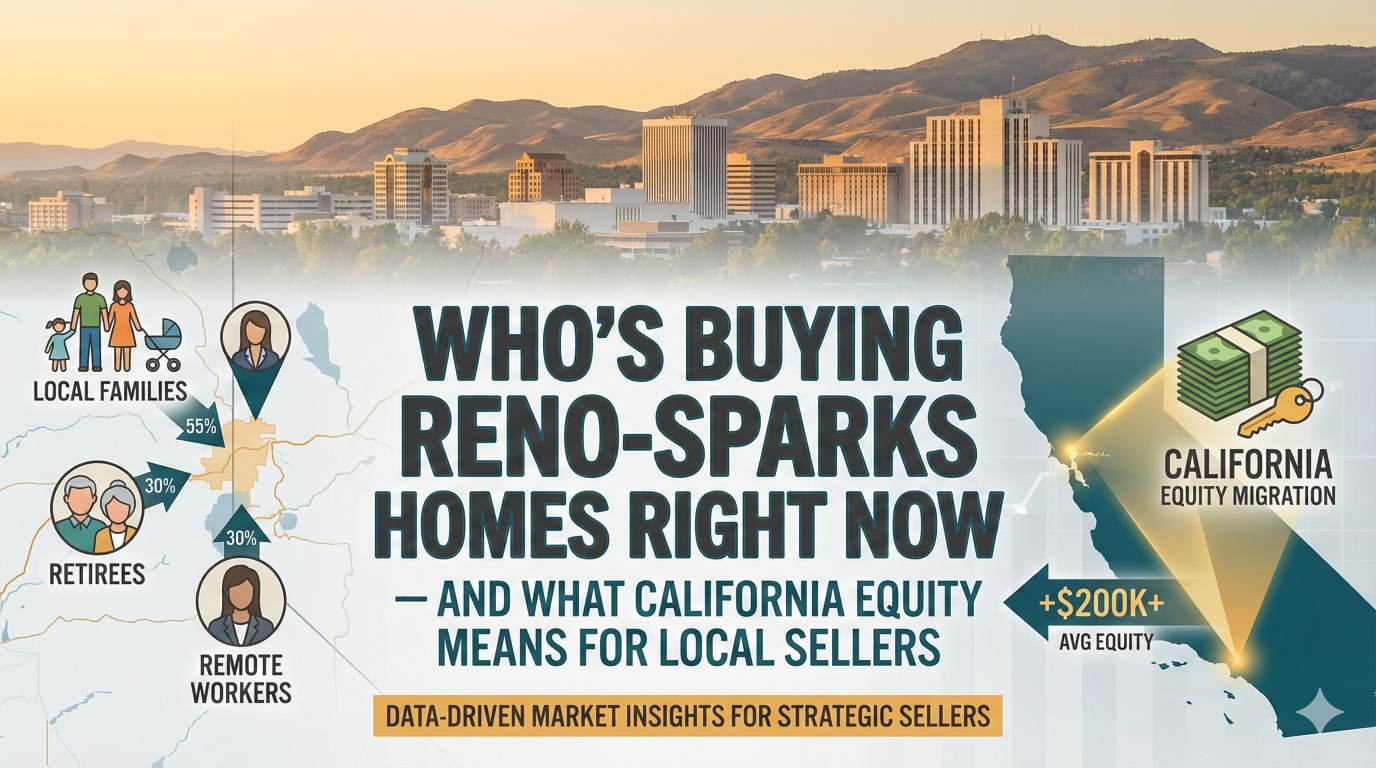
The short version: the highest-volume source of buyer demand flowing into the Reno-Sparks market is coming from California metros where the typical homeowner is sitting on six or even seven figures in home equity. When those buyers sell a $1.3 million home in San Francisco and start shopping in Somersett or Damonte Ranch or Caughlin Ranch, the financial math works differently than it does for someone stretching to make a first purchase. And that distinction creates a meaningful advantage for prepared Reno-Sparks sellers who understand it.
Where the Demand Is Actually Coming From
According to Redfin's migration data, San Francisco homebuyers searched to move into the Reno metro area more than any other destination in the country. Los Angeles followed close behind. This isn't anecdotal — it's tracked through actual search behavior on one of the nation's largest real estate platforms.
That migration pattern is supported by broader data. Nevada ranked tenth nationally for inbound migration in 2025, according to the United Van Lines National Movers Study cited in EDAWN's 2026 State of the Economy presentation. The motivations behind those moves are worth noting: family reasons led at 20.5%, followed by retirement at 19.9% and employment at 19.9%. Lifestyle accounted for 13%, while cost of living — often assumed to be the primary driver — actually ranked fifth at just 8.1%.
That breakdown matters because it tells you something important about who these buyers are. They're not bargain hunters trying to find the cheapest possible option. They're families, retirees, and professionals making deliberate moves driven by quality-of-life decisions. And many of them are arriving with substantial financial resources from the sale of California real estate.
The economic engine underneath this migration isn't slowing down either. The Reno metro area was ranked the number one Leading Metro for economic growth out of 949 national metro areas, according to EDAWN's presentation. That ranking isn't based on a single metric — it reflects $534 million in new business investment during 2025, 593 new jobs at an average salary of $76,800, and the region's emergence as the fastest-growing data center hub in the United States. According to the Upwind/JLL 2024 Data Center Report, the Reno-Las Vegas corridor posted growth rates up to 953%, ahead of Salt Lake City, Phoenix, Atlanta, and Dallas-Fort Worth.
For sellers, this matters because it means demand isn't fragile. It isn't dependent on a single employer or a temporary pandemic-era trend. It's structural, diversified, and accelerating. When you list a quality home in Reno-Sparks, you're listing into a market that national employers, venture capital firms, and relocating families have collectively identified as one of the best-positioned metros in the country. Our 2026 Reno-Sparks Housing Market Outlook covered this economic foundation in detail, and the data has only strengthened since.
The Equity Equation: What California Money Actually Buys in Reno-Sparks
Here's where it gets specific. Let's run some actual numbers — the kind of math that California relocators are doing on their kitchen tables right now, and the kind of math that Reno-Sparks sellers should understand because it directly affects how those buyers show up at your front door.
The median home price in San Francisco was $1.3 million as of January 2026, according to Redfin. In San Jose and Santa Clara County, the figure was approximately $1.9 million in the fourth quarter of 2025, according to NAR's quarterly metro report. Even in Sacramento, where prices are lower than the coastal metros, the median hovers around $525,000 — essentially what a Sparks home costs, but without the tax advantages Nevada offers.
Now consider what happens when a Bay Area homeowner who bought a home for $900,000 in 2018 sells at today's $1.3 million median. After paying off a remaining mortgage balance of perhaps $650,000, closing costs, and capital gains considerations, that seller could walk away with $550,000 to $600,000 in net proceeds. Some will have even more — homeowners who purchased before 2016 or who made significant payments during years of low rates may carry $700,000 to $800,000 in equity.
When that buyer turns to Reno-Sparks, where the median single-family home price in Reno was $580,000 and in Sparks was $525,000 in January 2026 according to Domus Analytics MLS data, that equity fundamentally changes the transaction. A buyer with $600,000 in California equity putting $200,000 down on a $650,000 Somersett home is financing only $450,000. At the current 30-year fixed rate of 6.01% — the lowest since September 2022, according to Freddie Mac's February 19, 2026 survey — that $450,000 mortgage translates to a monthly principal and interest payment of approximately $2,700.
Compare that to what the same buyer was paying in the Bay Area, or to what renting a comparable home in Reno would cost at $2,300 or more per month. The math isn't close.
But here's what makes this even more compelling from a seller's perspective. These aren't buyers who need to stretch to make the numbers work. They aren't waiting for rates to drop another half point before they can qualify. They're arriving with enough equity to put 20%, 30%, sometimes 40% or more down — which means stronger offers, fewer financing contingencies, and a much higher probability of closing without complications. According to EDAWN's presentation, 49% of older baby boomers — one of the dominant buyer demographics nationally — are purchasing their next home entirely with cash.
Wondering how the current rate environment affects buyer qualification in more detail? Our recent analysis covered how the drop from 6.85% a year ago to 6.01% today is expanding the qualified buyer pool across every price tier.
The Tax Advantage Multiplier
The equity from a California home sale is only part of the financial picture. The other piece — and it's a significant one — is what happens to a relocator's income after they establish Nevada residency.
California's state income tax rates are among the highest in the country, reaching 9.3% for income above approximately $68,000 (single filer) and climbing to 12.3% for income over approximately $698,000, with an additional 1% Mental Health Services Tax on income exceeding $1 million. The top effective rate is 13.3%. Nevada has no state income tax. Zero.
For a household earning $200,000 annually — not uncommon among the Bay Area professionals and remote workers driving migration into Reno — the California state income tax bill could run approximately $14,000 to $16,000 per year, depending on filing status and deductions. In Nevada, that tax obligation disappears entirely. Over five years, that's $70,000 to $80,000 in retained income that would have gone to Sacramento. Over ten years, it approaches or exceeds $150,000.
That's money that goes directly into mortgage payments, home improvements, savings, or simply a higher quality of life. And it helps explain why so many California relocators arrive in Reno-Sparks and buy more home than someone at the same income level might otherwise afford — because their effective take-home pay just increased by thousands of dollars per year.
Property taxes add another layer. In Washoe County, the effective property tax rate runs approximately 0.47% to 0.64%, depending on the specific property and exemptions. Nevada's property tax system also includes a 3% annual cap on increases for owner-occupied residential properties, plus a depreciation factor that reduces taxable value over time — a feature unique among all 50 states. While California's Proposition 13 also provides protections for existing homeowners, a new purchase in California resets the assessed value to the purchase price, which at Bay Area price levels can create a substantial annual tax bill.
The practical result: a Reno-Sparks buyer purchasing a $650,000 home might pay roughly $3,000 to $4,000 per year in property taxes. The same buyer purchasing a comparable home in the Bay Area at $1.3 million could face property taxes of $14,000 or more in the first year. That $10,000-plus annual difference compounds meaningfully over time.
Considering how your home fits into this buyer equation? Contact Kevin Kinney at 775-391-8402 or Robin Renwick at 775-813-1255 for a candid conversation about what the current demand profile means for your specific neighborhood and price point.
What This Means Neighborhood by Neighborhood
The California equity dynamic doesn't affect every Reno-Sparks neighborhood equally. Understanding where the relocator demand concentrates — and why — helps sellers position their homes more effectively.
Somersett has become one of the most popular destinations for California relocators, particularly retirees and remote workers seeking master-planned community amenities with Sierra views. The median sale price in Somersett reached $817,500 in January 2026, up 7.6% year-over-year according to Redfin — one of the strongest appreciation rates in the metro. For a Bay Area buyer converting $600,000 or more in equity, Somersett's price point lands squarely in the comfortable range, and the community's golf courses, trails, and 55-plus neighborhoods appeal directly to the retirement and lifestyle demographics driving migration.
Damonte Ranch and Double Diamond attract families and professionals in the $450,000 to $750,000 range, with strong schools including Damonte Ranch High School and proximity to south Reno's retail and restaurant corridor. These neighborhoods are a natural fit for California families who previously couldn't afford a comparable quality of life in the Bay Area suburbs.
Caughlin Ranch appeals to the buyer seeking established neighborhoods with larger lots, mature landscaping, and a central location. Properties here range broadly, with entry points in the mid-$600,000s and custom homes well above $1 million. The neighborhood's proximity to shopping, medical facilities, and major commuting routes makes it attractive to both families and downsizers.
Northwest Reno continues to offer relative value compared to south Reno neighborhoods, with quality homes in the $600,000 to $800,000 range. For California buyers who want more square footage and newer construction, this area delivers strong returns per dollar.
ArrowCreek and Montreux represent the luxury tier at $800,000 and above — sometimes well above. These gated communities attract the highest-equity California buyers, particularly those selling premium Bay Area properties. Sellers of upper-mid to luxury homes in these neighborhoods are competing for a buyer who has options everywhere in the West; understanding what strategic representation for quality properties looks like at this level is essential.
Spanish Springs and Sparks neighborhoods offer accessible price points in the $400,000 to $550,000 range, drawing California buyers on tighter budgets as well as local move-up buyers. Sparks posted particularly strong fundamentals in January 2026, with only 2.0 months of supply and a 98.8% sale-to-list price ratio according to MLS data — tighter than Reno's already favorable numbers.
Why This Isn't 2021 — And Why That's Better for Sellers
Some sellers may hear "California buyers" and think back to 2020 and 2021, when a flood of pandemic-era relocations drove frenzied bidding wars and unsustainable price escalation. It's a reasonable concern, and the distinction matters.
What's happening now is fundamentally different. The 2021 surge was driven partly by panic — people fleeing urban centers during a pandemic, often before they had jobs in the new location, sometimes sight unseen. Much of that demand was speculative in the sense that buyers were making emotional decisions without fully understanding the market they were entering.
Today's migration is driven by structural economic factors. The Reno metro's number-one economic growth ranking reflects real job creation, real capital investment, and real infrastructure development — not a temporary remote-work experiment. The data center construction boom alone, with spending expected to rise 23% in 2026 according to EDAWN data, represents a long-term economic commitment from major technology companies.
The buyers arriving today tend to be more deliberate. They've done their research. They're comparing neighborhoods carefully. They're working with financial advisors to optimize the tax transition. And they're making offers based on value rather than fear of missing out.
For sellers, this translates to a more sustainable and reliable market. You may not see 15 offers over asking price in the first weekend, but you're also not selling into a bubble that could deflate. You're selling into demand that has economic substance behind it. Nationally, the housing market shows signs of recovery — NAR's Housing Affordability Index reached 116.5 in January 2026, the most affordable reading since March 2022. The typical U.S. homeowner has accumulated approximately $130,500 in housing wealth since January 2020, according to NAR's February 12, 2026 existing-home sales report. In Reno-Sparks, where appreciation has outpaced many national markets, long-term homeowners likely hold even more.
If you're a Reno-Sparks homeowner weighing whether the current market rewards selling, contact Kevin Kinney at 775-391-8402 or Robin Renwick at 775-813-1255. We'll walk through the actual demand data for your specific neighborhood — no assumptions, just numbers.
The Seller Advantage You Might Not See
There's a subtlety here that most market commentary misses entirely. When your buyer pool is dominated by relocators carrying six-figure equity from higher-cost markets, the traditional dynamics of rate sensitivity and affordability strain don't apply in the same way.
National headlines focus on affordability challenges — and those challenges are real for first-time buyers working with limited savings. But that's not the primary buyer competing for your Somersett listing or your Caughlin Ranch property. The primary buyer for quality Reno-Sparks homes at upper-mid price points is often someone whose purchasing power is cushioned by existing equity, amplified by annual tax savings, and motivated by life circumstances that have little to do with whether rates are 5.8% or 6.2%.
According to the NAR 2025 Profile of Home Buyers and Sellers, first-time buyers dropped to an all-time low of just 21% of all transactions. The market is being driven by repeat buyers — particularly baby boomers with substantial equity — who are making strategic moves. In Reno-Sparks, many of those repeat buyers are arriving from out of state with financial positions that make them among the strongest purchasers in the market.
This is why preparation matters so much. The buyer walking through your front door may have just sold a $1.5 million San Jose home and is looking at your $750,000 Reno property as a financial upgrade in every dimension. They're not stretching. They're not going to lowball you because they can't afford to pay your price. But they are discerning. They've lived in well-presented California homes, and they have expectations about condition, staging, and how a property should show. Understanding what home staging delivers in measurable ROI becomes especially important when your buyer pool has that level of experience and sophistication.
Where the Market Stands Today
The broader market data supports the timing case for sellers who are prepared. Mortgage rates at 6.01% are the lowest in over three years. Purchase applications are up 16% and refinance activity has surged 40% year over year, according to the Mortgage Bankers Association. Sam Khater, Freddie Mac's Chief Economist, noted in the February 19, 2026 survey release that the lower rate environment is "improving affordability for prospective homebuyers" and "strengthening the financial position of homeowners."
Locally, the January 2026 Reno-Sparks MLS data tells a story of stable values with manageable supply. Reno's median sale price stood at $580,000 with 2.6 months of supply. Sparks posted a $525,000 median with an even tighter 2.0 months of supply. Both markets are well below the 5-to-6 month range that would indicate oversupply, meaning sellers still hold leverage — particularly in well-positioned neighborhoods with quality homes. Our January 2026 market update broke down those numbers neighborhood by neighborhood.
Lawrence Yun, NAR's Chief Economist, has projected a 14% increase in existing-home sales nationally during 2026 and a 4% gain in median home prices. If that forecast holds — and the combination of improving rates, strong employment, and pent-up demand suggests it reasonably could — sellers who list in the spring window will benefit from rising transaction volume before the late-spring competition wave brings more listings to market.
Positioning Your Home for This Buyer
If the buyer most likely to purchase your home is arriving from a market where median prices run three to four times higher than Reno-Sparks, what does that change about how you prepare?
First, it raises the bar on presentation. A buyer who just sold a $1.2 million Bay Area home and toured properties with professional staging, premium finishes, and meticulous landscaping is going to notice deferred maintenance, dated fixtures, and cluttered rooms. Your competition isn't just the house down the street — it's the standard of home presentation that your buyer experienced in their previous market.
Second, it changes the pricing conversation. California relocators typically research extensively before arriving. They know the neighborhoods. They know the comps. They understand what $650,000 should buy in Damonte Ranch versus what $900,000 should buy in ArrowCreek. They're not impulsive, and they're not naive about value. Pricing too aggressively above market will lose them, and pricing too conservatively leaves money on the table. The precision matters, and it requires a listing agent who understands the dynamics at each price tier.
Third, it means you should think about your home through the eyes of someone comparing your property not just to other Reno listings, but to the quality of life they're buying into. Proximity to trails, views of the Sierra, access to Lake Tahoe, quiet cul-de-sacs, modern kitchens, energy-efficient systems — these are the details that California relocators weigh heavily, because they're choosing Reno-Sparks for lifestyle reasons, not just economics.
The Bottom Line for Reno-Sparks Sellers
The buyer pool for quality Reno-Sparks homes in 2026 is deep, well-funded, and motivated by factors that extend well beyond mortgage rate headlines. Migration data confirms that the Bay Area and Los Angeles are the primary sources of relocator demand. EDAWN's economic data confirms that the economic engine drawing that demand is real and accelerating. And the financial math — California equity plus eliminated state income tax plus lower property taxes — creates a buyer who arrives with more purchasing power than the typical local transaction might suggest.
For sellers, this means three things. Your home is in demand from a buyer pool that most sellers underestimate. That demand rewards preparation, strategic pricing, and professional presentation. And the window to capture spring 2026 market conditions — with rates at three-year lows, buyer affordability at the best level since March 2022, and the nation's number-one ranked metro economy underneath you — is open right now.
If you're considering a strategic sale or a well-prepared purchase, we're happy to have a thoughtful conversation about your goals. Contact Kevin Kinney at 775-391-8402 or Robin Renwick at 775-813-1255. We'll walk through the demand profile for your specific neighborhood, the equity position you're working from, and the timeline that makes sense for your situation. Every recommendation starts with listening first.
3. FAQs (8)
Q: Are California buyers really the primary demand source for Reno-Sparks homes? A: According to Redfin migration data, San Francisco homebuyers searched to move into the Reno metro area more than any other destination in the country, with Los Angeles as the second-largest source. Nevada ranked tenth nationally for inbound migration in 2025 according to the United Van Lines National Movers Study. The pattern is consistent and well-documented across multiple data sources.
Q: How much equity does a typical California relocator bring to a Reno-Sparks purchase? A: It varies significantly depending on when and where they purchased. The median home price in San Francisco was $1.3 million as of January 2026 (Redfin), and in San Jose-Santa Clara it was approximately $1.9 million (NAR Q4 2025). A Bay Area homeowner who purchased for $900,000 in 2018 and sells at today's median could net $550,000 to $600,000 or more in equity after payoffs and closing costs, depending on their mortgage balance.
Q: Does the California tax savings really make that much difference? A: For a household earning $200,000, California state income tax could run $14,000 to $16,000 per year. Nevada has zero state income tax. Over ten years, that represents $140,000 to $160,000 in retained income. These figures are illustrative — actual savings depend on income level, filing status, and deductions, so consulting a CPA is essential.
Q: What Reno-Sparks neighborhoods attract the most California relocators? A: Somersett is particularly popular with retirees and remote workers, posting a $817,500 median sale price in January 2026 with 7.6% year-over-year appreciation (Redfin). Damonte Ranch and Double Diamond attract families with school-age children. Caughlin Ranch appeals to those seeking established neighborhoods with larger lots. ArrowCreek and Montreux draw the highest-equity buyers at the luxury tier.
Q: Should I be worried this is another 2021-style bubble? A: The current migration pattern is structurally different from the pandemic-era surge. Today's demand is driven by sustained economic fundamentals — the Reno metro was ranked number one for economic growth among 949 national metros, with $534 million in new business investment in 2025 and a data center construction boom. These are long-term economic commitments, not temporary pandemic responses.
Q: How do lower mortgage rates benefit me as a seller? A: The current 30-year fixed rate of 6.01% (Freddie Mac, February 19, 2026) — the lowest since September 2022 — directly expands the pool of buyers who can qualify for financing. A buyer who couldn't afford the monthly payment at 6.85% (one year ago) may now qualify comfortably, increasing demand for your listing across every price range. Purchase applications are up 16% year-over-year according to the Mortgage Bankers Association.
Q: How should I price my home differently knowing the buyer pool includes California relocators? A: California relocators tend to research extensively before arriving. They understand neighborhood comps and are deliberate — not impulsive. Pricing too aggressively above market will lose them, while pricing too conservatively leaves money on the table. The key is precision: accurate pricing based on current comparable sales, supported by professional presentation that meets the standard these buyers experienced in their previous market.
Q: Is spring 2026 a good time to sell in Reno-Sparks? A: Multiple data points converge favorably. Mortgage rates are at three-year lows, buyer affordability is at its best level since March 2022 (NAR Housing Affordability Index: 116.5 in January), the Reno metro economy is ranked number one nationally, and NAR projects a 14% increase in existing-home sales in 2026. Sellers who list before the late-spring competition wave typically face less inventory competition and more motivated buyers.
Check out this article next