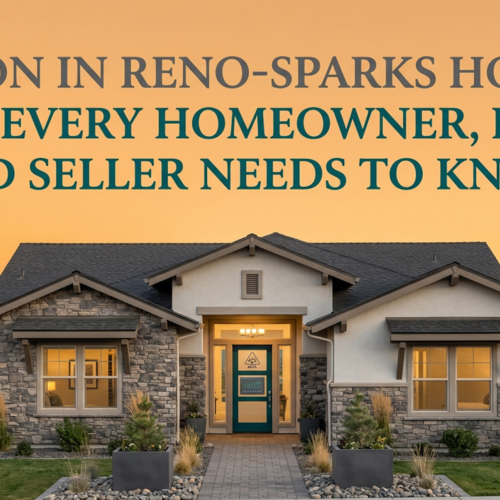


A note before we start. Our own site has a home valuation tool at kinneyandrenwickteam.com/home-valuation. It uses the same kind of automated model Zillow and Redfin use. We're not going to pretend otherwise. This blog is about what every automated estimate — theirs and ours — can and can't do, and why the conversation that happens after the estimate is where the real number lives.
Every Reno-Sparks homeowner, at some point, has typed their own address into Zillow just to see what pops up. It's human. The number that comes back — a specific dollar figure, down to the last thousand, sometimes down to the last dollar — feels authoritative. It looks like an answer.
It isn't an answer. It's a starting point, and understanding the difference between a starting point and an answer is the single most important thing a homeowner can learn before deciding whether to list.
Every online home valuation tool works the same way. Zillow's Zestimate. Redfin's estimate. Realtor.com's estimate. The home valuation tool we run on our own site at kinneyandrenwickteam.com/home-valuation. All of them are built on the same basic mechanism: an algorithm pulls recent sales of nearby homes, weights them by proximity and similarity, and produces an average. That average becomes your estimate.
Which means the number you see has never seen your home. It has never walked your landscaping. It has never noticed that your roof was replaced two years ago. It doesn't know about the kitchen you redid in 2022, or that your primary bath still has the original 1998 tile. It doesn't know that your lot backs to open space and your neighbor's lot backs to another house. It doesn't know that your golf course view is a real view, not a maintenance-cart path obscured by a tree.
It's an average of your neighbors. That's it. That's all it's ever been.
This isn't a criticism of any particular algorithm. Zillow is open about it on their own help page — they acknowledge that accuracy depends on the data available in a given area. Our own home valuation page pulls from the same kind of model. Every AVM does. They are genuinely useful tools for answering one question: what is the rough ballpark in this neighborhood right now? For that purpose, they work fine. For answering the question a seller actually needs answered — what is my specific home worth to a real buyer in today's market — they are not enough.
What the algorithm can't see
In Reno-Sparks specifically, the places where automated estimates miss are the places where the most value lives or the most value is lost. Robin Renwick has been running comparative market analyses in this market for over twenty years, and the patterns are consistent.
Updates and condition. We've walked into homes where the Zestimate was $80,000 low because the owners had put $120,000 into the kitchen, the primary bath, and the flooring — none of which shows up in tax records. We've also walked into brand-new construction where the Zestimate was $40,000 high because the builder hadn't finished the landscaping, and the algorithm didn't know that the home was sitting on a dirt lot with no irrigation. Same square footage as the neighbor's place. Not the same home.
Landscaping. This one surprises people. Mature landscaping — established trees, finished irrigation, real curb appeal — adds real money to a sale. Bare dirt or a hastily-seeded lawn subtracts real money. An algorithm cannot tell the difference between a Somersett home with a completed landscape package and the same floor plan next door with a rocked front yard and a dying juniper. A buyer absolutely can.
Views and lot orientation. In Galena Forest, ArrowCreek, and the ridge lots in Somersett, the view is a significant part of the value. The algorithm sees square footage and lot size. It does not see what you see when you walk out the back door. Lot orientation matters too — two identical Damonte Ranch homes, same floor plan, can differ by tens of thousands based on whether the yard faces north or south, whether the windows catch morning light, and whether the back fence borders open space or another home's back fence.
Golf course adjacency. Somersett, Red Hawk in Wingfield Springs, Montreux, ArrowCreek, Caughlin Ranch — the premium for being on the course, versus backing to the course, versus being three lots off the course, is real. The algorithm treats all three as "near the golf course." They are not the same home to a buyer.
Upgrades that never made it into records. Washoe County tax records are thorough, but they don't capture what you did to the interior last year unless a permit was pulled. Kitchens, bathrooms, flooring, finished basements, custom closet systems — much of this is invisible to the algorithm. An AVM can only work from what it can see.
Custom homes. In Old Southwest Reno and Galena Forest, a meaningful share of the housing stock is custom or semi-custom. There are no true comparables. Every home is different. An algorithm that works by averaging nearby sales produces its weakest estimates precisely in the neighborhoods where Reno-Sparks' most expensive homes sit.
What a real CMA actually looks like
A comparative market analysis — a real one, the kind Robin builds — is a different kind of work from what an algorithm does. It's not faster. It isn't automated. It's a person, at a desk, pulling each comparable sale one at a time and asking specific questions about it.
Robin starts with floor plan matches whenever possible. If you have a 2,400-square-foot single-story in Damonte Ranch, the strongest comp is another 2,400-square-foot single-story in Damonte Ranch, not a two-story of similar total square footage. Floor plan matters to buyers. It matters to the comp.
She studies the listing photos on every comparable sale. Not the MLS data. The actual photos. Because the photos tell her what the algorithm can never know — whether the comp had granite or quartz, whether the flooring was original or replaced, whether the yard was landscaped or rocked, whether the primary bathroom had the builder-grade fixtures or a full remodel. Two homes with identical tax records and identical square footage can have $60,000 of difference in them, visible only in the photos.
And then she calls. Robin picks up the phone and calls the listing agent of a comp when she needs to understand what actually happened in that transaction. An MLS price tells you the number. It doesn't tell you the story.
She asks about recent updates to the home and the condition of the landscaping — the same things that were invisible to the algorithm. She asks whether the sale was cash or financed, because cash buyers often pay a little less and financed sales sometimes include concessions that inflate the headline price. She asks about financing concessions — did the seller pay closing costs, buy down the rate, credit for repairs? Any of those inflate the sale price on paper and need to be adjusted out of the comp. She asks whether there were multiple offers or a single offer, because a home that got five offers in the first weekend is telling a different story than a home that sat for three weeks before attracting one buyer. She asks about days on market and price reductions. A comp that closed at $800,000 after an original list of $875,000 is not the same $800,000 as a comp that closed at $800,000 after a three-day bidding war.
Every one of those questions changes how a comp gets weighted. An algorithm can't make those calls. A person with twenty years of local relationships can.
The Reno-Sparks market in 2026
Current data underscores why the gap between algorithm and CMA matters more in this market than in most. The Reno-Sparks metro was ranked the #1 economic growth market out of 949 nationally in EDAWN's 2026 State of the Economy presentation. Data center growth in the region is expanding at rates as high as 953%, according to the Upwind/JLL 2024 Data Center Report. California equity continues to flow in — San Francisco homebuyers search to move into Reno more than any other metro, followed by Los Angeles, per Redfin's migration data.
Markets with strong and growing demand reward sellers who price accurately and penalize sellers who price off a bad number. Overprice by $30,000 and the home sits while buyers go look at something sharper. Underprice by $30,000 and the buyer who would have paid list doesn't have to. Either mistake costs real money, and either mistake is easier to make when the starting point is an algorithm's average rather than a real analysis of what your specific home brings to the table.
Neighborhoods tell the same story at a more granular level. Somersett homes ranged from $614,000 to $2,658,000 in a recent twelve-month window, per Dave Hughes's public Somersett statistics — a span that no algorithm averaging the neighborhood can honestly reflect in a single number. Southwest Reno, Caughlin Ranch, Galena Forest, Spanish Springs, Wingfield Springs, ArrowCreek, Rancharrah — each of these neighborhoods has internal price variation that depends on exactly the kind of detail an algorithm can't see. An average is the wrong tool.
How to actually find out what your home is worth
Here's the honest answer. Start with an automated estimate. Run it on Zillow, run it on Redfin, run it on our site at kinneyandrenwickteam.com/home-valuation. Three different algorithms will give you three different numbers, and the range between them is a useful first clue. If they're all tightly clustered — within 3% or 4% — your home is probably in the easier-to-estimate category, and the ballpark is roughly right. If they diverge widely, something in your home's profile is confusing the algorithms, and that's exactly where a human CMA adds the most value.
Then, when you want the real number — the one that reflects your kitchen, your landscaping, your view, your upgrades, your lot orientation — reach out. Robin or Kevin will sit down with you, pull the actual comps one at a time, and walk you through what your home is worth to a real buyer in today's Reno-Sparks market.
If you're curious what that conversation looks like, you can start the home valuation process at kinneyandrenwickteam.com/home-valuation. The automated estimate is the starting point. Robin and Kevin are the conversation that gets you to the real number.
Contact Kevin Kinney at 775-391-8402 or Robin Renwick at 775-813-1255.
8. Frequently Asked Questions
1. How accurate is the Zillow Zestimate in Reno-Sparks? Zillow reports nationwide median error rates of roughly 2.4% for homes currently listed and about 7.5% for off-market homes. In Reno-Sparks, accuracy varies significantly by neighborhood — dense tract neighborhoods with frequent sales produce tighter estimates, while custom-home neighborhoods like Galena Forest and Old Southwest Reno, or view-heavy neighborhoods like ArrowCreek and Somersett ridge lots, produce wider errors because the algorithm can't see what makes those homes different.
2. Is the home valuation tool on the Kinney & Renwick site more accurate than Zillow? Our valuation tool draws from the same kind of automated model that Zillow and Redfin use. It's a useful starting point, not a final answer. The difference is what happens next — when you use our page, you can follow up with a real conversation with Robin or Kevin to get a genuine comparative market analysis. That's where the real number lives.
3. What is the difference between a Zestimate and a CMA? A Zestimate is an algorithm's average of nearby sales, adjusted for your home's basic data. A CMA — a comparative market analysis — is a real estate professional manually pulling comparable sales, studying each one in detail, and often calling the listing agents of the comps to understand what actually happened in those transactions. A CMA accounts for condition, updates, landscaping, views, and market dynamics that no algorithm can see.
4. How long does a real CMA take? A thorough CMA for a Reno-Sparks home typically takes a few hours of actual work across several days — pulling comps, studying photos, making phone calls to listing agents, and adjusting for differences between your home and each comp. It's not instant, and the time itself is part of why a CMA is more accurate than an algorithm.
5. Why do two identical-looking homes sell for different prices? Landscaping, condition, updates inside the home, lot orientation, views, timing of the sale, whether the buyer was cash or financed, whether the seller paid closing costs or other concessions, and how many offers came in all move the final sale price. Two homes with the same square footage and bedroom count can sell for $50,000 or more apart. An algorithm sees the square footage and bedroom count. A buyer and a CMA see everything else.
6. Should I trust my Zestimate when deciding whether to sell? Trust it as a rough starting point, not as a decision-making number. The risk of overpricing based on a high Zestimate is a home that sits on the market while buyers go look at better-priced homes nearby. The risk of listing based on a low Zestimate is leaving money on the table. Either way, the decision should be made off a real CMA, not an algorithm's average.
7. What neighborhoods in Reno-Sparks are hardest for algorithms to estimate accurately? Generally, custom or semi-custom home neighborhoods (Galena Forest, Old Southwest Reno, parts of ArrowCreek and Montreux), view-premium neighborhoods where the view is a meaningful portion of value (ridge lots in Somersett, Galena Forest, Caughlin Ranch), golf course communities where adjacency premiums vary, and lower-inventory neighborhoods where recent sales are sparse. In all of these, a human CMA is significantly more reliable than an automated estimate.
8. How do I get a real home value analysis from Kinney & Renwick? Start at kinneyandrenwickteam.com/home-valuation to get an automated starting estimate. After that, contact Kevin Kinney at 775-391-8402 or Robin Renwick at 775-813-1255 to schedule a real comparative market analysis — the kind that reflects your specific home, not an average of your neighbors.
This article is for general informational purposes only and is not legal, tax, or financial advice. Market conditions change. Automated home value estimates, including the one on our own site, are algorithmic estimates and do not reflect the actual market value of any specific home. For a true comparative market analysis of your Reno-Sparks home, contact Kevin Kinney or Robin Renwick directly.
Check out this article next