
Spring Home Selling Season in Reno-Sparks: Why the Window Is Already Open
Key Takeaways
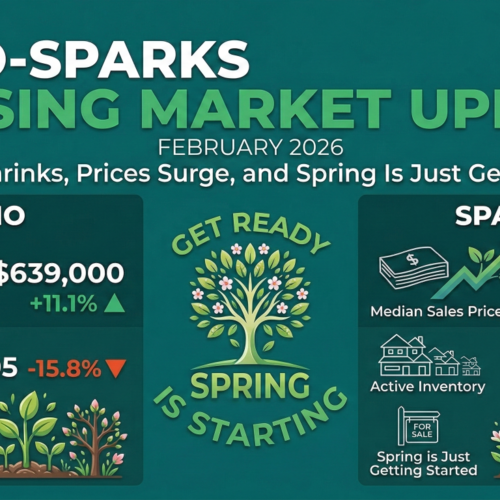
- Reno's median sale price reached $639,000 in February 2026 — up 11.1% from January, 3.9% year over year
- Sparks homes went under contract in a median of just 17 days in February — down 48.5% from January's pace
- The 30-year fixed mortgage rate is 6.00% as of March 5, 2026 (Freddie Mac) — near a three-year low, and nearly a full point below where it stood a year ago
- Sparks has only 164 active single-family listings for the entire city — down 36.4% from February 2025
- Spring 2026 in Reno-Sparks didn't wait for the calendar. It arrived in February — and the data confirms it.
Disclaimer: This post is for informational purposes only and does not constitute financial, legal, or investment advice. Local market data is sourced from the Northern Nevada Regional MLS (NNRMLS) via Domus Analytics, updated March 1, 2026. Rate data is from the Freddie Mac Primary Mortgage Market Survey (PMMS), released March 5, 2026. Mortgage payment figures are illustrative only and exclude taxes, insurance, HOA fees, and other costs. Conditions change — consult a licensed real estate professional before making any real estate decision. Kevin Kinney and Robin Renwick are licensed Nevada real estate professionals.
Every spring, the same advice circulates across real estate websites and social media: buyer activity picks up in March, peaks in April and May, and sellers who time their listing to catch the season's momentum earn the best outcomes. That framework is a reasonable description of the national housing market. It is not a particularly accurate description of what's happening in Reno-Sparks right now.
Spring didn't announce itself here with warmer temperatures and fresh listings hitting the MLS in mid-March. The February 2026 data tells a different story. Inventory was already tightening. Prices were already accelerating. In Sparks, homes were already going under contract faster than they were in the same month of last year — not in spite of it being winter, but because the demand driving this market isn't primarily seasonal. It's structural. And it was running ahead of schedule.
For sellers who've been waiting for confirmation that now is the right time to move, February provided that confirmation weeks ago. This piece walks through what the data actually shows, why the current rate environment is amplifying it, what makes this spring structurally different from past years, and what sellers who want to take advantage of it need to understand.
What the February Numbers Actually Show
The NNRMLS data, updated March 1, 2026 via Domus Analytics, covers February's activity across the Reno-Sparks market. The numbers are worth reading carefully because they describe conditions that typically don't emerge until well into spring.
Reno's median sale price for single-family homes came in at $639,000 for February — an 11.1% increase from January's median and 3.9% above where prices stood in February 2025. Month-over-month acceleration of that magnitude in mid-winter is not typical seasonal behavior. What it reflects is compression: fewer available homes, more buyers competing for them, and a willingness among those buyers to pay at or near asking price to secure a contract. The sale-to-list ratio in Reno hit 98.6%. Full-price offers are the expectation right now, not the exception. For a comprehensive breakdown of every key metric from February, the full February 2026 Reno-Sparks Housing Market Update covers the numbers in detail.
In Sparks, the picture is even sharper. The median days to contract fell to 17 days in February — a 48.5% decline from January's pace. That's not a minor seasonal adjustment. That's a market that moved into an entirely different gear over the course of a single month. Sellers in Sparks received 99.1% of list price on average. Active inventory across the entire city sits at 164 homes — down 19.6% from January and down 36.4% from February 2025. To put a finer point on it: there are 164 single-family homes available for purchase across all of Sparks right now, in a city of roughly 110,000 people. That inventory level is not a market in balance. It's a market where a well-prepared, accurately priced listing in the right neighborhood has a meaningful advantage before a single showing is scheduled.
Reno's inventory is tighter as well, though the pace of compression differs slightly. Active listings in Reno fell 15.8% from January and 12.5% year over year. With 2.1 months of supply — well below the four-to-six months that defines a balanced market — Reno's inventory continues to operate in territory that historically favors sellers. The median days to contract in Reno came in at 34 days. That's still a fast-moving market by any reasonable standard, though notably quicker than winter's typical pace.
Sellers who understand these numbers recognize something the national spring selling headlines can't tell them: in Reno-Sparks, the spring window isn't approaching. It arrived early, and it's already open.
The Rate Environment Amplifying the Demand
The timing of this market tightening isn't coincidental. It tracks closely with what's been happening to mortgage rates over the past several months — and with what's happening this week specifically.
On March 5, 2026, Freddie Mac released the latest results of its Primary Mortgage Market Survey. The 30-year fixed-rate mortgage averaged 6.00% — essentially holding at last week's 5.98%, but down from 6.63% at this point in 2025. Nearly a full percentage point of improvement year over year, at exactly the moment when buyer activity typically begins its seasonal ramp.
Sam Khater, Freddie Mac's Chief Economist, described the effect directly: "Mortgage rates held steady at 6% this week, hovering near their lowest level since 2022. In fact, rates are down nearly a full percentage point from this time in 2024, spurring activity from buyers, sellers and owners. As a result, refinance activity is up, and purchase applications are ahead of last year's pace."
That last phrase is the one that matters most for Reno-Sparks sellers: purchase applications ahead of last year's pace. The buyers who spent 2024 and early 2025 watching rates and waiting for a better moment to re-enter the market are re-entering. They're doing it now, at the exact moment when seasonal buyer activity is climbing toward its annual peak.
Run the actual numbers on a Reno transaction to understand what a nearly one-point rate improvement means in practice. A buyer purchasing a $639,000 home — Reno's February median — with 20% down is financing $511,200. At today's 6.00% rate, that buyer's principal and interest payment is approximately $3,065 per month. At last February's 6.63% rate, that same transaction carried a payment of roughly $3,300 per month. That's more than $235 less per month today, or roughly $2,820 in annual savings on a Reno-median purchase.
That reduction does two things. It makes existing buyers more confident in their ability to complete a transaction. And it expands the total pool of households who can qualify for a Reno-priced home in the first place. More qualified buyers entering the market while inventory remains this constrained is the core mechanism that drives multiple-offer situations, above-list-price outcomes, and compressed days on market. The rate improvement didn't create the spring market in Reno-Sparks. But it's pouring fuel on conditions that were already favorable.
Why This Spring Is Structurally Different
Seasonal buying patterns are real and well-documented. But the underlying demand sustaining the Reno-Sparks market isn't purely seasonal — and that's a distinction worth understanding when you're evaluating your timing.
At EDAWN's 2026 State of the Economy presentation, delivered February 5 and attended by Kevin Kinney, the Reno Metropolitan Statistical Area was ranked the number one leading metro for economic growth out of 949 metros nationally. Not top ten. Number one. EDAWN's data documented $534 million in new business investment flowing into the region in 2025, with 593 new jobs at an average salary of $76,800. The Reno-Las Vegas corridor holds the position of the fastest-growing data center hub in the United States, ahead of Salt Lake City, Phoenix, Atlanta, and Dallas-Fort Worth, with growth rates reaching 953% according to Upwind and JLL's 2024 Data Center Report. The regional startup ecosystem attracted $1 billion in venture capital over the past year, including Reno's first tech unicorn.
Companies relocating divisions and expanding operations in the Northern Nevada corridor don't place their employees on a seasonal schedule. Tesla doesn't tell a new engineer to start their Reno housing search in April because that's when ShowingTime data peaks. Corporate relocations, technology sector hires, and the steady inbound migration from California, Washington, and Oregon that has characterized Northern Nevada for the past several years — these buyers operate on their own timelines, driven by career moves and equity events, not the spring selling calendar.
That structural demand underneath the seasonal surface is one of the reasons the February data looks the way it does. The well-capitalized California relocators we've written about [link to sellers stronger position blog] — arriving with Bay Area or Sacramento equity that translates to full-cash or large-down-payment buying power in Reno — don't wait for April. They move when their circumstances allow it. And when those buyers are active in a market with 164 available homes in Sparks and 2.1 months of supply in Reno, the effect on contract timelines and pricing is significant.
Spring amplifies this structural demand. It doesn't create it. That distinction is what makes this spring in Reno-Sparks more powerful than a typical seasonal uptick in most other markets.
What "More Buyers, More Offers, Faster Sales" Actually Means Here
National spring selling data consistently shows three improvements over winter conditions: more buyers actively touring homes, more offers per listing, and shorter days on market. These aren't aspirational talking points — they're patterns documented over years in the ShowingTime data on buyer tours and the National Association of Realtors' Realtors Confidence Index on offers per listing. Realtor.com research shows homes sell approximately 20 days faster in spring compared to winter nationally.
Redfin's current assessment is direct: homebuying demand is improving, with mortgage purchase applications near their highest level in three years.
Apply that national framework to Reno-Sparks specifically, where the baseline conditions — inventory at 2.1 and 1.6 months, 98.6-99.1% sale-to-list, 17 days to contract in Sparks — are already operating at spring-quality levels heading into the season.
A well-prepared home listed in Somersett, Caughlin Ranch, or Northwest Reno during peak showing season, in a market where buyers are already competing for limited options, has a fundamentally different negotiating environment than the same home listed six months from now. A well-presented home in Damonte Ranch, South Meadows, or the premium corridors of South Reno listed now enters a market where buyers are motivated, pre-approved, and acutely aware that options are limited. Spanish Springs and Wingfield Springs in Sparks, where 17-day contract timelines are the current reality, represent neighborhoods where a properly positioned listing could realistically see showings, offers, and contracts within a compressed window that didn't exist three months ago.
More buyers don't just increase the probability of a sale. They change the shape of the negotiation. When a seller in Damonte Ranch receives two or three well-qualified offers in the same weekend, the conversation shifts from "what are you willing to accept" to "which offer is strongest on price, terms, and certainty of close." That's a very different position to negotiate from.
The Inventory Math Every Seller Should Understand
There's an aspect of spring selling timing that most national articles overlook because it doesn't fit a simple narrative: your competition isn't the total national housing inventory. It's the inventory in your neighborhood, in your price range, in your condition class. And that micro-market inventory is what determines whether a new listing faces five competing homes or fifty.
In Sparks right now, with 164 active listings across the entire city, a well-staged home in Wingfield Springs or Spanish Springs isn't competing against dozens of near-identical alternatives. It may be competing against three or four — possibly fewer. When buyers with strong pre-approvals are ready to move and have limited options to evaluate, decision timelines compress and negotiating leverage shifts clearly to the seller's side.
The same dynamic plays out across Reno's premium neighborhoods. Homes priced appropriately in Somersett's gated sections, Caughlin Ranch's established corridors, the Old Southwest Reno's historic properties, or the newer builds in South Reno's higher-end developments face a market where competition can be counted on one hand at any given price point. That isn't a rhetorical advantage — it's a mathematical reality produced by 2.1 months of supply across an entire city.
The timing element that sophisticated sellers understand is this: spring demand doesn't arrive all at once on a fixed date. It builds over a period of weeks, and listing inventory grows alongside it. The sellers who list early in the spring window — March and April — face the strongest buyer-to-inventory ratio of the year. By May and June, additional listings have come to market as other sellers gain confidence in the conditions and decide to move. The competitive environment for any individual listing is measurably different at the beginning of the spring wave than at the peak of it.
This is why the February data matters so much. Reno-Sparks is already at the beginning of that spring wave — not approaching it. Sellers who've been waiting for conditions to feel obvious are waiting for something that already arrived. And each week that passes without action is a week of that window closing incrementally as new inventory enters the market. For sellers who want to understand the most common preparation mistakes that erode outcomes in this environment, the issues we documented in our spring seller strategy piece [link to seller mistakes blog] are worth working through before the listing goes live.
What Strong Positioning Looks Like in This Market
Conditions are favorable. That doesn't eliminate the need for strategy — in some ways, it amplifies it. In a market where buyers are receiving 98.6 to 99.1% of list price, overpriced listings don't just sit longer. They accumulate days on market that signal weakness to the very buyers they're trying to attract, and they often end up selling for less than they would have at an accurate initial price.
Strategic pricing starts with an honest read of where comparable homes have actually sold, not where they've been listed. Kevin Kinney's role in the K&R process is price positioning — analyzing the comparable sales data with the precision required to find the number that attracts buyer attention rather than buyer hesitation. In a market this tight, there's often a narrow range where a well-prepared home generates competition and a range just above it where it generates questions. Getting that positioning right at the outset is worth more than almost any individual negotiating tactic after the fact.
Presentation is the second major variable. Robin Renwick leads staging coordination for every K&R listing — working directly with a trusted stager and a vetted vendor network to bring each home to market at its strongest possible level of visual appeal. This isn't about decorating. It's about psychology: qualified buyers make offer decisions based on whether they can picture their life in the space. Professional staging shapes that perception in a way that amateur presentation or lived-in furniture cannot replicate. The documented impact on days on market and final sale price is consistent enough that we've covered it in detail separately [link to staging ROI blog] — the short version is that the return on that investment tends to outperform most other pre-listing expenditures.
Once the home is staged and live, Kevin handles showings and negotiation directly. A background in advocacy means sellers aren't just represented — they're represented with clarity and strength at the moments where it matters most. When two offers come in simultaneously and the seller has a 24-hour decision window, the quality of negotiation in that window can shift the final outcome by tens of thousands of dollars. Calm, informed, strategic counsel at that moment is what K&R's process is designed to provide. Robin anchors the operational execution: contracts, timelines, vendor coordination, communication — the elements that determine whether a transaction closes cleanly or falls apart.
For sellers who are considering the 2026 spring window and want to understand how to choose the right representation for this kind of environment, the factors that actually separate listing agents in a competitive market are worth understanding [link to right listing agent blog].
The Window Is Open — The Question Is Whether You're Ready for It
Spring selling season in Reno-Sparks didn't wait for a calendar announcement. It arrived in February, confirmed by data that shows inventory tightening, prices accelerating, and homes going under contract at a pace that looks more like peak summer than mid-winter. It's being reinforced this week by mortgage rates holding at their most favorable level since 2022 and a Freddie Mac Chief Economist describing purchase applications running ahead of last year's pace.
The conditions are real. They're documented. And they have a shelf life — not because demand will disappear, but because the inventory advantage that exists right now, with 164 homes in Sparks and 2.1 months of supply in Reno, will be partially offset as additional sellers gain confidence in the market and bring their homes online through spring and into summer.
Sellers who act well-prepared, priced precisely, and positioned correctly in March and April will enter that market at a different moment than sellers who wait until May to finalize their decisions. Both may sell. The question is the conditions under which they negotiate.
Spring doesn't guarantee outcomes. Strategy does. But this season gives sellers something genuinely valuable: momentum, compressed inventory, improving affordability for buyers, and a regional economy that's ranked first in the nation for growth. Those aren't talking points. They're the actual conditions in which your home would go to market if you listed it this spring.
If you're considering a strategic sale in 2026 and want a thoughtful conversation about what today's market means for your specific situation, we're happy to have it. Kevin Kinney: 775-391-8402. Robin Renwick: 775-813-1255.
Frequently Asked Questions
1. When is the best time to sell a home in Reno-Sparks in 2026? The data suggests the best window has already opened. February 2026 produced a Reno median of $639,000 — up 11.1% from January — with Sparks homes going under contract in 17 days and inventory down 36.4% year over year. Spring conditions typically persist through April and May, but sellers who list in March do so against lower competing inventory than those who wait until the season is in full swing.
2. What is the current median home price in Reno in spring 2026? Reno's median sale price for single-family homes reached $639,000 in February 2026, according to the Northern Nevada Regional MLS via Domus Analytics (updated March 1, 2026). That's up 11.1% from January 2026 and 3.9% above February 2025.
3. How long are homes on the market in Reno-Sparks right now? In February 2026, the median days to contract was 34 days in Reno and 17 days in Sparks. Sparks figures represent a 48.5% decline from January's pace alone, indicating the market moved meaningfully faster heading into spring.
4. What are current mortgage rates in March 2026? The 30-year fixed-rate mortgage averaged 6.00% as of March 5, 2026, according to Freddie Mac's Primary Mortgage Market Survey. That's down from 6.63% a year ago — a nearly full percentage point improvement that Freddie Mac Chief Economist Sam Khater noted is "spurring activity from buyers, sellers and owners" with purchase applications running ahead of last year's pace.
5. Is it a buyer's or seller's market in Reno-Sparks right now? Both cities are firmly in seller's market territory. Reno has 2.1 months of supply and Sparks has just 1.6 months — well below the 4-6 months that defines a balanced market. Sellers are receiving 98.6% of list price in Reno and 99.1% in Sparks. Sparks has only 164 active single-family listings for the entire city.
6. Does Reno-Sparks follow national spring real estate trends? Reno-Sparks tracks national seasonal patterns but tends to outperform them because of structural demand: corporate relocation tied to Tesla, Switch, and the data center industry; consistent inbound migration from California, Washington, and Oregon; and an economy EDAWN ranked first for growth out of 949 national metros. That structural demand sustains buyer activity year-round and amplifies it during the spring seasonal peak.
7. Should I wait until May to list my home in Reno-Sparks? The data suggests sellers who list in March or April face a more favorable inventory environment than those who wait until May. As spring progresses, new listings enter the market alongside new buyers — and the inventory advantage that exists right now (2.1 months in Reno, 1.6 in Sparks) will partially diminish as competing listings come online. Listing earlier in the spring window, with a well-prepared home, has historically produced stronger outcomes in tight inventory conditions.
8. Which Reno-Sparks neighborhoods are strongest for sellers this spring? The tightest conditions are in Sparks — neighborhoods like Wingfield Springs, Spanish Springs, and established communities in South Sparks are operating with very limited competition. In Reno, upper-mid and higher price point homes in Somersett, Caughlin Ranch, Damonte Ranch, South Meadows, Northwest Reno, and South Reno's established corridors are benefiting from compressed inventory and motivated, well-qualified demand.
Check out this article next