

The following analysis combines data from the National Association of Home Builders (NAHB), the U.S. Supreme Court opinion in Learning Resources, Inc. v. Trump, 607 U.S. ___ (2026), the Center for American Progress, the Freddie Mac Primary Mortgage Market Survey (February 26, 2026), and the Economic Development Authority of Western Nevada (EDAWN) 2026 State of the Economy presentation. This content is informational and does not constitute legal, tax, or financial advice. Local market statistics sourced from Domus Analytics / NNRMLS updated January 2026.
You've been told that tariffs are bad news for real estate. That the trade war is driving up costs, stalling builders, and creating uncertainty nobody can afford. And if you've been following the headlines — from the Supreme Court's landmark ruling on February 20 to the new global tariffs that replaced the old ones within hours — you'd be forgiven for thinking this is a terrible time to be anywhere near the housing market.
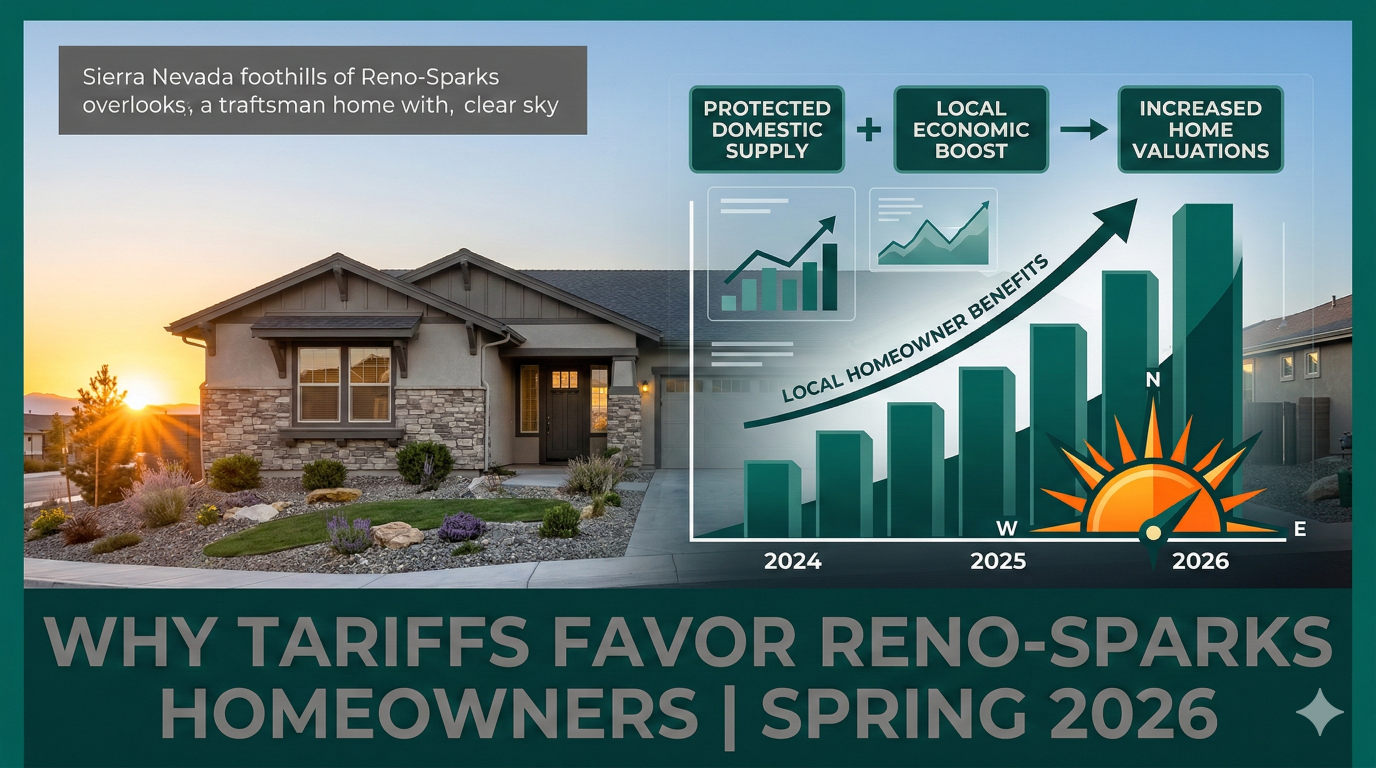
But here's what those national headlines won't tell you: if you already own a home in Reno-Sparks, the tariff environment is quietly working in your favor.
Not in some abstract, theoretical sense. In actual dollars. The same forces that are making new construction more expensive, more uncertain, and harder to deliver are simultaneously making your existing home more competitive, more attractive, and more valuable to the growing pool of qualified buyers entering this market right now.
This isn't cheerful spin. The data supports it — and the math is straightforward once you understand where the tariff impact actually lands.
The Tariff Burden Falls on New Construction — Not Your Home
Let's start with the most important distinction most coverage misses entirely. Tariffs on building materials affect new homes. The lumber, steel, aluminum, cabinets, appliances, and fixtures that go into building a house from scratch — those are the costs absorbing the tariff impact. Your home has already been built. Those materials were purchased at pre-tariff prices, installed years ago, and fully paid for.
The National Association of Home Builders estimated in its April 2025 Housing Market Index survey that tariff actions add approximately $10,900 to the cost of constructing a typical new single-family home. A separate analysis from the Center for American Progress, using Urban-Brookings Tax Policy Center modeling, puts the figure even higher at roughly $17,500 per home when accounting for the full range of tariffs on residential construction inputs — approximately $27 billion in added costs spread across 1.55 million annual new home starts.
The difference in those estimates reflects methodology and timing. But the directional conclusion is the same: building a new home in America now carries a significant tariff surcharge that didn't exist five years ago.
That surcharge shows up in the data. Building material prices have already risen 34% above December 2020 levels, according to the NAHB — far outpacing general inflation. And this isn't a temporary blip. Roughly 7% of all goods used in new residential construction are imported, according to the NAHB's own analysis, and several of the most critical materials carry the steepest tariffs.
Canadian softwood lumber, which accounts for approximately 85% of all U.S. softwood lumber imports, currently carries a 14.5% tariff rate — and the Commerce Department has signaled plans to more than double that to 34.5%. Steel and aluminum face 50% tariffs under Section 232 of the Trade Expansion Act, which the Supreme Court's February ruling left untouched. Kitchen cabinets and vanities — standard components in virtually every new home — face tariffs that were scheduled to rise to 50% on January 1, 2026, before being temporarily held at 25%.
None of those costs touch your existing home. Not a dollar of it.
The Supreme Court Ruling Changed the Rules — But Not the Costs
On February 20, 2026, the Supreme Court issued its decision in Learning Resources, Inc. v. Trump, ruling 6-3 that the International Emergency Economic Powers Act does not authorize the president to impose tariffs. Chief Justice Roberts, writing for the majority, was direct: "IEEPA contains no reference to tariffs or duties. Until now, no President has read IEEPA to confer such power."
The decision struck down both the "Trafficking and Immigration Tariffs" imposed in February 2025 and the sweeping "Liberation Day" reciprocal tariffs from April 2025. The Tax Foundation estimates that more than $160 billion in IEEPA tariffs had been collected through the date of the ruling — revenue the government may now be required to refund, though the process for doing so remains unresolved and is expected to take years of litigation.
Within hours of the decision, the administration imposed new tariffs under Section 122 of the Trade Act of 1974: a 15% global tariff effective February 24, 2026, which is the maximum rate allowed under that statute. There's a critical limitation, though. Section 122 tariffs are capped at 150 days — meaning they expire by July 24, 2026 — unless Congress votes to extend them.
For builders trying to plan projects that take 6 to 12 months from permitting to completion, this creates a planning environment that is, to put it gently, difficult. Which tariffs will be in place when your materials are delivered? Will the 15% surcharge expire in July or get extended? Will Section 232 tariffs on steel and aluminum change? Will the lumber tariff rate double as signaled?
Nobody building a new home in 2026 can answer those questions with confidence. And that uncertainty has consequences.
Builders Are Already Adjusting — And Not in Ways That Help Buyers
The tariff uncertainty isn't just theoretical. It's already showing up in builder behavior. According to NAR reporting, roughly 40% of builders cut prices in December 2025, with average reductions around 5%. Nearly two-thirds are offering other incentives — mortgage rate buydowns, closing cost credits, design center allowances — to move inventory. PulteGroup's CFO told investors that tariffs could increase their build costs by approximately $1,500 per home starting in 2026, and that was a conservative estimate before the Section 122 tariffs were imposed.
Robert Dietz, NAHB's Senior Vice President and Chief Economist, has been transparent about the challenge: the organization hasn't issued updated per-home tariff estimates beyond the $10,900 figure specifically because tariff policy keeps changing. He acknowledged that uncertainty itself is a cost — one that makes builders hesitant to start new projects when the rules might shift again before they break ground.
The Center for American Progress projects that tariff-induced higher building costs will result in approximately 450,000 fewer homes being built over the next five years. That's not a forecast about a distant future. That's a reduction in supply happening right now, in 2026, in every market where builders are pulling back on new starts.
For anyone thinking about buying a new construction home, this means higher prices, fewer options, and incentives that may narrow as builders' margins get squeezed further. For existing homeowners, it means the opposite: less competition from new inventory, stronger relative positioning, and a buyer pool that's increasingly looking at resale homes not as a second choice but as the better value.
Wondering how your home fits into the current competitive landscape? Contact Kevin Kinney at 775-391-8402 or Robin Renwick at 775-813-1255 for a candid conversation about what the data means for your specific property and neighborhood.
In Reno-Sparks, the Math Makes This Even Clearer
Nationally, the price gap between new and existing homes has narrowed to historic lows. According to NAHB analysis of Census Bureau and NAR data, the median new single-family home sold for $416,900 in the first quarter of 2025, compared to $402,300 for an existing home — a gap of just $14,600. For context, that gap averaged $66,000 from 2010 to 2019. And in the second and third quarters of 2024, existing home medians actually exceeded new home medians for the first time in decades.
In Reno-Sparks, the gap works differently — and the tariff dynamic matters even more. EDAWN's 2026 State of the Economy data, compiled by Applied Analysis from trailing 12-month closings, shows the local median for new homes at $592,953, compared to $555,542 for existing homes. That's a $37,411 premium for new construction before any additional tariff costs filter through to buyers.
Layer the NAHB's $10,900 tariff estimate on top of that existing premium, and a new construction buyer in the Reno-Sparks area is looking at an effective cost gap of nearly $50,000 compared to a comparable existing home. The more conservative PulteGroup estimate still adds $1,500 or more. The broader Urban-Brookings methodology suggests the actual figure could be substantially higher.
And here's the factor that makes Northern Nevada unique: there isn't a lot of new land to develop. Brian Gordon of Applied Analysis noted during the EDAWN presentation that most vacant land in the region is either federally owned or has terrain unsuitable for residential development. "There is not a lot of opportunity for future development out into the community," Gordon said, "so this is what's causing elevated land pricing. We already know costs are high from a material standpoint. We know costs are high from a labor standpoint."
Tariffs stack on top of already elevated land and labor costs. In markets like parts of Texas and Florida, where builders have room to spread out and where new construction represents a large share of inventory, the tariff impact plays out differently. In Reno-Sparks, where buildable land is constrained by federal ownership and topography, the tariff squeeze on new supply amplifies the value proposition of homes that already exist in established neighborhoods like Damonte Ranch, Somersett, and Caughlin Ranch.
Data Center Construction Is Competing for the Same Materials
There's another dimension to this story that's specific to Reno-Sparks and largely invisible in national tariff coverage.
Northern Nevada has approximately $26 billion in data center projects either under construction or in planning stages. The Upwind/JLL 2024 Data Center Report ranked Reno/Las Vegas as the #1 fastest-growing data center hub in the country — a 953% growth rate, ahead of Salt Lake City, Phoenix, Atlanta, Dallas-Fort Worth, and every other major metro.
Data centers consume enormous quantities of steel, concrete, electrical components, and specialized materials. When construction spending on data centers is projected to rise 23% nationally in 2026, and Northern Nevada is ground zero for that growth, it means residential builders in this market aren't just competing with tariff costs — they're competing with massive commercial projects for the same materials, the same contractors, and the same labor pool.
EDAWN's data tells the broader story: $534 million in business investment in 2025, 593 new jobs at an average salary of $76,800, 11 company relocations, and 4 expansions — with 14 site visits per month placing the region in the top 1% nationally for economic development activity. The metro area earned the #1 Leading Metro designation out of 949 metros nationwide.
All of that economic activity is positive for property values and buyer demand. But it also means the infrastructure supporting new residential construction is being pulled in other directions. Existing homes in Reno-Sparks benefit from that demand pressure without bearing any of the cost burden.
Sub-6% Mortgage Rates Are Bringing Buyers Back — Right on Schedule
The tariff story converges with another development that matters enormously for existing home sellers. As of February 26, 2026, the 30-year fixed-rate mortgage averaged 5.98%, according to the Freddie Mac Primary Mortgage Market Survey — the first time rates have dropped below 6% in more than three and a half years.
"For the first time in three and a half years, the 30-year fixed-rate mortgage dropped into the 5% range, falling even lower than last week's milestone," said Sam Khater, Freddie Mac's Chief Economist. "This rate, combined with the improving availability of homes for sale, is meaningful and will drive more potential buyers into the market for spring homebuying season."
That word — meaningful — is worth pausing on. The psychology of rates dropping below 6% matters as much as the actual payment savings. Buyers who've been sitting on the sidelines waiting for "rates to come down" now have the headline they needed. And those buyers are increasingly looking at existing homes because the tariff-driven cost dynamics make new construction less accessible.
A year ago, the 30-year rate sat at 6.76%. On a $580,000 home — the current Reno median — a buyer financing 80% of the purchase price saves approximately $375 per month at today's rate compared to February 2025. That's $4,500 annually in real household budget impact, arriving just as spring buying season begins.
For sellers in communities like ArrowCreek, Double Diamond, or Northwest Reno, this convergence — tariff pressure elevating new construction costs while falling rates expand the buyer pool — is the kind of market window that doesn't open on any predictable schedule.
The Buyer Pool Is Deep and Well-Capitalized
One more factor worth understanding: the buyers entering this spring market aren't marginal. The demand pipeline for Reno-Sparks homes is anchored by well-capitalized relocators from California, where the median home price in San Francisco still exceeds $1.3 million and San Jose approaches $1.9 million. A Bay Area homeowner bringing $500,000 to $600,000 or more in equity to a Reno purchase isn't sensitive to a $375 payment difference the way a first-time buyer might be. They're looking for value, quality, and livability — and existing homes in established Reno neighborhoods deliver all three.
Nevada's continued ranking as the tenth-highest state for inbound migration in 2025, according to the United Van Lines National Movers Study, confirms the demand pattern. Family reasons led the motivations at 20.5%, followed by retirement at 19.9% and employment at 19.9%. These aren't speculative buyers. They're making permanent moves driven by life circumstances — the kind of transitions that don't wait for tariff uncertainty to resolve.
In Reno proper, homes are selling at 98.6% of asking price. In Sparks, that figure is 98.8%. Months of supply sits at 2.6 in Reno and 2.0 in Sparks — comfortably in seller-favorable territory. The current market data, sourced from Domus Analytics and the Northern Nevada Regional MLS for January 2026, shows a market where well-prepared, accurately priced existing homes are moving with efficiency.
What This Means for Reno-Sparks Sellers Right Now
If you own a home in Spanish Springs, Southwest Reno, Somersett, or any of the established neighborhoods across the metro area, the tariff environment is shifting the competitive landscape in your direction. Not because tariffs are "good" in some broad economic sense — they create real costs and real uncertainty — but because the specific mechanics of where those costs land disproportionately burden new construction while leaving existing homes untouched.
The convergence happening right now is unusual. Tariff costs are elevated and likely to remain so regardless of how the post-SCOTUS policy landscape settles. New construction supply is constrained by those costs, by limited buildable land, and by competition from commercial development. Mortgage rates just crossed below 6% for the first time since 2022. The buyer pool is deep, well-capitalized, and driven by life events that don't pause for trade policy.
Spring selling season in Reno-Sparks doesn't come with a guarantee. Pricing still needs to be precise — not aspirational. Presentation still matters. Preparation still separates the homes that sell efficiently from the ones that sit and accumulate price reductions. But the underlying market dynamics right now? They favor the homeowner who's already built, already established, and ready to let the market come to them.
If you're weighing whether this spring is the right time to position your home strategically, we're happy to have a thoughtful conversation about what the data means for your specific neighborhood and situation. Contact Kevin Kinney at 775-391-8402 or Robin Renwick at 775-813-1255. We listen first, then advise — and what we're hearing from the data right now is worth your attention.
FAQs
How do tariffs affect existing home prices in Reno-Sparks? Tariffs don't directly increase the cost of an existing home since the building materials were purchased and installed before current tariff policies took effect. However, by raising the cost of new construction, tariffs make existing homes more competitive by comparison. The NAHB estimates tariffs add approximately $10,900 to the cost of a new home, which effectively narrows or eliminates the price advantage new construction might otherwise offer. In Reno-Sparks, where the new-to-existing home price gap was already $37,411 according to EDAWN data, the tariff surcharge makes existing homes in established neighborhoods increasingly attractive to buyers.
What did the Supreme Court's February 2026 tariff ruling actually change? The Supreme Court held 6-3 in Learning Resources, Inc. v. Trump that the International Emergency Economic Powers Act (IEEPA) does not authorize the president to impose tariffs. This struck down both the "Trafficking and Immigration Tariffs" and the "Liberation Day" reciprocal tariffs. However, within hours, the administration imposed a 15% global tariff under Section 122 of the Trade Act of 1974, capped at 150 days (expiring July 24, 2026 unless Congress extends). Section 232 tariffs on steel and aluminum (50%) remain in effect, meaning builders still face significant material cost pressures.
Are mortgage rates expected to stay below 6% through spring 2026? As of February 26, 2026, the 30-year fixed-rate mortgage averaged 5.98% according to Freddie Mac — the first sub-6% reading in three and a half years. Sam Khater, Freddie Mac's Chief Economist, called it "meaningful" for the spring buying season. While no one can predict rates with certainty, the general trajectory has been downward, and most industry forecasts project rates averaging in the 5.9% to 6.3% range through 2026. Sellers benefit from current rates because lower rates expand the pool of qualified buyers who can afford to purchase.
Why are builders offering so many incentives right now? Roughly 40% of builders cut prices in December 2025, with average reductions around 5%, and nearly two-thirds are offering additional incentives like mortgage rate buydowns and closing cost credits. These incentives reflect the margin pressure builders face from elevated material costs, tariff uncertainty, and the need to move inventory. While incentives make new construction more accessible for buyers, they also signal that builders are absorbing costs they can't pass through — a dynamic that limits new supply growth and benefits existing homeowners whose properties don't carry those same cost burdens.
How much more does it cost to build a new home in 2026 compared to pre-pandemic levels? Building material prices have risen 34% above December 2020 levels, according to the NAHB. Tariff actions add an estimated $10,900 to $17,500 per new home on top of that elevated baseline, depending on the methodology used. The lower figure comes from NAHB's builder survey; the higher figure comes from the Center for American Progress using Urban-Brookings Tax Policy Center modeling. Labor costs have also risen significantly, and in Reno-Sparks specifically, limited buildable land adds further cost pressure that's unique to the region.
Does the tariff environment affect the Reno-Sparks market differently than other markets? Yes. In markets with abundant buildable land — parts of Texas, Florida, and the Southeast — builders have more room to absorb tariff costs or build smaller homes on cheaper lots. In Reno-Sparks, approximately 80% of Nevada's land is federally owned, and much of the remaining land faces topographic constraints. Brian Gordon of Applied Analysis noted at EDAWN's 2026 presentation that there is limited opportunity for future development in the community, which is driving elevated land pricing on top of material and labor costs. Additionally, Northern Nevada's $26 billion in data center projects competes for the same construction materials and labor, further constraining residential building capacity.
Is this a good time to sell my home in Reno-Sparks? Market data supports a favorable environment for prepared sellers. Mortgage rates below 6% are expanding buyer demand. Tariff costs are constraining new construction supply. The Reno-Sparks market shows 2.0 to 2.6 months of supply with homes selling at approximately 98.6% to 98.8% of asking price. California equity and inbound migration continue to drive well-capitalized buyer demand. However, "favorable" doesn't mean "automatic." Pricing precision, thorough preparation, and strategic presentation remain essential — homes that are overpriced or underprepared still face price reductions, even in a strong market.
How much equity does a typical California buyer bring to a Reno-Sparks purchase? It varies significantly depending on when and where they purchased. With San Francisco's median at approximately $1.3 million and San Jose near $1.9 million (NAR Q4 2025), a Bay Area homeowner who purchased for $900,000 in 2018 could net $500,000 to $600,000 or more in equity after payoffs and closing costs. That purchasing power allows many California relocators to make cash-heavy or all-cash offers on homes in Reno neighborhoods like Somersett, Caughlin Ranch, or ArrowCreek — providing sellers with stronger, more reliable transactions.
Check out this article next