
The following analysis combines January 2026 data from the Northern Nevada Regional MLS (Domus Analytics, updated February 5, 2026) with national context from Freddie Mac, the National Association of Realtors, and EDAWN's 2026 State of the Economy presentation. All local statistics reflect single-family residences in Washoe County. Market conditions vary by neighborhood and price point.
Every month produces a new batch of headlines about the housing market. Some tell you the sky is falling. Others insist everything is booming. Most of them are written by people who have never set foot in Reno or Sparks, pulling numbers from national aggregators and calling it local analysis.
That's not what this is.
This is a ground-level look at what actually happened in the Reno-Sparks housing market in January 2026 — straight from the Northern Nevada Regional MLS — with the economic context to explain why these numbers matter and what they signal for the months ahead. Kevin Kinney attended EDAWN's 2026 State of the Economy presentation on February 5, where Brian Gordon of Applied Analysis and Taylor Adams of EDAWN presented 145 slides of data on the region's economic trajectory. That data, combined with real MLS numbers and national rate context, gives us a complete picture that no single source can provide on its own.
Here's what the data actually says.
Reno: $580,000 Median, Tight Inventory, Sellers Holding Their Ground
Reno's median sales price for single-family homes came in at $580,000 in January 2026. That's down 1.7% from January 2025 and 14.1% below December's median — but before anyone reads those numbers as alarm bells, it's worth understanding what they actually reflect.
January is always the lowest-volume month of the year. The homes closing in January were largely negotiated in November and December, when buyer activity naturally slows for the holidays. December closings, by contrast, often include transactions that were pushed to close before year-end for tax or relocation purposes, which tends to inflate that month's median. The seasonal pullback from December to January isn't a market correction — it's a calendar effect that shows up every single year.
The more telling number is the list price received: 98.6%. That figure actually ticked up 0.8% compared to January 2025. Sellers who priced correctly in January got virtually their full asking price. And the median sold price per square foot — $325, essentially flat year-over-year at +0.2% — confirms that on a per-square-foot basis, values have held steady even as the headline median dipped slightly.
Reno recorded 180 closed sales in January, down 10.4% from January 2025. That's a number to watch but not to overreact to. The 45-day median time to contract (up 11.3% year-over-year) tells us buyers are being more deliberate, taking slightly longer to make decisions, but they're still closing at essentially full asking price when they do move forward. This is a market where well-priced homes in neighborhoods like Somersett, Damonte Ranch, and Caughlin Ranch are still attracting serious offers, while overpriced listings in any neighborhood are sitting longer.
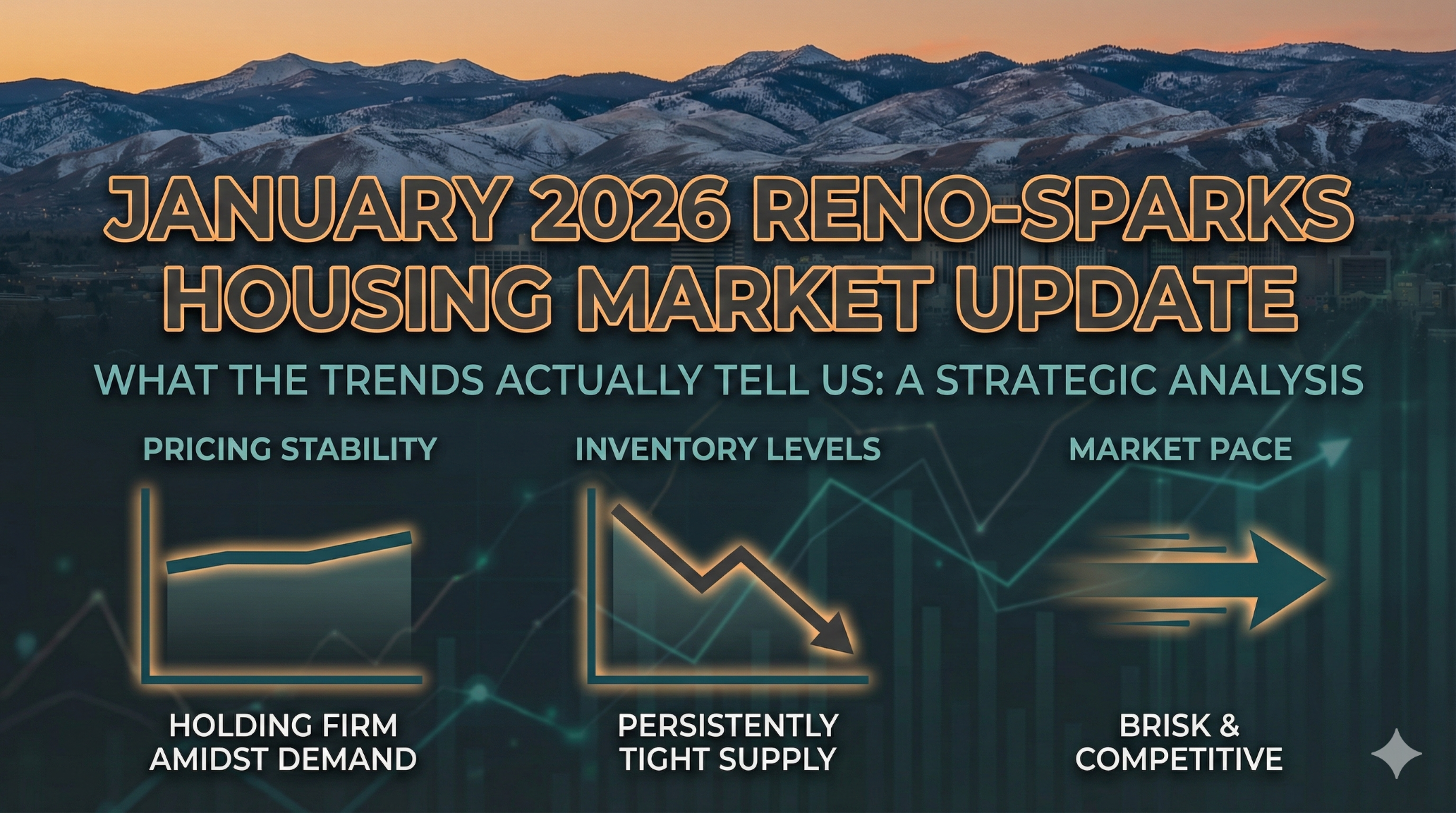
The inventory picture is the real story. Reno's active inventory dropped to 464 homes — down 5.9% from January 2025 and down 13.6% from December. That translates to just 2.6 months of supply. To put that in perspective, a balanced market is generally considered to be around six months of supply. At 2.6 months, Reno remains firmly in seller-favorable territory, even during the slowest month of the year.
New listings surged 64.2% from December to January — 243 new homes came to market — signaling that sellers are beginning to position for spring. But that influx hasn't loosened inventory because buyer activity absorbed much of it. The year-over-year new listing count was flat, meaning we're not seeing a flood of new supply. We're seeing normal seasonal preparation.
Sparks: Even Tighter, Even Faster
Sparks told an even more compelling story in January. The median sales price landed at $525,000, essentially flat month-over-month (up 0.6% from December) but down 4.5% from January 2025. That year-over-year dip, however, doesn't tell the full story when you look at the underlying metrics.
Sparks closed 95 sales in January — up 14.5% from January 2025. More homes sold, at a faster pace. The median days to contract was 35 days, and while that's up from a notably fast January 2025, 35 days is still a market where homes are going under contract in roughly five weeks. Sellers received 98.8% of their list price, up slightly year-over-year. And the median sold price per square foot rose 3.5% to $292, which means on a value-per-square-foot basis, Sparks homes are actually appreciating.
The standout number in Sparks is inventory. Active listings dropped to just 188 homes — down a striking 23% from January 2025. Months of supply fell to 2.0, down 32.7% year-over-year. That's the kind of supply constraint that gives well-prepared sellers genuine leverage, particularly in neighborhoods like Spanish Springs, the Marina District, and areas near TRIC where proximity to the region's employment base matters to buyers relocating for work.
New listings did jump 59.8% from December, with 139 homes entering the market. But just as in Reno, that surge was absorbed by demand, and the total new listing count was actually down 10.9% from January 2025. Fewer sellers listed this January than last January, while more homes sold. That's a supply-demand dynamic that favors sellers heading into spring.
The Combined Picture: What Reno-Sparks Sellers Need to Know
When you step back and look at both markets together, the January data tells a consistent story. Sellers who price strategically are getting their number — 98.6% in Reno, 98.8% in Sparks. Inventory is tighter than it was a year ago in both markets. Per-square-foot values are holding or growing. And the seasonal dip in sales volume and median price is exactly what happens every January, not a market shift.
The combined Reno-Sparks market at roughly 2.3 months of supply heading into February is significantly below the six-month balanced threshold. For sellers who have been considering their timing, this matters. Spring typically brings both more buyers and more competing inventory. Right now, inventory is tight and serious buyers are already active.
Why the Numbers Look This Way: The Economic Engine Behind the Data
Housing data without economic context is just numbers on a page. The reason Reno-Sparks inventory remains tight and buyer demand stays resilient — even with mortgage rates still above 6% — comes down to what's happening underneath the surface of this economy.
At EDAWN's 2026 State of the Economy presentation, the data painted a picture of a regional economy that's not just stable, but accelerating in strategic ways. The Reno metro area was designated the #1 Leading Metro for economic growth out of 949 national metro areas. That's not a talking point — that's a ranking based on measurable economic performance indicators.
In 2025 alone, EDAWN facilitated $534 million in new business investment in the region, adding 593 new jobs at an average salary of $76,800. The organization fielded 275 qualified leads from companies considering relocation or expansion, conducted 176 site visits — 14 per month, placing them in the top 1% nationally for economic development activity — and announced 11 company relocations and 4 expansions. Leads came from as far as Europe, Asia, and Canada.
The data center story is particularly significant for housing demand. According to the Upwind/JLL 2024 Data Center Report, the Reno-Las Vegas corridor is the #1 fastest-growing data center hub in the entire United States, with growth rates up to 953% — ahead of Salt Lake City, Phoenix, Atlanta, Dallas-Fort Worth, Chicago, Austin, and Denver. As Brian Gordon noted in the presentation, commercial builders are increasingly focused on data center construction, with spending expected to rise 23% in 2026.
What does this mean for housing? Every data center built needs engineers, technicians, project managers, and support staff. Every company that relocates brings employees who need homes. Every venture-funded startup — and Reno saw $554.3 million flow into 20 funded startups in 2025, with $1 billion in total venture capital in the past year and the region's first tech unicorn — adds to the demand base. According to United Van Lines' 2025 National Movers Study, Nevada ranks #10 nationally for inbound migration, with family (20.5%), retirement (19.9%), and employment (19.9%) as the top reasons people are moving here.
This economic pipeline is why inventory stays tight despite rates above 6%. The demand isn't speculative. It's driven by jobs, relocation, and economic fundamentals that are measurable and growing.
Mortgage Rates: Stable, Favorable, and Not Going Anywhere Fast
The rate environment continues to work in favor of a healthy spring market. As of February 5, 2026, the 30-year fixed-rate mortgage averaged 6.11%, according to Freddie Mac's Primary Mortgage Market Survey. That's up just one basis point from the prior week and down nearly 80 basis points from 6.89% a year ago.
Sam Khater, Freddie Mac's Chief Economist, put it directly: "For the last several weeks, the 30-year fixed-rate mortgage has remained at its lowest level in years. The combination of improving affordability and availability of homes to purchase is a positive sign for buyers and sellers heading into the spring home sales season."
For context, that rate drop translates to real savings. On a $500,000 loan amount, the difference between 6.89% and 6.11% is approximately $260 per month — over $93,000 over the life of a 30-year loan. For well-capitalized buyers relocating from California with significant equity, the rate environment makes Reno-Sparks purchasing power even stronger.
Nationally, the market is responding. NAR reported that December 2025 existing-home sales rose 5.1% month-over-month to a seasonally adjusted annual rate of 4.35 million — the strongest pace in nearly three years. Lawrence Yun, NAR's Chief Economist, noted that "in the fourth quarter, conditions began improving, with lower mortgage rates and slower home price growth." That national momentum, combined with Reno-Sparks' economic fundamentals, sets up a spring where both buyers and sellers have reasons to engage.
Wondering what your home is worth in this market, or whether now is the right time to position for spring? Contact Kevin Kinney at 775-391-8402 or Robin Renwick at 775-813-1255 for a neighborhood-specific pricing analysis.
What This Means for Spring 2026
January's data is the starting line for the year, and what it reveals is a market with strong fundamentals heading into the busiest selling season. Here's what sellers and serious buyers should be watching:
For sellers considering a spring listing, the window for positioning is now. New listings jumped 60%+ from December in both Reno and Sparks — your competition is already preparing. The sellers who perform best in spring are the ones who invest in strategic presentation and price with precision before the market gets crowded. With 2.6 months of supply in Reno and 2.0 in Sparks, sellers who list in the next 60 days face less competition than those who wait until April or May when inventory seasonally peaks.
For buyers, particularly those relocating from out of state, the January numbers confirm that this market rewards preparation and decisiveness. Well-priced homes are still going under contract in 35-45 days. Rates near three-year lows won't last indefinitely. The EDAWN data on job growth and business investment means demand pressure isn't going away — if anything, it's intensifying.
The Reno-Sparks market isn't experiencing a slowdown. It's experiencing a January. And the economic foundation underneath it — $534 million in new investment, data center growth outpacing every metro in America, $1 billion in venture capital flowing into the startup ecosystem — suggests that spring 2026 will see exactly what the fundamentals predict: sustained demand meeting limited supply, with strategic sellers positioned to capture the strongest outcomes.
If you're considering a strategic sale or a well-prepared purchase in 2026, we're happy to have a thoughtful conversation about your goals. Contact Kevin Kinney at 775-391-8402 or Robin Renwick at 775-813-1255.
FAQs
Q: Is the Reno housing market slowing down in 2026? A: No. January's seasonal dip in volume and median price is a normal calendar effect. Year-over-year, Reno's list-price-received ratio improved to 98.6%, per-square-foot values held steady, and active inventory dropped 5.9%. At 2.6 months of supply, the market remains firmly seller-favorable.
Q: Why did the Reno median home price drop from December to January? A: The 14.1% month-over-month decline reflects seasonal patterns, not a market correction. December closings often include year-end transactions at elevated price points. January typically records the year's lowest volume and median. The year-over-year dip of just 1.7% with per-square-foot values essentially flat confirms underlying stability.
Q: How tight is housing inventory in Reno-Sparks right now? A: Very tight. Reno has 2.6 months of supply and Sparks has 2.0 months. A balanced market is generally considered to be six months. Active inventory in Sparks dropped 23% year-over-year. Both markets have less available housing than at this time last year.
Q: What's driving housing demand in the Reno-Sparks area? A: According to EDAWN's 2026 State of the Economy presentation, the Reno metro ranked #1 for economic growth out of 949 national metros. The region saw $534 million in new business investment in 2025, 593 new jobs at $76,800 average salary, and has become the nation's fastest-growing data center hub. Nevada also ranks #10 nationally for inbound migration.
Q: Where are mortgage rates right now and how do they affect the Reno market? A: As of February 5, 2026, the 30-year fixed rate averaged 6.11% according to Freddie Mac — down from 6.89% a year ago and near three-year lows. That roughly 80-basis-point drop translates to approximately $260 per month in savings on a $500,000 loan, boosting buyer purchasing power heading into spring.
Q: Are home prices in Sparks going down? A: The Sparks median dipped 4.5% year-over-year to $525,000, but per-square-foot values actually rose 3.5%. Closed sales increased 14.5% year-over-year, and sellers received 98.8% of list price. Active inventory dropped 23% with just 2.0 months of supply — a market that strongly favors sellers.
Q: When is the best time to list a home for sale in Reno-Sparks in 2026? A: The February-through-April preparation window often yields the best spring results. New listings surged 60%+ from December in both markets, meaning your competition is already preparing. With current inventory below three months of supply, sellers who list before the spring rush face less competition.
Q: How does the Reno-Sparks market compare to the national housing market? A: Reno-Sparks is outperforming many national indicators. Nationally, the median price is $405,400 with 3.3 months of supply. Reno's $580,000 median reflects a premium market driven by economic fundamentals most metros lack — #1 data center growth nationally, $1 billion in recent venture capital, and consistent inbound migration from higher-cost western states.
Check out this article next