
Disclaimer: Market conditions change. Always consult a qualified real estate professional for advice specific to your situation.
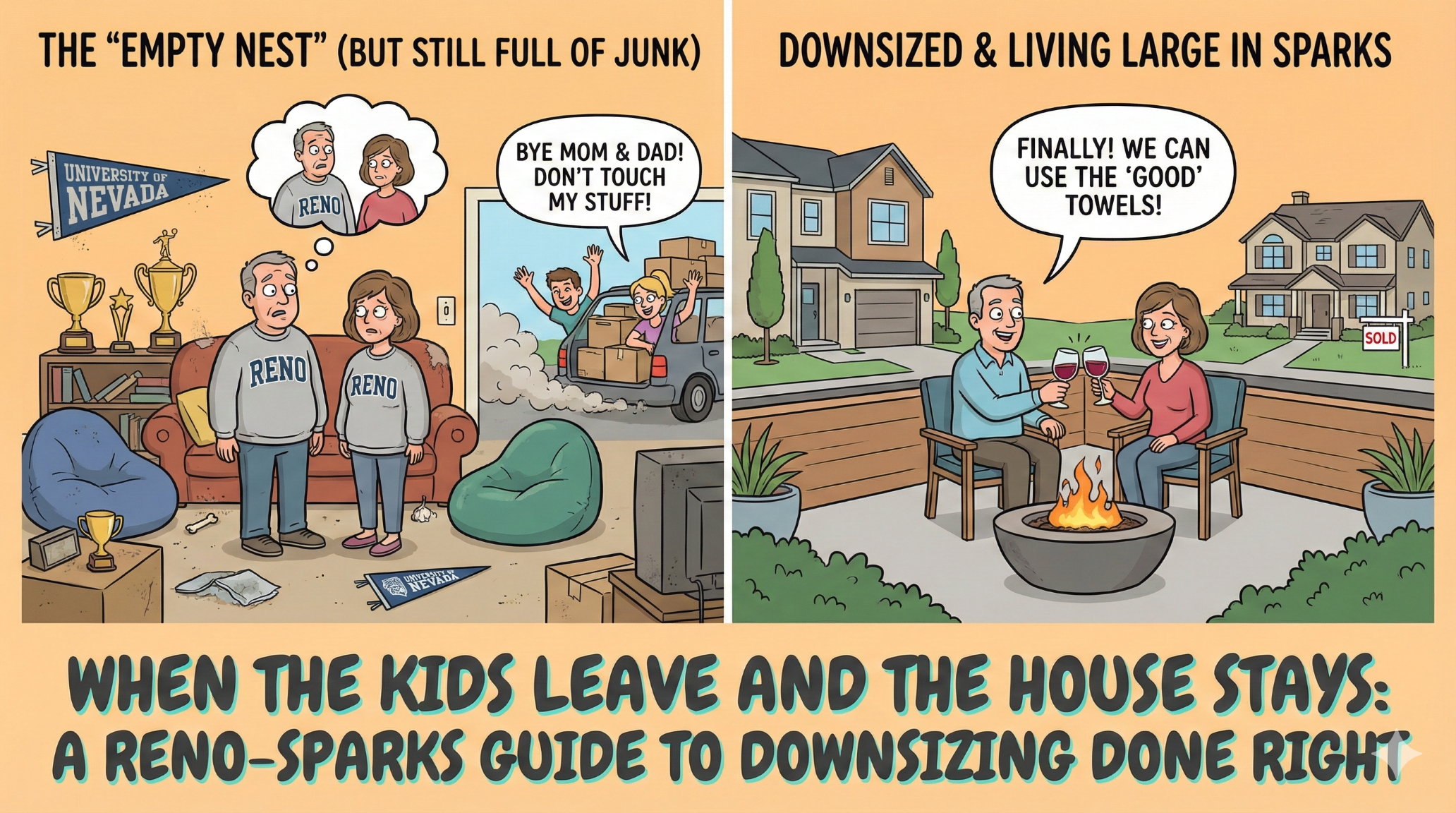
You raised your family in that house. The bedrooms that once overflowed with toys and teenage drama now sit quiet. The backyard where soccer practices happened hasn't seen a kickball in years. And every month, you're still paying to heat, cool, clean, and maintain square footage nobody uses.
If this sounds familiar, you're not alone — and you're definitely not stuck.
According to the 2025 NAR Home Buyers and Sellers Generational Trends Report, baby boomers now make up 53% of all home sellers nationwide. That's the largest share of any generation. The reasons they're selling? Moving closer to friends and family, retirement, and — perhaps most commonly — their homes are simply too large for their current lives.
Here's what makes this moment particularly interesting for Reno-Sparks empty nesters: you likely have far more options than you realize. The equity you've built, combined with a market that still rewards well-prepared sellers, means downsizing doesn't have to feel like a compromise. It can feel like freedom.
Let's walk through what that actually looks like.
The Numbers Behind the Decision
The typical older boomer in NAR's study owned their home for 16 years before selling. Sixteen years of mortgage payments. Sixteen years of appreciation. In a market like Reno-Sparks, where the median sale price hit $549,000 in December 2025 — up 5.2% from a year ago — that timeline translates to substantial equity.
Just how substantial? Nationally, the average mortgaged homeowner now sits on approximately $299,000 in equity, according to Cotality's Q3 2025 Homeowner Equity Report. For long-term Reno homeowners who bought before the pandemic surge, that number could be significantly higher. If you purchased a home in Somersett or Caughlin Ranch twelve years ago, you've likely watched your property value more than double.
This equity changes the math on everything.
Nearly half of older boomers — those aged 70 to 78 — are purchasing their next homes entirely with cash. No mortgage applications. No rate anxiety. No monthly payments. Among younger boomers (ages 60 to 69), 39% are doing the same. When Jessica Lautz, NAR's deputy chief economist, analyzed the data, she noted that boomers have "overtaken millennials — the largest U.S. population — to become the top generation of home buyers." The reason? They're flexing their equity.
For Reno-Sparks homeowners specifically, this creates an interesting dynamic. You may have a 3% mortgage rate that feels impossible to give up. We've written before about when your 3% mortgage rate isn't worth keeping, and the core insight applies here: if you can purchase your next home with cash or a substantial down payment, the rate you're leaving behind matters far less than you think.
Consider a scenario: You sell your $750,000 Caughlin Ranch home with $500,000 in equity. You purchase a $450,000 single-story in Northwest Reno or a low-maintenance townhome in Spanish Springs. You pay cash. Your monthly housing costs drop to property taxes, insurance, and HOA fees — perhaps $600 to $800 per month total, compared to the $2,500 or more you were paying before.
That's not downsizing. That's upgrading your financial life.
Why Reno-Sparks Empty Nesters Hold the Cards
The Reno-Sparks market has characteristics that work particularly well for sellers in your position.
First, you own the kind of homes buyers want. The 2026 Reno-Sparks Housing Market Outlook shows continued demand from well-qualified buyers — particularly California relocators bringing substantial equity from Bay Area or Southern California sales. These buyers are looking for established neighborhoods with good schools, mature landscaping, and move-in-ready condition. Your 15-year-old Damonte Ranch home with the upgraded kitchen and the backyard that's actually been maintained? That's exactly what they're searching for.
Second, you have time on your side. Unlike sellers who must move quickly for job relocations or financial pressure, empty nesters can be strategic. You can prepare your home properly, choose your listing window deliberately, and wait for the right buyer rather than accepting the first offer. In a market where homes are averaging 66 days on market, patience is an asset.
Third — and this matters more than most people realize — you have emotional clarity. The biggest obstacle for many sellers isn't the market or the logistics. It's the attachment. But when your kids have built their own lives elsewhere and the house feels more like a museum of memories than a functional home, the emotional calculus shifts. You're not abandoning the past. You're making space for what comes next.
The Five Ds — And Where Downsizing Fits
In our work with Reno-Sparks sellers, we've identified five life circumstances that consistently override rate considerations and market timing concerns. We call them The 5 Ds: Diplomas, Diapers, Divorce, Downsizing, and Death.
Downsizing sits in the middle of that list for a reason. It's rarely urgent in the way divorce or job relocation can be. But it's also not something you want to delay indefinitely.
Here's what NAR found when they surveyed boomer homeowners who say they "never plan to sell": 57% admitted that a serious health issue could force them to reconsider. Another 39% said their home becoming too difficult to maintain could change their minds. In other words, the people who insist they'll never sell are often just one fall, one hip replacement, or one winter of snow shoveling away from suddenly needing to move under pressure.
The smart play is to downsize while you can be strategic about it — while you have time to prepare your home, interview agents, and find the right next property. Selling from a position of strength always yields better results than selling from necessity.
What Downsizers in Reno-Sparks Are Actually Buying
NAR's data shows that about 30% of boomer buyers purchased newly built homes, attracted by the idea of avoiding renovations and having the ability to customize features. In Reno-Sparks, that might mean a new single-story in Kiley Ranch or a contemporary townhome in one of the newer Spanish Springs developments.
But new construction isn't the only path. Many downsizers in our market are moving to:
Established single-story homes in Northwest Reno or Southwest Reno — neighborhoods with decades of mature trees, walkable streets, and no stairs to navigate as mobility becomes a consideration.
Townhomes and condos in communities like Arrowcreek or Double Diamond — where exterior maintenance is handled by the HOA, freeing up time for travel or hobbies.
Senior-focused communities — NAR reports that about 20% of buyers over 60 purchased senior-related housing. In the Reno-Sparks area, options range from active adult communities to continuing care arrangements.
Smaller single-family homes in the same neighborhood — sometimes the best move is staying in Somersett but trading the 3,200-square-foot home for the 1,800-square-foot model down the street.
The common thread isn't the specific property type. It's the shift in priorities: less maintenance, lower carrying costs, and a home that fits your actual life rather than the life you lived a decade ago.
The Psychology of Letting Go
We'd be doing you a disservice if we pretended this was purely a financial decision. It's not.
NAR found that 86% of boomer homeowners with plans to sell have concerns about the process. The top worry, cited by 55%, is the time and effort required to move. That's not irrational — a household accumulated over 15 or 20 years has a lot of stuff, and sorting through it is emotionally exhausting.
Another 36% worry about finding an affordable replacement home, and the same percentage worry about finding a home that meets their needs. These concerns are valid, but they're also solvable with proper planning.
The timeline matters here. Professional organizers consistently recommend starting the decluttering process 12 to 18 months before you plan to list. That sounds aggressive, but it gives you time to thoughtfully sort through belongings, host a moving sale for larger items, and avoid the panic of trying to pack a lifetime into two frantic weeks.
When we work with empty nesters preparing to sell, we encourage them to approach staging strategically — and that process naturally begins with removing excess furniture and personal items. The same steps that make your home more appealing to buyers also make it easier for you to pack and move.
Making the Financial Case Concrete
Let's run some real numbers using current Reno-Sparks market conditions.
Scenario: The Damonte Ranch Downsize
You own a 2,800-square-foot home in Damonte Ranch, purchased in 2012 for $385,000. Current estimated value: $725,000. Remaining mortgage: $180,000. Your equity position: approximately $545,000.
You sell, netting roughly $490,000 after commissions, closing costs, and preparation expenses. You purchase a 1,600-square-foot single-story in Northwest Reno for $475,000, paying cash. You pocket $15,000 and eliminate your monthly mortgage payment entirely.
Your previous monthly housing costs: $1,850 (mortgage) + $450 (property taxes) + $200 (insurance) + $350 (utilities) + $200 (maintenance) = approximately $3,050.
Your new monthly housing costs: $375 (property taxes) + $150 (insurance) + $250 (utilities) + $150 (maintenance) = approximately $925.
Annual savings: roughly $25,500.
Over ten years, that's $255,000 in reduced housing costs — money available for travel, helping grandchildren, or simply enjoying a more comfortable retirement.
Scenario: The Somersett to Townhome Transition
You own a 3,500-square-foot home in Somersett, purchased in 2008 for $520,000. Current estimated value: $950,000. Remaining mortgage: $125,000. Your equity: approximately $825,000.
You sell, netting roughly $745,000 after costs. You purchase a $525,000 townhome in a community with HOA-maintained grounds. You pay cash and invest the remaining $220,000.
Your monthly housing costs drop from approximately $4,200 to approximately $1,100 (including a $400 HOA fee that covers landscaping and exterior maintenance). The $220,000 invested conservatively at 4% generates an additional $8,800 annually.
You've gone from spending money to effectively earning money — all while living in a property that requires less work.
When Is the Right Time?
The honest answer: before you have to.
The NAR data showing that 57% of "never sellers" would reconsider for health reasons isn't abstract. Every real estate professional has worked with families who waited too long, found themselves in a crisis situation, and had to sell under pressure. The outcomes are consistently worse — lower sale prices, rushed timelines, and decisions made reactively rather than strategically.
The 2026 market outlook suggests continued stability in Reno-Sparks, with steady appreciation and sustained buyer demand. That's a favorable environment for sellers who want to take their time and do things right.
Spring and early summer traditionally bring the most buyer activity, meaning a listing in March through June typically attracts more eyes and potentially stronger offers. But well-priced, well-prepared homes sell year-round in Reno-Sparks — and if your timeline suggests listing in fall or winter, that's not a reason to delay. It's simply a reason to price accordingly.
What Happens Next
If you're starting to think seriously about downsizing, here's a framework that works well for most Reno-Sparks empty nesters:
12-18 months out: Begin decluttering one room at a time. Identify items with sentimental value versus items you're keeping out of inertia. Research where you might want to live next — visit neighborhoods, tour properties, understand your options.
6-12 months out: Have a strategic conversation with a listing agent about your home's current condition, what preparation would have the highest ROI, and realistic pricing expectations. Start any necessary repairs or improvements.
3-6 months out: Finalize your next home selection. Coordinate timelines so you're not scrambling to move twice or carrying two properties simultaneously. Complete staging and professional photography.
Listing to close: Execute with confidence, knowing you've prepared thoroughly and positioned yourself for the strongest possible outcome.
This isn't the only way to do it. Some sellers move faster; others take longer. The key is matching your timeline to your circumstances rather than rushing because you "should" or waiting because moving feels overwhelming.
The K&R Approach to Empty Nester Transitions
Every seller's situation is different, and we've learned to ask questions before making assumptions. How long have you been in your current home? What's driving the conversation now — is it practical, financial, emotional, or some combination? Where are your adult children, and does proximity to them matter? What does your ideal next chapter actually look like?
Choosing the right listing agent matters especially for empty nesters, because the stakes are high and the process is personal. You're not just selling a property. You're closing a chapter that spans decades of family life. That deserves thoughtful, strategic representation — not a transactional approach that treats your home like inventory to move.
Robin has two decades of experience in Reno-Sparks real estate and handles the operational coordination that keeps complex transactions on track. Kevin focuses on pricing strategy, buyer negotiations, and on-site execution. Together, we've helped numerous empty nesters navigate this transition — from the initial "what if" conversation through closing day and beyond.
If you're considering a strategic downsize and want to understand what your options actually look like, we'd welcome the chance to talk through your situation. No pressure, no pitch — just a thoughtful conversation about your goals and the market realities that shape them.
Contact Kevin Kinney at 775-391-8402 or Robin Renwick at 775-813-1255.
FAQs: Empty Nester Downsizing in Reno-Sparks
How much equity do most Reno-Sparks homeowners have after 15-20 years? It varies significantly by neighborhood and purchase timing, but long-term Reno-Sparks homeowners commonly have $300,000 to $600,000 or more in equity. Nationally, the average mortgaged homeowner holds approximately $299,000 in equity as of Q3 2025. Many local empty nesters who purchased before 2015 have substantially exceeded this average due to significant appreciation in neighborhoods like Somersett, Caughlin Ranch, and Damonte Ranch.
Can I really buy my next home with cash if I sell my current home? Many can. NAR's 2025 data shows that nearly half of older boomers (ages 70-78) and 39% of younger boomers (ages 60-69) are purchasing homes entirely with cash. If you're selling an $800,000 home and purchasing a $450,000 townhome, the equity difference often covers the full purchase price plus moving costs.
What percentage of home sellers are downsizing? NAR reports that 17% of all homebuyers in their 2025 study moved into smaller homes. Among sellers aged 79-99, downsizing was the most common reason for selling. Baby boomers (ages 60-78) frequently cite "home too large" as a primary motivation.
Should I sell before finding my next home, or buy first? This depends on your financial situation and risk tolerance. Sellers with substantial equity often prefer to secure their next property first, using a home equity line of credit or bridge financing for the down payment, then paying off that balance when their current home sells. Others prefer the certainty of selling first and renting temporarily if needed. We can walk through the pros and cons for your specific circumstances.
What neighborhoods in Reno-Sparks are popular for downsizers? Northwest Reno and Southwest Reno attract empty nesters seeking established single-story homes. Spanish Springs and Kiley Ranch offer newer townhome options. Active adult communities provide maintenance-free living for those who prioritize simplicity. Many Somersett residents downsize within Somersett itself, moving from larger estate homes to smaller models in the same community.
How long should I plan for the downsizing process? Professional organizers recommend 12-18 months for thorough decluttering before listing. The actual sale process typically takes 2-3 months from listing to closing in the current Reno-Sparks market, where homes average 66 days on market. Add time for finding and closing on your next property, and 18-24 months from initial planning to settled in your new home is realistic for a stress-minimized transition.
Will downsizing affect my property taxes in Nevada? Potentially yes, in your favor. Nevada has no state income tax, and property taxes are based on assessed value. Moving from an $800,000 home to a $450,000 home reduces your tax basis proportionally. Additionally, Nevada offers property tax exemptions for seniors (65+) and veterans that may apply to your new property.
What if I have a 3% mortgage rate — does it ever make sense to give that up? Yes, especially when downsizing. If you sell a $750,000 home and purchase a $450,000 home with cash, you eliminate mortgage payments entirely — making your old rate irrelevant. Even if you finance part of the new purchase, your loan amount will be dramatically smaller, meaning the absolute dollar impact of a higher rate is far less than staying in your current oversized home.
Check out this article next