
Disclaimer: Market data referenced in this article is sourced from the National Association of Realtors® (NAR), Redfin, and other verified sources as noted. Real estate outcomes vary by property, condition, location, and market timing. This content is for informational purposes and does not guarantee specific results.
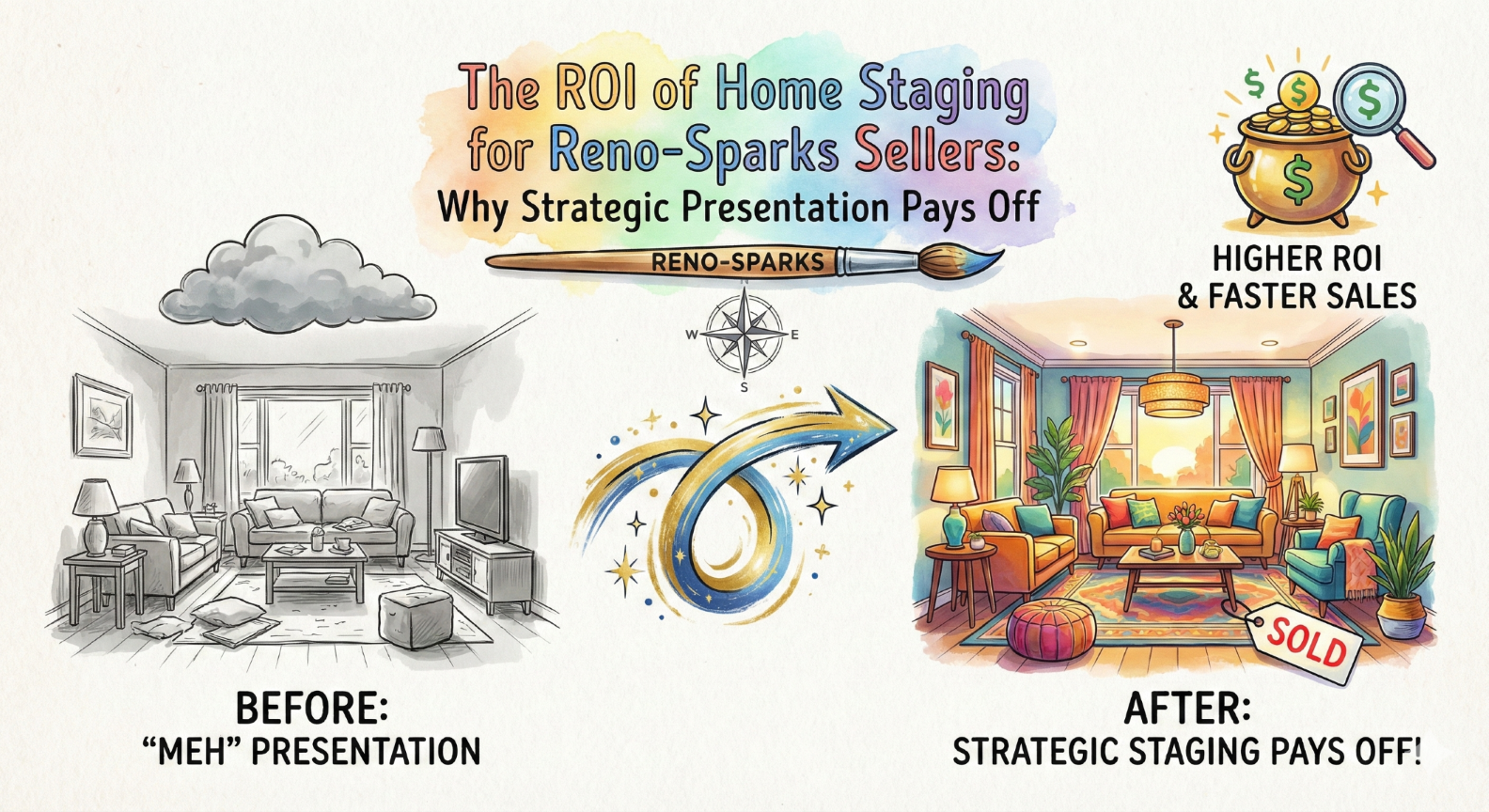
There is a moment in every home sale when a property stops being someone's home and starts being a product on the market. How that transition happens — how deliberately and strategically a home is presented to buyers — can mean the difference between a strong opening weekend and weeks of silence followed by a price reduction. In Reno-Sparks, where the median sale price reached $549,000 in December 2025 and homes are averaging 66 days on market, the financial stakes of presentation are not abstract. They are measured in tens of thousands of dollars. Home staging — the professional practice of furnishing and styling a property to maximize buyer appeal — is one of the most consistently underutilized tools in a serious seller's strategy. And the data behind it is more compelling than most sellers realize.
What the National Data Actually Says About Staging ROI
The National Association of Realtors® released its 2025 Profile of Home Staging in May 2025, surveying over 1,200 active real estate professionals across the country. The findings put hard numbers behind what experienced listing agents have observed for years.
Nearly three out of ten agents reported that staging their sellers' homes led to a 1% to 10% increase in the dollar value offered by buyers. Broken down further, 19% of sellers' agents saw a 1% to 5% increase compared to similar unstaged homes, while another 10% reported a 6% to 10% jump in offers they directly attributed to staging. On a Reno-area home listed at $549,000, a 1% increase represents roughly $5,500 in additional value. A 5% increase translates to approximately $27,500. At the higher end of that range, a 10% staging-driven increase would mean nearly $55,000 in additional value — all from a strategic investment that typically costs a fraction of that amount.
Beyond price, staging also affects the speed of sale. According to the same NAR report, 49% of home sellers' agents observed that staging reduced the time their listings spent on the market, with 30% noting a slight decrease and 19% reporting a significant reduction. In a market where Reno homes are averaging 66 days on market, reducing that timeline by even two to three weeks can save sellers thousands in carrying costs — mortgage payments, insurance, utilities, HOA dues, and the accumulated stress of a listing that lingers.
Perhaps the most telling statistic for sellers considering whether staging is worth the investment: 83% of buyers' real estate agents said that staging made it easier for a buyer to envision the property as their future home. That single data point captures the entire psychology of why staging works. Buyers do not purchase square footage and roof lines. They purchase the feeling of walking into a space that already feels like theirs.
Why Vacant Homes Need Staging Most — And What Reno Buyers Actually See
If you have ever walked through an empty house, you understand the challenge. Rooms feel smaller than they are. Odd angles become more pronounced. Buyers struggle to gauge whether their furniture will fit, whether the living room can handle a sectional, whether the primary bedroom is large enough for a king bed and nightstands. Without visual anchors, buyers focus on flaws — the scuff on the baseboard, the dated light fixture, the crack in the ceiling — instead of imagining the life they could build in that space.
This is not speculation. The NAR 2025 staging report found that 31% of buyers were more willing to walk through a home they first saw online when it was staged. In a market where listing photos are the first — and often only — impression a property makes, vacant rooms photographed with nothing but bare walls and empty floors create a visual disadvantage that no amount of pricing strategy can fully overcome.
And buyer expectations are rising. The same NAR report found that 48% of agents said home buyers now expect properties to look like the staged homes they see on television, and 58% reported that buyers were disappointed when homes did not meet those TV-influenced expectations. Whether that standard is fair or not, it is the reality of how today's buyers evaluate properties. Sellers who acknowledge that reality and prepare accordingly are the ones who sell faster and for stronger prices.
In Reno-Sparks specifically, vacant properties face an added consideration. Many of the buyers actively searching in neighborhoods like Somersett, Damonte Ranch, Caughlin Ranch, and Rancharrah are relocating from out of state — often from California, Washington, or Oregon. These buyers are frequently touring homes on tight weekend trips, evaluating three to five properties in a single day. A staged home creates an immediate emotional impression that an empty one simply cannot match. When a relocating buyer walks into a professionally styled living room with mountain-view-oriented furniture placement and warm, neutral tones, they stop comparing and start envisioning. That shift is where offers originate.
The "Heart of the Home" Approach: Strategic Staging Without Overspending
One of the most common objections sellers raise about staging is cost. And it is a fair concern — staging an entire home with rental furniture can run anywhere from $2,000 to $5,000 or more, depending on the property's size and the scope of the project. The NAR 2025 report found that the median cost for a staging service was $1,500 nationally.
But strategic staging does not require furnishing every room. The most effective approach focuses on what experienced stagers call the "Heart of the Home" — the living room, kitchen, and primary bedroom and bath. These are the spaces where buyers form their strongest emotional impressions and where the NAR data shows staging has the greatest impact.
According to the 2025 NAR report, the rooms most commonly staged by sellers' agents were the living room (91%), primary bedroom (83%), dining room (69%), and kitchen (68%). On the buyer side, the living room was considered the most important room to stage (37%), followed by the primary bedroom (34%) and kitchen (23%). Guest bedrooms and children's rooms ranked lowest in importance at just 7% and 22% respectively.
What this means for Reno-Sparks sellers is clear: you do not need to stage every room to capture the ROI. A targeted approach — staging the living room, kitchen area, and primary suite — delivers the psychological impact buyers need while keeping the investment focused and manageable. For a typical vacant Reno home, this kind of strategic staging might cost $2,000 to $4,000, depending on the stager's inventory and the property's size.
Now run the math on a $549,000 home. If staging produces even a 1% increase in the offer price — a conservative estimate given the NAR data — that is approximately $5,500 in additional value against a $2,000 to $4,000 investment. At a 5% increase, you are looking at roughly $27,500 in additional value. The return on investment is not marginal. It is substantial.
For sellers in upper-mid to luxury price points — homes in the $700,000 to $1 million range common in Southwest Reno, Somersett, and ArrowCreek — the numbers scale even further. A 5% staging-driven increase on a $800,000 home represents $40,000 in additional value. That is the kind of return that makes staging not just a nice-to-have but a strategic imperative.
What Makes a Good Stager — And Why the Right Partnership Matters
Staging is not interior decorating. It is not about personal taste or creating a space that reflects the seller's style. It is about creating a neutral, aspirational environment that allows the broadest possible range of buyers to see themselves in the home. That distinction matters enormously, and it is why choosing the right stager is a decision that deserves the same care as choosing the right listing agent.
A skilled stager brings two essential assets to the table: design talent and physical inventory. The talent side involves understanding current buyer preferences, knowing how to scale furniture to room proportions, and creating visual flow that draws buyers through the home rather than leaving them stranded in the entryway. The inventory side is equally critical — a stager needs access to quality furniture, artwork, textiles, and accessories that match the home's style, price point, and target buyer demographic. A mid-century modern staging package does not belong in a traditional Caughlin Ranch home, and vice versa.
This is where having a listing team with established stager relationships adds genuine value. When your agent already has a working partnership with a trusted local stager — someone with proven results in the Reno-Sparks market and the inventory to match — the entire process moves faster and more efficiently. The stager understands the market, knows what Reno buyers respond to, and can coordinate the staging timeline seamlessly within the broader listing preparation process.
At the Kinney & Renwick Team, staging coordination is one of the areas where our two-pronged structure creates a real advantage for sellers. Robin Renwick, our Operational Anchor with over 20 years of Reno-Sparks experience, handles the initial stager meeting and coordinates the entire staging process — from the walkthrough to delivery and setup. Robin knows the local stagers, knows which vendors deliver consistent quality, and knows what resonates with buyers in specific Reno neighborhoods. That local knowledge matters. What works in a Spanish Springs ranch home is different from what works in a Rancharrah luxury listing. A stager recommended by someone who has spent two decades in this market is fundamentally different from one found through a random internet search.
Once the home is staged and live on the market, Kevin Kinney steps into the on-site execution role — handling showings, price positioning, and direct negotiations. The staging creates the visual foundation. The strategic marketing and negotiation build on that foundation to generate the strongest possible outcome.
The seller always has the final choice on which stager to use. But having a trusted recommendation — backed by a track record of successful Reno-Sparks listings — removes one of the biggest variables from the equation. Staging is ultimately about trusting someone who has both the talent to envision how a space should look and the inventory to make that vision real.
When Staging Makes the Difference: A Reno Example
Sometimes the data tells the story in percentages, and sometimes a single property tells it more clearly. A home in Rancharrah — one of Reno's most desirable gated communities in the heart of south Reno — sat vacant on the market without generating the buyer interest the property deserved. The home itself was well-built in a strong location. But empty rooms do not sell themselves, even in a sought-after neighborhood.
The seller made the decision to bring in a professional stager. The transformation was significant — not because the home needed fixing, but because it needed context. Buyers who had scrolled past the listing with empty-room photos now saw a home that felt finished, warm, and move-in ready. The property sold after staging.
This is not an unusual outcome. It is exactly what the NAR data predicts. Nearly half of sellers' agents report that staging reduces time on market. One in three buyers' agents say their clients are more likely to schedule a showing after seeing staged photos online. When you combine those dynamics with a competitive market where 41% of Reno-Sparks listings receive at least one price reduction before selling, staging becomes less of an optional upgrade and more of a strategic defense against the single most costly outcome in real estate: sitting.
A home that sits accumulates costs. Every month on market represents another mortgage payment, another round of utilities, another month of insurance and HOA dues. It also accumulates perception damage — buyers begin to wonder what is wrong with a listing that has been active for 90 or 120 days. By the time a price reduction comes, the seller has already lost leverage. Staging, in this context, is not an expense. It is insurance against a far more expensive alternative.
The Occupied Home Consideration
Not every home that benefits from staging is vacant. Occupied homes present a different set of challenges and opportunities. The most common approach for occupied properties involves working with the homeowner's existing furniture — rearranging, editing, and supplementing with select professional pieces to improve the overall presentation.
However, this approach works best when the seller's existing furniture is in good condition and complements the home's style and scale. A stager may occasionally use the homeowner's own pieces and supplement with items from their own inventory, but this is generally not the preferred method. The reason is practical: professional staging furniture is selected specifically for photographic appeal, neutral aesthetics, and proper scale. Personal furniture, no matter how nice, carries the owner's taste and history in ways that can limit a buyer's ability to project their own life onto the space.
For most Reno-Sparks sellers in the upper-mid to luxury price points, the strongest staging results come from vacant properties staged with professional inventory. This is particularly true for homes in neighborhoods like Damonte Ranch, Southwest Reno, Double Diamond, and Somersett, where buyers at the $550,000 to $900,000+ range have high expectations and are comparing your property against other well-presented listings.
The NAR report reinforces this: 51% of sellers' agents did not stage homes but recommended sellers declutter or correct property faults. Only 21% staged all their sellers' homes before listing. What this tells sophisticated sellers is that staging remains a genuine competitive advantage — most of the properties you are competing against are not staged. By investing in professional presentation, you are immediately differentiating your listing from the majority of the market.
The Tax Deductibility Factor Sellers Often Miss
Here is a detail that makes the staging investment even more attractive: staging costs are generally tax deductible when the home sells. The IRS typically classifies staging as an advertising expense, which can be deducted from the capital gains on the sale. Combined with Nevada's lack of state income tax, this means Reno-Sparks sellers may be able to recover a meaningful portion of their staging investment through tax benefits.
This does not constitute tax advice — sellers should absolutely consult their tax professional for guidance specific to their situation. But it is worth knowing that the effective cost of staging, after potential deductions, may be lower than the initial price tag suggests.
How Staging Fits Into a Complete Listing Strategy
Staging does not operate in isolation. It is one component of a comprehensive listing preparation strategy that includes pricing, photography, marketing, and choosing the right listing agent to execute the plan. The most effective staging results come when all of these elements work together.
The sequence matters. Preparation and repairs come first — addressing deferred maintenance, freshening paint in key areas, ensuring landscaping is clean and inviting. Then staging transforms the prepared space into a buyer-ready product. Then professional photography captures the staged home in its best light. Then strategic marketing puts those images in front of the right buyers — particularly well-qualified relocators from California, Washington, and Oregon who are actively searching for Reno-Sparks properties and often making decisions based heavily on online presentation.
This is why staging decisions benefit from being made as part of the listing strategy, not as an afterthought. When your listing team understands the target buyer, the competitive landscape in your specific neighborhood, and the optimal timing for your market, staging becomes a precision tool rather than a generic recommendation.
What This Means for Serious Reno-Sparks Sellers
The evidence is clear and consistent: professionally staged homes sell faster and for more money than their unstaged counterparts. The NAR 2025 data, the Reno-Sparks market dynamics, and the practical experience of listing hundreds of properties all point to the same conclusion — staging is one of the highest-return investments a seller can make in their listing preparation.
For sellers in Spanish Springs, Northwest Reno, Midtown, or any of the neighborhoods across the Reno-Sparks market, the question is not whether staging adds value. The data has answered that decisively. The question is whether you are working with a listing team that understands how to deploy staging strategically — selecting the right stager, targeting the right rooms, coordinating the timeline with your broader listing preparation, and then leveraging that staged presentation through professional photography and targeted marketing.
If you are considering a strategic sale of a quality Reno-Sparks property, we are happy to have a thoughtful conversation about your goals — including whether staging makes sense for your specific home, neighborhood, and timeline. Contact Kevin Kinney at 775-391-8402 or Robin Renwick at 775-813-1255.
Frequently Asked Questions
How much does it cost to stage a home in Reno-Sparks? Professional staging for a vacant Reno-Sparks home typically costs between $2,000 and $5,000, depending on the home's size and the number of rooms staged. The NAR 2025 Profile of Home Staging found the national median cost for a staging service was $1,500. A "Heart of the Home" approach — staging the living room, kitchen, and primary bedroom — keeps costs focused on the rooms that matter most to buyers while maximizing the return on your investment.
Does staging actually help sell a home faster in Reno? According to the NAR 2025 Profile of Home Staging, 49% of sellers' agents observed that staging reduced the time their listings spent on the market. In a Reno market where homes are averaging 66 days on market, reducing that timeline can save sellers significant carrying costs in mortgage payments, utilities, insurance, and HOA dues — not to mention the psychological toll of a listing that sits.
What rooms should I stage to get the best ROI? The NAR data is clear: the living room, primary bedroom, and kitchen are the highest-impact rooms. Buyers ranked the living room as the most important staged space (37%), followed by the primary bedroom (34%) and kitchen (23%). Guest bedrooms and children's rooms had the least impact. Focus your staging investment on the spaces where buyers form their strongest emotional impressions.
Is staging worth it for a Reno home priced at $500,000 to $700,000? Absolutely. On a $600,000 Reno home, even a conservative 1% staging-driven increase in offer price represents $6,000 in additional value against a typical $2,000 to $4,000 staging investment. At 5%, that number climbs to $30,000. The NAR found that 29% of agents reported staging produced a 1% to 10% increase in the dollar value offered — making the potential return substantial at this price point.
Should I stage an occupied home or wait until it is vacant? Both approaches can work, but the strongest results typically come from staging vacant homes with professional inventory. Stagers can occasionally work with a homeowner's existing furniture if it complements the home's style, but professional staging furniture is selected specifically for broad buyer appeal, photographic quality, and proper scale. Your listing agent and stager can advise on the best approach for your specific situation.
Who pays for staging when selling a home in Reno? In most Reno-Sparks transactions, the seller covers the cost of staging as part of their listing preparation investment. According to the NAR 2025 report, 17% of sellers' agents said the seller pays for staging directly, while 26% said it depends on the situation. Some agents personally offer staging services, while others recommend professional stagers. The key is treating staging as a strategic investment with measurable returns, not just an optional expense.
Can home staging costs be deducted from taxes in Nevada? Staging costs are generally considered an advertising or selling expense by the IRS, which means they may be deductible from your capital gains when the home sells. Combined with Nevada's zero state income tax, this can make the effective cost of staging even lower. However, tax situations vary — always consult your tax professional for guidance specific to your circumstances.
How does staging affect online listing photos for Reno-Sparks homes? Online photos are the first impression most buyers have of your property, and staged homes photograph dramatically better than empty ones. The NAR 2025 report found that 73% of buyers' agents said photos were highly important to their clients, and 31% of buyers said they were more willing to walk through a staged home they saw online. In a market where out-of-state relocators are often evaluating properties from California, Oregon, or Washington before visiting in person, staged photography can be the difference between a showing request and a scroll-past.
Check out this article next