

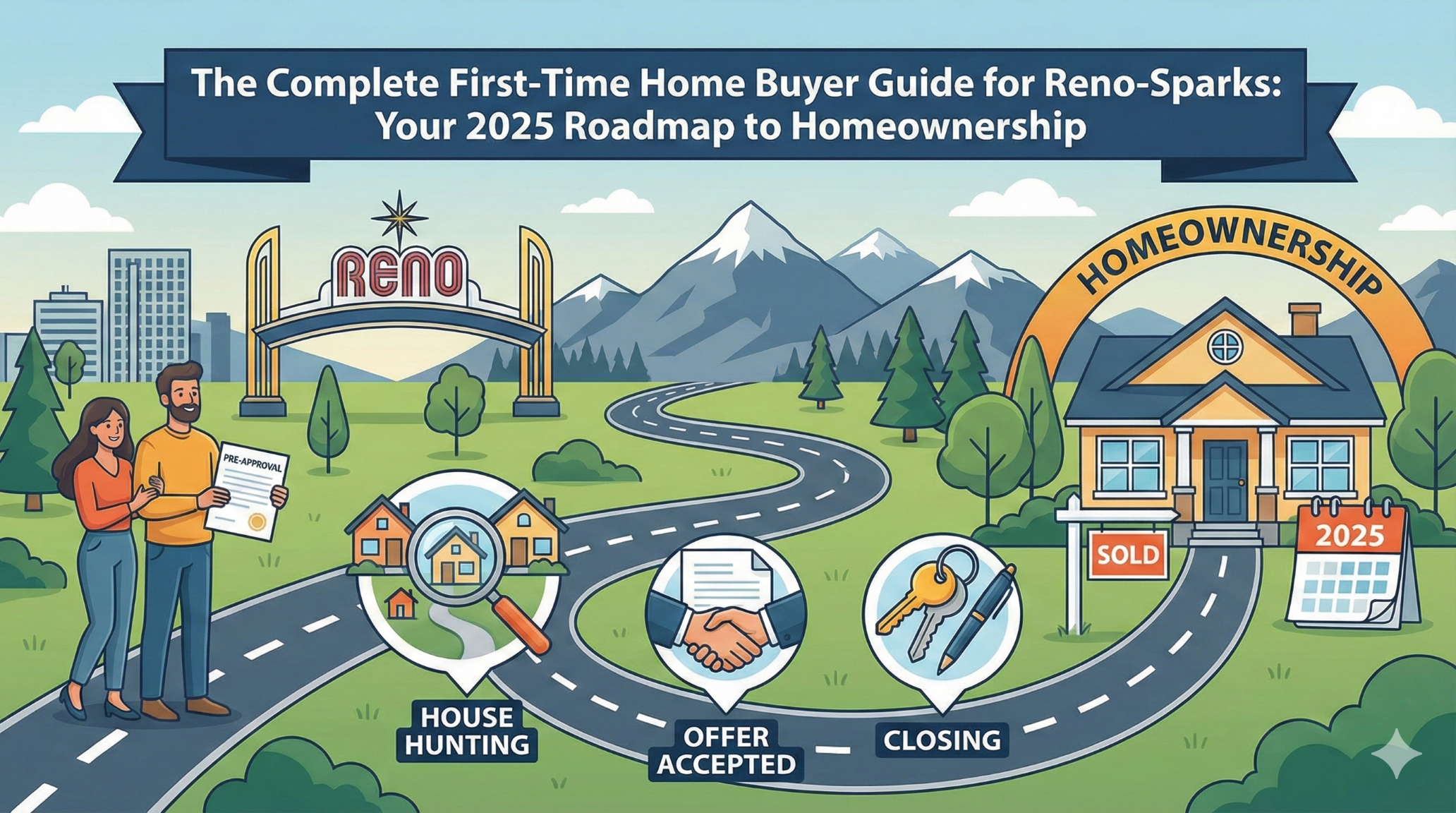
Buying your first home in Reno-Sparks isn't like buying anywhere else in the country.
You're navigating a market where median prices typically hover around $545,000-$600,000 depending on the neighborhood. Where California relocators with cash offers compete alongside local first-time buyers stretching their budgets. Where down payment assistance programs can save you $10,000-$30,000 but require specific knowledge to access. Where neighborhoods 15 minutes apart—Damonte Ranch versus Sun Valley, Somersett versus Lemmon Valley—offer dramatically different price points, lifestyles, and long-term value propositions.
After nearly 20 years helping first-time buyers successfully navigate this market, we've distilled the process into this comprehensive guide. This isn't generic national advice repackaged for Nevada. This is the exact roadmap our clients use to go from "overwhelmed renter" to "confident homeowner"—with specific programs, realistic budgets, neighborhood recommendations by price range, and strategic timing for the current market.
If you're ready to stop renting and start building equity in Northern Nevada, here's everything you need to know.
Important Disclaimer: This guide reflects market conditions, program details, and pricing information current as of December 2025. Real estate markets change continuously—specific home prices, interest rates, program availability, income limits, and neighborhood characteristics may differ at the time you're reading this. Median prices and cost examples are illustrative based on recent market data and typical scenarios. Always verify current information with licensed real estate professionals, mortgage lenders, and program administrators before making decisions. This guide is educational and should not be considered financial, legal, or investment advice.
Step 1: Understand What "First-Time Buyer" Actually Means (And What It Unlocks)
In Nevada, you're considered a first-time home buyer if you haven't owned a home in the past three years. This definition matters because it unlocks access to powerful assistance programs that can dramatically reduce your upfront costs.
What first-time buyer status gets you:
Home Is Possible program: Up to 4% of your loan amount (that's potentially $24,000 on a $600,000 home) toward down payment and closing costs. The assistance comes as a forgivable second mortgage at 0% interest—meaning if you stay in the home for three years, you typically never have to repay it.
Home First program: Up to $15,000 in down payment assistance, also typically forgivable after three years. Requires six months of Nevada residency.
FHA loans with 3.5% down: Federal Housing Administration loans allow you to buy with just 3.5% down if your credit score is 580 or higher. On a $550,000 Reno-Sparks home, that's approximately $19,250 down instead of the $110,000 that 20% would require.
Important clarifications:
"Three years" means exactly that—not "I haven't owned a home in a while." If you sold a home 2 years and 11 months ago, you don't qualify yet. Wait one more month.
Veterans are often exempt from first-time buyer requirements for many programs, even if you've owned homes previously.
If your spouse owned a home in the past three years but you didn't, you may not qualify for some programs—lender-specific, so ask upfront.
Why this matters: These programs can be the difference between "I need to save $60,000-120,000 for a down payment" and "I need to save $10,000-25,000." They're potentially the difference between renting for another 3-5 years and buying within the next year.
Program availability note: Down payment assistance programs have funding limits and requirements that change. Visit HomeIsPossibleNV.org or contact Nevada Housing Division approved lenders for current program status, funding availability, and specific eligibility requirements.
Step 2: Get Your Credit Score Ready (And Know the Exact Requirements)
Your credit score determines everything: whether you qualify for a mortgage, which programs you can access, and what interest rate you'll pay. In Reno-Sparks, where a 1% difference in interest rate can cost you approximately $350/month on a $600,000 home, your credit score literally affects thousands in annual costs.
Typical Nevada first-time buyer program credit requirements (as of December 2025—verify current requirements with lenders):
| Program | Typical Minimum Credit Score | What It Generally Offers |
|---|---|---|
| Home Is Possible | 640 (660 for government loans, 680 for manufactured homes) | Up to 4% down payment assistance, typically forgivable after 3 years |
| Home First | 660 | Up to $15,000 down payment assistance, typically forgivable after 3 years |
| FHA Loans | 580 for 3.5% down / 500 for 10% down | Low down payment option, more flexible credit requirements |
| Conventional Loans | 620 minimum (660+ for better rates) | Standard financing, best rates typically at 720+ |
| VA Loans | No official minimum (lenders typically want 620+) | $0 down for eligible veterans and active military |
| USDA Loans | 640 | $0 down for eligible rural properties |
The credit score tiers that typically matter in Reno-Sparks:
640-659: You may qualify for Home Is Possible and most first-time buyer programs, but your interest rates will typically be higher. On a $600,000 loan, you might pay 7.25-7.5% instead of 6.75% (rates as of December 2025).
660-699: Solid position. You typically qualify for all major programs including Home First. Interest rates generally improve to the 6.75-7.25% range.
700-739: Strong position. You'll generally get competitive rates (approximately 6.5-7%) and lenders will typically view you favorably in multiple-offer situations.
740+: Excellent position. You'll typically get the best available rates (approximately 6.25-6.75% range in the current market) and maximum flexibility.
If your credit score is below 640:
Don't panic—you have options, but you'll need a strategy:
- FHA loans typically accept scores as low as 580 (3.5% down) or 500 (10% down). You may not qualify for Nevada's best assistance programs, but you can still buy.
- Work on improving your score for 3-6 months before applying. Pay down credit card balances to below 30% of limits, dispute any errors on your credit report, and avoid opening new credit accounts.
- Consider a co-borrower with stronger credit (parent, spouse, partner) if your finances otherwise support homeownership.
- Explore manual underwriting through local credit unions that may consider your full financial picture beyond just the credit score.
Action step: Pull your credit report from all three bureaus (Equifax, Experian, TransUnion) at AnnualCreditReport.com. Check for errors—studies suggest approximately 1 in 5 credit reports contain mistakes that can potentially be disputed and corrected.
Step 3: Calculate Your TRUE Buying Budget (Not Just What Lenders Approve)
Lenders will approve you for the maximum amount you can theoretically afford based on debt-to-income ratios. That doesn't mean you should spend that much.
The general guideline for your comfortable budget:
Total monthly housing payment should typically not exceed 28-30% of your gross monthly income.
Total monthly housing payment includes:
- Mortgage principal + interest
- Property taxes (approximately 0.53-0.84% of home value annually in Reno-Sparks)
- Homeowners insurance (approximately $100-250/month depending on wildfire risk and coverage)
- HOA fees if applicable (approximately $150-400/month in master-planned communities)
- Private Mortgage Insurance (PMI) if putting less than 20% down (approximately $100-300/month depending on down payment amount)
Real-world example (using December 2025 market conditions and approximate 7% interest rate):
You earn $90,000/year ($7,500/month gross). Your comfortable housing budget is approximately $2,100-2,250/month based on the 28-30% guideline.
Let's see what that might look like in different Reno-Sparks neighborhoods with 5% down and an approximate 7% interest rate:
Scenario A: $500,000 home in Sun Valley or Lemmon Valley
- Down payment (5%): $25,000
- Loan amount: $475,000
- Approximate monthly mortgage payment (P+I): $3,160
- Estimated property taxes: $330/month
- Estimated insurance: $125/month
- Estimated PMI: $200/month
- Approximate Total: $3,815/month ❌ Over budget
Scenario B: $425,000 home in Sun Valley
- Down payment (5%): $21,250
- Loan amount: $403,750
- Approximate monthly mortgage payment (P+I): $2,685
- Estimated property taxes: $280/month
- Estimated insurance: $110/month
- Estimated PMI: $170/month
- Approximate Total: $3,245/month ❌ Still over budget
The reality: On $90,000/year income, your comfortable price range in Reno-Sparks is typically approximately $350,000-400,000 unless you:
- Increase your down payment significantly (15-20%)
- Have zero other debts (no car payment, student loans, credit cards)
- Choose neighborhoods without HOA fees
- Are willing to stretch to 35% of income (financially risky)
Important note on examples: These examples use approximate interest rates and costs current as of December 2025. Your actual payment will vary based on current rates, your specific credit score, down payment amount, and the specific property taxes/insurance/HOA fees for the home you purchase. Always get personalized payment estimates from your lender based on your specific situation.
This is why many first-time buyers in Reno-Sparks either:
- Look at more affordable areas (Fernley, Dayton: typically $350,000-450,000 median)
- Buy with a partner/co-borrower to combine incomes
- Save longer for a larger down payment
- Consider townhomes/condos (typically $300,000-450,000 range)
Action step: Use a budget calculator reality check:
- What's your gross monthly income?
- Multiply by 0.28 = comfortable housing payment
- Subtract estimated property taxes ($275-500/month depending on price)
- Subtract estimated insurance ($100-200/month)
- Subtract estimated HOA if applicable ($150-400/month)
- Subtract estimated PMI if less than 20% down ($100-300/month)
- What's left = maximum comfortable mortgage payment (P+I)
- Use a mortgage calculator to determine approximate home price at current rates
Be honest with yourself. The goal is comfortable homeownership, not financial stress.
Step 4: Choose Your Neighborhood Strategically (By Budget AND Lifestyle)
Reno-Sparks isn't one market—it's a dozen distinct markets with different price points, demographics, commute times, schools, and lifestyles. Your neighborhood choice matters as much as your home choice.
Important neighborhood note: The following neighborhood information reflects general market conditions as of late 2024/early 2025. Specific prices, inventory, and characteristics change continuously. Prices vary significantly by specific location, condition, and property size. Always research current listings and tour neighborhoods in person before making decisions.
First-time buyer neighborhoods by approximate budget:
Budget: $350,000-450,000
Fernley (30-35 minutes east of Reno)
- Approximate median: $380,000-420,000 (as of late 2024/early 2025)
- Pros: Generally most affordable, newer homes available, larger lots, growing community
- Cons: Long commute to Reno/Sparks, fewer urban amenities, still developing infrastructure
- Best for: Remote workers, families prioritizing space over location, buyers with Fernley/Fallon jobs
Dayton (25-30 minutes southeast)
- Approximate median: $400,000-450,000
- Pros: Generally affordable, mix of newer and older homes, some larger lots
- Cons: Commute to Reno, limited dining/entertainment, older infrastructure in some areas
- Best for: Buyers stretching from Carson City, families wanting space, budget-conscious buyers
Sun Valley (15-20 minutes north of Reno)
- Approximate median: $380,000-480,000
- Pros: Closest affordable option to central Reno, improving community, larger lots available
- Cons: Some areas have higher crime rates, aging housing stock, fewer amenities
- Best for: First-time buyers prioritizing proximity to Reno on a tight budget
Lemmon Valley (20-25 minutes north of Reno)
- Approximate median: $420,000-520,000
- Pros: Larger lots, some horse properties, generally more affordable than central Reno
- Cons: Rural feel may not suit everyone, longer commute, limited walkability
- Best for: Buyers wanting land/space, outdoor enthusiasts, those with north Reno jobs
Budget: $450,000-550,000
Spanish Springs (Sparks, 20-30 minutes northeast)
- Approximate median: $500,000-600,000
- Pros: Newer construction available, good schools, family-friendly, master-planned feel
- Cons: Commute to central Reno (25-35 minutes), HOA fees common, limited walkability
- Best for: Families with kids, buyers wanting newer homes, those working in Sparks/east Reno
South Meadows (South Reno)
- Approximate median: $520,000-650,000
- Pros: Excellent schools, newer development, family-oriented, shopping/dining nearby
- Cons: Can be pricey, HOA fees in some areas, traffic during rush hour
- Best for: Families prioritizing schools, those wanting suburban convenience
Northwest Reno (various neighborhoods)
- Approximate median: $480,000-620,000 (wide range)
- Pros: Established neighborhoods, good schools in some areas, closer to downtown, mature trees
- Cons: Older homes (1960s-1990s) may need updates, some areas have wildfire risk
- Best for: Buyers who prefer character over cookie-cutter new construction, those prioritizing commute
Old Southwest Reno
- Approximate median: $450,000-600,000
- Pros: Historic charm, tree-lined streets, walkable to downtown, character homes
- Cons: Older homes need maintenance, smaller lots, limited parking in some areas
- Best for: Urban enthusiasts, those who value walkability and charm, buyers handy with renovations
Budget: $550,000-700,000+
Damonte Ranch (South Reno/Sparks)
- Approximate median: $620,000-780,000
- Pros: Top-rated schools, master-planned amenities, family-friendly, newer construction
- Cons: HOA fees (typically $180-250/month), pricier, can feel generic/suburban
- Best for: Families willing to pay premium for schools and amenities
Caughlin Ranch (Southwest Reno)
- Approximate median: $650,000-900,000
- Pros: Established, mature landscaping, scenic, good schools, strong property values
- Cons: Higher prices, homes from 1980s-1990s may need updates, wildfire risk in some areas
- Best for: Buyers wanting established neighborhood feel, those prioritizing schools and property values
Somersett (Northwest Reno foothills)
- Approximate median: $700,000-1,000,000+
- Pros: Master-planned with golf course, stunning views, upscale amenities, newer construction
- Cons: Expensive, HOA fees (typically $250-400/month), wildfire risk, distance from some employment centers
- Best for: Move-up buyers, those prioritizing amenities and views (typically not first-time buyers unless high dual income or cash from previous state)
Midtown Reno
- Approximate median: $450,000-650,000 (varies widely)
- Pros: Urban walkability, trendy restaurants/bars, vibrant culture, close to downtown
- Cons: Older homes, limited parking, smaller lots, some areas noisy
- Best for: Young professionals, those valuing walkability over space, buyers who prioritize lifestyle over schools
First-time buyer reality check: Most first-time buyers in Reno-Sparks with typical $70,000-100,000 household income often end up in Spanish Springs, South Meadows (lower end), parts of Northwest Reno, or commuter towns like Fernley/Dayton. That's not a failure—that's smart strategy. You're building equity and establishing yourself. You can potentially move to Damonte Ranch or Caughlin Ranch in 5-7 years when you've built equity.
Action step: Visit 3-5 neighborhoods in different price ranges on weekends. Drive them at rush hour. Visit the closest grocery store, schools (if relevant), and parks. Spend time getting a feel for the area before you narrow your search.
Step 5: Get Pre-Approved (Not Pre-Qualified) Before You Tour Homes
This is non-negotiable in the Reno-Sparks December 2025 market.
Pre-qualification = lender looks at your self-reported income/debt and gives you a rough estimate
Pre-approval = lender verifies your income, employment, assets, credit, and issues a written commitment to lend you a specific amount
Sellers and listing agents can immediately tell the difference. In any neighborhood where homes receive multiple offers (Damonte Ranch, parts of South Reno, well-priced homes in Spanish Springs), pre-qualification typically won't get your offer seriously considered.
What you'll typically need for pre-approval:
- Last 2 years of tax returns
- Last 2 months of pay stubs
- Last 2 months of bank statements (all accounts)
- Copy of driver's license or ID
- List of current debts (credit cards, car loans, student loans)
- Authorization for credit check
- Explanation letters for any credit issues, employment gaps, or unusual deposits
Timeline: With responsive document submission, most pre-approvals take 3-5 business days. Some lenders offer same-day pre-approval for straightforward situations.
Where to get pre-approved in Reno-Sparks:
- Local credit unions (Greater Nevada Credit Union, One Nevada Credit Union): Often competitive rates, understand local market, potentially more flexible underwriting for borderline situations
- Nevada Housing Division approved lenders (80+ lenders): Required if using Home Is Possible or Home First programs—find the current list at HomeIsPossibleNV.org
- National lenders (Rocket Mortgage, Guaranteed Rate, loanDepot): Quick online process, competitive rates, but less local market knowledge
- Local mortgage brokers: Can shop multiple lenders for you, particularly useful if you have complex income or credit situations
Pro tip: Get pre-approved with 2-3 lenders. Compare:
- Interest rates (should typically be within 0.125-0.25% of each other)
- Lender fees (origination, underwriting, processing)
- Closing timeline (faster = potentially more competitive in multiple offers)
- Down payment assistance program experience (critical if using Nevada programs)
The pre-approval conversation—questions to ask your lender:
- "Based on my finances, what purchase price do you recommend (not just approve)?"
- "Do you have experience with Nevada's Home Is Possible or Home First programs?"
- "What's your average time from pre-approval to closing?"
- "What could disqualify me between pre-approval and closing?" (Common answers: changing jobs, opening new credit, making large purchases, letting credit score drop)
- "Can you provide a detailed breakdown of my estimated monthly payment at different price points?"
Action step: Start the pre-approval process within the next week if you're serious about buying in the next 3-6 months. Pre-approvals are typically valid for 60-90 days and can be renewed. Having this done before you tour homes prevents the heartbreak of falling in love with a home you can't actually afford.
Step 6: Understand Down Payment Assistance Programs (And How to Actually Access Them)
This is where first-time buyers in Reno-Sparks gain their biggest potential advantage—but only if you understand how these programs actually work.
Nevada's major first-time buyer programs (as of December 2025—verify current details):
Home Is Possible (HIP)
What it typically offers: Up to 4% of your loan amount for down payment and closing costs (that's potentially up to $24,000 on a $600,000 purchase)
How it generally works: Forgivable second mortgage at 0% interest. If you live in the home for 3 years, the debt is typically completely forgiven. If you sell or refinance before 3 years, you typically repay a prorated amount.
General eligibility requirements (verify current requirements):
- First-time buyer (haven't owned a home in 3 years)
- Credit score: typically 640 minimum (660 for government loans, 680 for manufactured homes)
- Income limits: generally $105,000 or less (single borrower), up to $135,000 (two or more borrowers)
- Must typically use FHA, VA, or USDA loan
- Must complete homebuyer education course
- Must be primary residence
Real-world example: You're buying a $575,000 home in Spanish Springs. HIP potentially provides $23,000 (4%) toward down payment/closing. You may only need to bring approximately $5,750 (1%) to closing instead of $28,750 (5%). That's potentially $23,000 less you need to save.
Home First
What it typically offers: Up to $15,000 in down payment assistance (generally cannot be used for closing costs)
How it generally works: Forgivable loan at 0% interest. Typically forgiven after 3 years of occupancy.
General eligibility requirements (verify current requirements):
- First-time buyer
- Nevada resident for at least 6 months
- Credit score: typically 660 minimum
- Income limits vary by household size
- Higher purchase price limits than HIP (typically up to $570,000)
- Must complete homebuyer education course
When to potentially use Home First instead of HIP: If you need more than 4% but less than the full down payment, or if you're buying in the $550,000-570,000 range where the fixed $15,000 may make more sense than a percentage.
Rural Program Options (Spanish Springs, Cold Springs, Lemmon Valley, Fernley, Dayton)
Nevada Rural Housing Authority Programs (verify current availability):
- Rural Rocks $20K: Potentially up to $20,000 for essential workers (teachers, healthcare, first responders, etc.). Typically requires minimum 640 credit score. Must work in qualifying profession and live in eligible rural area.
- Home At Last: Potentially up to 5% assistance with no interest or payments. Generally eligible in areas outside Reno/Sparks city limits.
- Launchpad: Typically 4% assistance for government-backed loans in targeted rural areas.
Action steps to access these programs:
- Take the homebuyer education course FIRST: Required for all Nevada Housing Division programs. Available online through multiple providers (FrameworkHomeownership.org, eHome America, etc.). Typical cost: $75-100. Time: 6-8 hours. Do this BEFORE you apply for programs.
- Work with an approved lender: Not all lenders participate in Nevada Housing Division programs. Use only lenders from the approved list at HomeIsPossibleNV.org. Your regular bank might not be on the list.
- Apply early in the process: Program funds are often limited and typically allocated first-come, first-served. Apply when you start house hunting, not when you find a house.
- Understand the timing: These programs may add 1-2 weeks to your closing timeline compared to conventional financing. In a competitive offer situation, this can sometimes matter.
Important program notes: Program availability, income limits, assistance amounts, and eligibility requirements are subject to change and funding availability. Some programs have limited annual funding. Visit HomeIsPossibleNV.org or contact Nevada Housing Division approved lenders for current program status, specific eligibility requirements, and funding availability before planning your purchase around these programs.
Combining programs: You can sometimes combine federal programs (FHA, VA, USDA) with state programs (HIP, Home First) to potentially maximize assistance. Your lender will help structure this if available.
Step 7: Work With a Local Agent Who Knows First-Time Buyers
Statistics suggest first-time buyers who work with experienced local agents often:
- Negotiate better prices (average 3-5% better through negotiation according to industry data)
- Avoid costly mistakes (inspection issues, contract problems, neighborhood mismatches)
- Close faster (experienced agents typically know how to navigate Nevada-specific requirements)
- Experience less stress (someone manages the 30+ tasks between offer and closing)
What a good Reno-Sparks buyer's agent typically does for first-time buyers:
Before you start looking:
- Connects you with trusted local lenders who participate in Nevada programs
- Explains the full buying process with Reno-Sparks specific timeline
- Sets realistic expectations about what you can afford in which neighborhoods
- Provides neighborhood tours and local market knowledge
During your search:
- Sets up MLS alerts for homes matching your criteria
- Schedules tours efficiently
- Points out potential issues you might miss (deferred maintenance, neighborhood concerns, resale problems)
- Provides comparable sales data to assess if homes are priced fairly
- Advises on offer strategy for each specific property
During offers and negotiations:
- Writes competitive offers that protect your interests
- Negotiates price, repairs, credits, and contingencies
- Coordinates inspection, appraisal, title, and lender communication
- Reviews all disclosures and contracts (Nevada has specific disclosure requirements)
- Manages timeline to help ensure you close on schedule
Red flags in agents (consider carefully):
- Pushes you to offer over asking on every property
- Doesn't ask about your budget or financial situation
- Suggests waiving inspection in current Reno-Sparks market (you typically have leverage now)
- Hasn't sold homes in your target neighborhoods recently
- Doesn't know about Nevada's down payment assistance programs
- Doesn't return calls/texts within 4-6 hours consistently
What to ask potential agents:
- "How many first-time buyers have you helped in the past 12 months?"
- "What neighborhoods do you recommend in my price range and why?"
- "Do you have experience with Home Is Possible and Home First programs?"
- "What's your process for helping buyers find the right home?"
- "Can you provide 2-3 references from recent first-time buyers?"
Cost to you: Typically $0. In Nevada (and most states), the buyer's agent commission is typically paid by the seller at closing. You generally get professional representation at no direct cost to you.
Step 8: Make Smart Offers in the Current Market
The Reno-Sparks market in December 2025 is dramatically different from the 2021-2022 frenzy. You now have more time and negotiating power—if you use it strategically.
Market conditions as of December 2025 (verify current conditions with your agent):
- Average days on market: approximately 68-95 days (depending on price range)
- Sale-to-list ratio: approximately 98.5%
- Inventory: up approximately 27% year-over-year
- Multiple offers: less common except on exceptionally well-priced homes in desirable neighborhoods
What this typically means for your offer strategy:
On well-priced homes in desirable areas (Damonte Ranch, good parts of South Meadows, Spanish Springs):
- Offer typically close to asking price (97-100% of list)
- Include strong pre-approval letter
- Keep contingencies but don't add unnecessary ones
- Fast response timeline (sellers appreciate decisiveness)
- Be prepared for possible multiple offers
On average-priced homes:
- Offer typically 95-98% of asking price
- Include standard contingencies (inspection, appraisal, financing)
- Negotiate repairs rather than waiving inspection
- Request closing cost credits if needed (sellers often agree to 1-2% in current market)
On overpriced homes or homes sitting 60+ days:
- Offer typically 90-95% of asking price based on comparable sales
- Use inspection as negotiation opportunity
- Request seller concessions (closing costs, repairs, home warranty)
- Don't be afraid to walk away if seller won't negotiate
Critical offer components for first-time buyers:
- Financing contingency: Protects you if loan doesn't come through (generally never waive this)
- Inspection contingency: Allows you to negotiate repairs or walk away based on inspection (generally never waive in current market)
- Appraisal contingency: Protects you if home doesn't appraise for purchase price
- Earnest money deposit: Typically $5,000-10,000 in Reno-Sparks, held in escrow, applied to down payment at closing
Nevada-specific contract considerations:
- Nevada uses the "Nevada Real Estate Division Purchase Agreement" standard contract
- Seller must provide a Seller's Real Property Disclosure Form disclosing known issues
- You typically have specific timelines for inspections (often 10-14 days) and loan approval (often 21-30 days)
- Missing deadlines can potentially cost you your earnest money deposit—stay on top of timeline
Common first-time buyer offer mistakes to avoid:
❌ Offering over asking "just to be safe" when home is already overpriced ❌ Waiving inspection to be "more competitive" (you typically have leverage now) ❌ Not reading the seller disclosures carefully before offering ❌ Making offers based on emotion without running the numbers ❌ Forgetting to factor in repair costs when offering on fixer-uppers
✅ Researching comparable sales before offering ✅ Keeping contingencies that protect your interests ✅ Writing clean offers with competitive terms while protecting yourself ✅ Being decisive but not desperate
Step 9: Navigate Inspections and Appraisals Successfully
Once your offer is accepted, you enter the "inspection and due diligence" phase. This is where first-time buyers either protect themselves or potentially make expensive mistakes.
Home inspection (typically budget $400-600):
What a good inspector typically checks in Reno-Sparks homes:
- Foundation and structure (settling is relatively common in high desert climate)
- Roof condition and age (roofs typically last 20-25 years in Northern Nevada)
- HVAC system operation and age (expensive to replace: typically $8,000-15,000)
- Electrical and plumbing systems
- Water heater condition and age
- Windows, doors, and weatherproofing
- Grading and drainage
- Signs of water intrusion or mold
- Stucco condition (improperly installed stucco is common in homes from 1990s-2010s)
Additional inspections to consider:
- Sewer scope (typically $150-250): Often recommended for homes 30+ years old—tree roots infiltrating sewer lines is relatively common and typically costs $5,000-15,000 to fix
- Well and septic (typically $400-600): Generally mandatory for rural properties (Cold Springs, Lemmon Valley, outside city limits)
- Roof inspection (typically $150-300): For roofs 15+ years old to get accurate remaining lifespan estimate
- Structural engineer (typically $500-800): If you see foundation cracks, settling, or structural concerns
What to do with inspection results:
Scenario A: Minor issues only (estimated total repair cost under $2,000)
- Proceed with purchase
- Budget for repairs yourself
- Maybe request seller cover one or two easy fixes
Scenario B: Moderate issues (estimated total repair cost $2,000-10,000)
- Request seller make repairs OR provide credit at closing
- Negotiate which items are highest priority
- Be reasonable—sellers expect some give and take
- In current market, sellers often agree to credits of approximately $2,000-5,000
Scenario C: Major issues (estimated total repair cost $10,000-30,000+)
- Foundation problems, roof replacement needed, HVAC system shot, major plumbing issues
- Request significant price reduction OR seller completes repairs before closing
- Get estimates from licensed contractors for negotiation
- Consider walking away if seller won't negotiate and you can't afford repairs
Scenario D: Dealbreaker issues
- Structural damage, mold throughout, major unpermitted additions, septic system failing
- Walk away, get your earnest money back (you have contingencies for this reason)
- Do not proceed hoping "it won't be that bad"—it typically ends up more expensive than anticipated
Appraisal (required by lender, typically $500-700):
The appraisal determines what the lender believes the home is worth. If it appraises for less than your purchase price, you have a problem.
Example:
- You offered $575,000
- Appraisal comes in at $560,000
- Your lender will only loan based on $560,000
- You typically need to either: (1) Renegotiate price to $560,000, (2) Bring extra $15,000 cash to make up difference, (3) Walk away using appraisal contingency
Current Reno-Sparks appraisal climate (as of December 2025): With homes generally selling near asking (approximately 98.5%), most appraisals come in at or near contract price. Low appraisals are less common in December 2025 compared to 2021-2022 when people were offering $50,000-100,000 over asking.
Step 10: Close Successfully and Move In Confident
You're in the final stretch. Your loan is approved, inspections are complete, you've signed numerous documents, and you're days away from getting keys.
Final walkthrough (typically 24-48 hours before closing):
This is your last chance to verify:
- Seller completed agreed-upon repairs
- Home is in same condition as when you went under contract
- All appliances and fixtures included in sale are still there and working
- No new damage occurred
- Home is vacant and clean (or tenant has moved out per agreement)
What to bring to closing:
- Government-issued photo ID
- Cashier's check or wire transfer confirmation for down payment and closing costs (personal checks typically not accepted)
- Proof of homeowners insurance (required by lender)
- Your real estate agent (they'll guide you through)
What you'll typically sign at closing:
- Final loan documents (promissory note, deed of trust)
- Final Closing Disclosure (details every dollar you're paying)
- Title documents transferring ownership to you
- HOA documents if applicable
- Various affidavits and disclosures
Typical closing costs to expect (generally 2-5% of purchase price, based on December 2025 market conditions):
On a $575,000 purchase, expect approximately $11,500-28,750 in total closing costs. Actual costs vary by lender, title company, property taxes, and insurance rates. Your lender will provide a Loan Estimate within 3 days of application showing your specific costs.
Typical components include:
- Lender fees (typically $2,000-4,000)
- Title insurance and escrow fees (typically $2,000-3,500)
- Prepaid property taxes and insurance (typically $3,000-6,000)
- Recording fees and transfer taxes (typically $500-1,500)
- Appraisal and credit report (typically $600-800)
- Homeowners insurance first year (typically $1,200-3,000)
- Miscellaneous fees (typically $500-2,000)
Using down payment assistance: If you're using Home Is Possible or Home First, these programs can potentially cover your closing costs up to the program limits, potentially dramatically reducing your cash needed at closing.
Keys and possession:
- Nevada standard contract typically transfers possession at closing
- You typically get keys immediately after signing (same day)
- If seller needs extra time, this must be negotiated in advance (relatively rare)
First-month homeowner checklist:
✅ Change locks (you don't know who has keys from previous owner) ✅ Set up utilities in your name ✅ Update mailing address with USPS, DMV, voter registration ✅ Familiarize yourself with shutoff valves (water, gas, electrical panel) ✅ Test smoke and carbon monoxide detectors ✅ Schedule HVAC service/filter change ✅ Document home's condition with photos (for insurance) ✅ Introduce yourself to neighbors ✅ Start building maintenance reserve fund (general guideline: 1% of home value annually)
Reno-Sparks First-Time Buyer Timeline: What to Typically Expect
This timeline reflects typical experiences as of December 2025. Your specific timeline may vary based on financing type, market conditions, and individual circumstances.
Month 1-2: Preparation Phase
- Pull credit report, address any issues
- Take homebuyer education course (required for Nevada programs)
- Save for down payment and closing costs
- Research neighborhoods
- Interview and select real estate agent
- Get pre-approved with 2-3 lenders
- Determine realistic budget
Month 3-4: Active Search Phase
- Tour neighborhoods multiple times
- View 10-20+ homes
- Attend open houses
- Narrow criteria based on what you actually like (versus what you thought you'd like)
- Make offer on right home
Week 1-2 Under Contract: Due Diligence Phase
- Schedule and complete home inspection
- Schedule specialized inspections if needed
- Review all seller disclosures
- Negotiate repairs/credits based on inspection
- Finalize financing details with lender
Week 3-4 Under Contract: Loan Processing
- Submit all requested documents to lender promptly
- Appraisal scheduled and completed
- Title search completed
- Homeowners insurance policy secured
- Final loan approval (clear to close)
Week 4-5: Closing Phase
- Review Closing Disclosure (typically 3 days before closing minimum)
- Coordinate moving plans
- Complete final walkthrough
- Wire down payment and closing costs
- Sign closing documents
- Receive keys!
Total timeline: Typically 60-90 days from starting your search to closing is common for first-time buyers in Reno-Sparks. Cash buyers or those with no contingencies can close faster (30-45 days), but that's relatively rare for first-time buyers.
Ready to Start Your Reno-Sparks Home Buying Journey?
Buying your first home in Northern Nevada is one of the biggest financial decisions you'll make. The difference between a stressful, expensive experience and a confident, successful purchase often comes down to having local expertise that understands this unique market.
We've helped hundreds of first-time buyers navigate the Reno-Sparks market successfully—from pre-approval through closing. We know which neighborhoods often offer the best value for first-timers, which lenders participate in the best Nevada assistance programs, and how to negotiate strategically in current market conditions.
Ready to discuss your specific situation and create a personalized home buying plan? Contact Kevin Kinney at 775-391-8402 or Robin Renwick at 775-813-1255 to schedule a comprehensive first-time buyer consultation. We'll walk through your finances, discuss neighborhood options that match your lifestyle and budget, explain Nevada's down payment assistance programs, and create a strategic timeline for your purchase. Let's turn your "someday" into a street address.
The Kinney & Renwick Team
Kevin Kinney — 775-391-8402
Robin Renwick — 775-813-1255
[email protected]
kinneyandrenwickteam.com
Frequently Asked Questions: First-Time Home Buyers in Reno-Sparks
What credit score do I actually need to buy in Reno-Sparks? Minimum typically ranges from 580 for FHA loans (3.5% down) to 640 for most Nevada assistance programs. Realistically, aim for 660+ to access the best programs and rates. If you're below 640, spend 3-6 months improving your score—it's often worth the wait for better terms and program access.
How much should I save before starting to look? Minimum: approximately $10,000-15,000 if using down payment assistance programs plus $3,000-5,000 for closing costs and reserves (total approximately $13,000-20,000). Comfortable: $25,000-40,000 to have more options and cushion. Remember, lenders typically verify you have reserves (often 2-3 months of housing payments in savings after closing).
Can I buy in Reno-Sparks making $60,000-70,000/year? Yes, but your options will likely be limited to more affordable areas (Fernley, Dayton, parts of Sun Valley) or you may need a co-borrower. On $65,000/year income, your comfortable price range is approximately $320,000-380,000. Use down payment assistance programs to potentially maximize buying power.
Should I wait for interest rates to drop or buy now? Rates might drop 0.5-1% over the next 1-2 years, or they might not—no one knows for certain. What we do know: While you're waiting, you're typically paying rent ($1,800-2,500/month in Reno-Sparks) instead of building equity. You can potentially refinance if rates drop significantly. You can't get back the equity you didn't build while waiting. If you're financially ready and find the right home, buying makes sense. Time in the market typically beats timing the market.
What if I can't afford anything in Reno or Sparks? Consider: (1) Expanding search to Fernley, Dayton, or Carson City, (2) Townhomes/condos instead of single-family homes (typically $300,000-450,000), (3) Waiting 1-2 years while saving more aggressively and improving credit score, (4) Finding a co-borrower to increase buying power, (5) Renting longer while your income grows. Buying the wrong home because you're desperate is typically worse than waiting for the right situation.
How do Reno-Sparks neighborhoods compare for first-time buyers? Spanish Springs: Generally good value for new construction and good schools. Damonte Ranch: Premium for best schools, typically too expensive for most first-timers. South Meadows: Good middle ground. Northwest Reno: Best proximity to jobs, but older homes. Sun Valley/Lemmon Valley: Most affordable Reno-adjacent. Fernley/Dayton: Most affordable overall, but long commute. There's no universally "best" neighborhood—only best for YOUR priorities and budget.
Should I buy a fixer-upper to save money? Only if: (1) You have cash reserves beyond down payment to fund repairs, (2) You're handy or have contractor relationships, (3) You have realistic expectations about cost/time (everything typically costs 2x more and takes 3x longer than anticipated), (4) You can live in construction chaos. Otherwise, paying slightly more for move-in ready is often worth it. Your first home doesn't need to be your forever home.
What are the biggest mistakes first-time buyers make in Reno-Sparks? Common mistakes: (1) Shopping at the top of their approval, not their comfort zone, (2) Choosing wrong neighborhood for their priorities, (3) Waiving inspection in current market (you typically have leverage—use it), (4) Not understanding true monthly costs (taxes, insurance, HOA, utilities), (5) Emotional decisions without data backing them, (6) Not using available down payment assistance programs, (7) Trying to time the market perfectly instead of buying when ready, (8) Not factoring in commute time to work.
How long does the entire process take from start to finish? From starting your search to getting keys typically takes 60-90 days for first-time buyers in Reno-Sparks (as of December 2025). This breaks down to approximately: finding the right home (2-8 weeks), offer to acceptance (1-7 days), inspection period (10-14 days), appraisal (7-14 days), loan processing (15-30 days), and closing preparations (3-5 days). With increased inventory, buyers now have more time to make strategic decisions compared to the rushed 2021-2022 market.
Check out this article next
