
Buying a home in the Reno-Sparks market isn't like buying anywhere else. With inventory up 27% year-over-year but homes still selling at 98.5% of asking price, with median prices ranging from $545,000 to $597,000 depending on the month, and with California relocators competing against local buyers in neighborhoods from Somersett to Damonte Ranch—the margin for error is slim.
Over nearly 20 years helping buyers in Northern Nevada, we've watched preventable mistakes cost people $10,000, $30,000, sometimes more. The difference between a strategic purchase and an expensive misstep often comes down to understanding what matters specifically in this market.
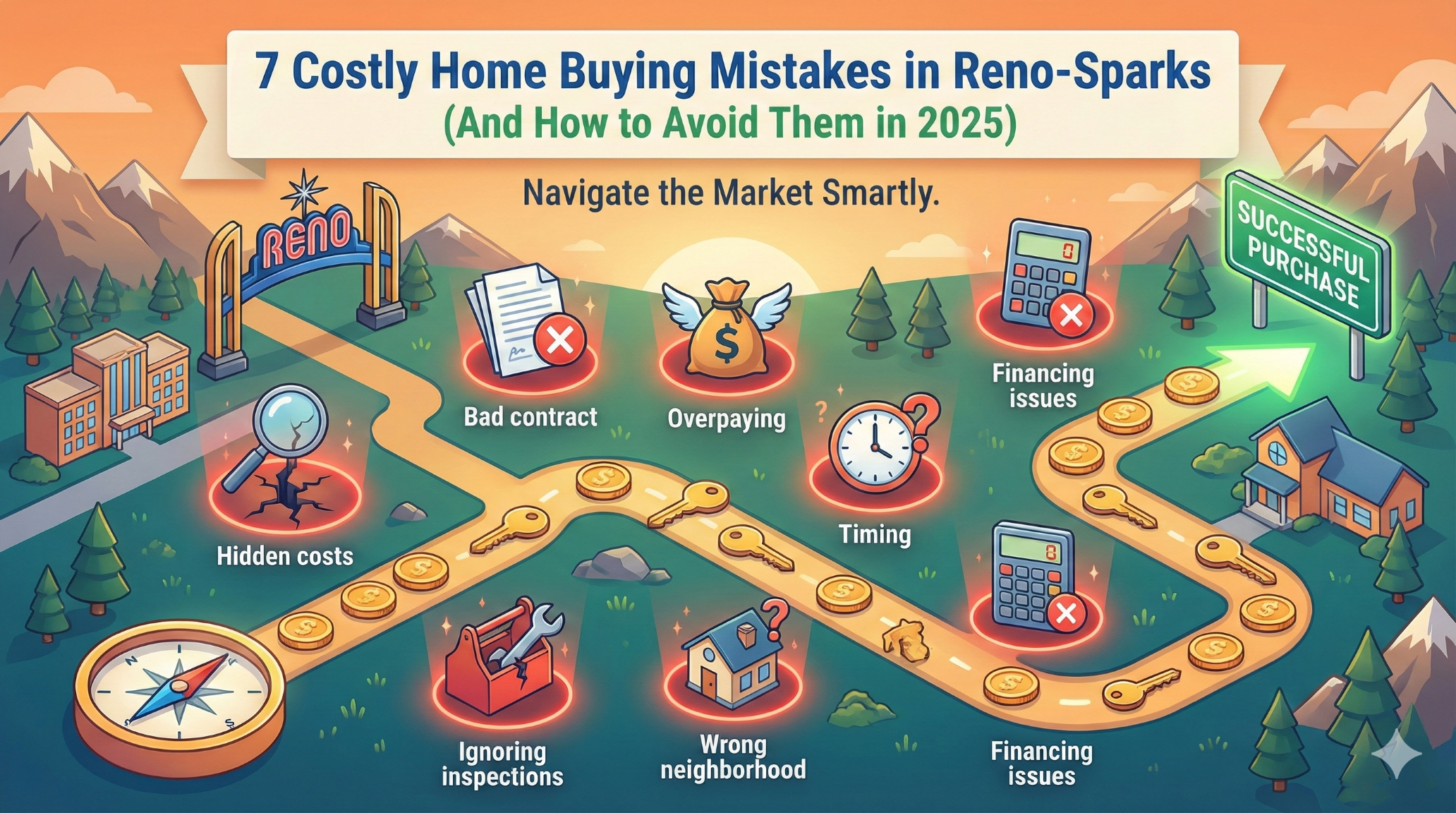
Here are the seven most costly home buying mistakes we see in Reno-Sparks—and exactly how to avoid them.
Mistake #1: Skipping Pre-Approval (or Confusing It With Pre-Qualification)
This is the fastest way to lose your dream home in Reno's current market.
Pre-qualification is a lender's estimate based on self-reported information. Pre-approval means a lender has verified your income, assets, credit, and employment—and committed in writing to lend you a specific amount.
Why this matters in Reno-Sparks right now: With homes taking an average of 68-95 days to sell (depending on price range and neighborhood), you have more time than the 2021-2022 frenzy. But in desirable areas like Damonte Ranch, Caughlin Ranch, or newer sections of Spanish Springs, well-priced homes still receive multiple offers. Sellers won't seriously consider an offer without pre-approval—and they shouldn't.
The cost of this mistake: You find the perfect home in Northwest Reno listed at $625,000. You submit an offer without pre-approval. The seller receives two other offers—both pre-approved. Yours gets dismissed immediately, regardless of price. Three weeks later, you finally get pre-approved and discover you actually qualify for $590,000, not $625,000. You've wasted a month and lost negotiating position in a shifting market.
How to avoid it: Contact a local lender before you tour a single home. The Nevada Housing Division offers programs like Home Is Possible (up to 4% down payment assistance) and Home First (up to $15,000 down payment assistance for qualifying buyers). Understanding these options early gives you a competitive advantage. Get fully pre-approved with verified documentation—this process typically takes 3-5 business days with responsive borrowers.
Mistake #2: Underestimating Total Monthly Housing Costs
Your mortgage payment is only the beginning.
Many Reno-Sparks buyers—particularly those relocating from California—focus solely on the purchase price and mortgage payment without accounting for the full monthly cost of homeownership in Northern Nevada.
What buyers miss:
- Property taxes: Nevada's effective property tax rate is approximately 0.53% to 0.84% depending on location and jurisdiction. On a $600,000 home in Sparks, expect $3,000-5,000 annually ($250-420/month).
- HOA fees: Master-planned communities like Somersett ($200-400/month), ArrowCreek ($150-300/month), and Damonte Ranch ($150-250/month) add hundreds to your monthly obligation. These fees cover amenities, landscaping, snow removal, and community maintenance—but they're not optional and they increase over time.
- Homeowners insurance: With 84% of Reno properties at some wildfire risk according to First Street Foundation data, insurance costs in foothill neighborhoods (Northwest Reno, parts of Southwest Reno) can run $150-250/month or higher. Properties in lower-risk areas like Sparks or South Meadows typically see $100-150/month.
- Utilities: Natural gas heating costs matter in Northern Nevada winters. Homes in older neighborhoods may have higher utility bills than newer construction with modern insulation and HVAC systems.
The cost of this mistake: You qualify for a $3,200/month mortgage payment. You find a beautiful $675,000 home in Somersett. Your mortgage payment will be $3,150/month—comfortably within budget. Then you discover the HOA is $325/month, property taxes add $430/month, insurance is $185/month due to wildfire risk, and utilities average $200/month in winter. Your actual monthly cost is $4,290—$1,090 over your mortgage payment and $1,090 more than you budgeted.
How to avoid it: Before you start house hunting, calculate your true monthly housing budget including ALL costs:
- Base mortgage payment (principal + interest)
- Property taxes (ask your agent for specific rates by neighborhood)
- HOA fees (these vary dramatically—ask upfront)
- Homeowners insurance (get quotes for specific neighborhoods)
- Utilities (request average bills from sellers)
- Maintenance reserve (budget 1% of home value annually)
A $600,000 home in Somersett might cost $4,200/month total. That same price in an older Northwest Reno neighborhood without HOA might cost $3,600/month. Your affordable price range depends on location, not just purchase price.
Mistake #3: Buying in the Wrong Neighborhood for Your Priorities
Reno and Sparks contain dozens of distinct neighborhoods—each with different lifestyles, price points, future development plans, and hidden considerations.
Common neighborhood mismatches we see:
The California relocator who buys in Spanish Springs: Attracted by newer construction and larger lots at better prices ($500,000-650,000 range), California buyers often choose Spanish Springs without realizing the 25-35 minute commute to central Reno, limited walkability, and newer community infrastructure. If you prioritize proximity to Midtown's restaurants, short commutes, or established neighborhoods with mature trees, Spanish Springs creates daily frustration despite the value.
The first-time buyer who stretches for Damonte Ranch: Yes, the schools are excellent and the amenities are impressive. But if you're maxing out your budget at $680,000 to get into Damonte Ranch when you could buy a similar home in South Meadows for $580,000, you're paying $100,000 for zip code prestige—and accepting higher HOA fees ($180-250/month) and property taxes.
The buyer who ignores wildfire risk: Northwestern foothill neighborhoods (parts of Caughlin Ranch, homes along the Mount Rose Highway corridor) offer stunning views and desirable locations. They also sit in high or very high wildfire risk zones. Insurance costs are higher, and evacuation plans matter. This isn't a reason to avoid these areas—it's a factor that should inform your decision with eyes wide open.
The investor who buys too far from job centers: Buying in Fernley or Dayton because prices are lower ($400,000-500,000) makes sense IF your tenants work in Fernley or Dayton. If they commute to Reno, you're limiting your renter pool and increasing vacancy risk.
How to avoid it: Make a priority list BEFORE you start looking:
- Commute requirements (where do you work? How far is acceptable?)
- Schools (if relevant—check GreatSchools ratings and growth trends)
- Walkability vs. space (urban Midtown vs. suburban Damonte Ranch vs. rural Cold Springs)
- HOA preferences (amenities worth the fees, or prefer freedom?)
- Future development (established vs. growing neighborhoods)
Tour neighborhoods at different times of day and days of the week. Drive the commute during rush hour. Visit local amenities. Spend time in the area before you commit. Northern Nevada neighborhoods have distinct personalities—find the one that matches your actual lifestyle, not your idealized one.
Mistake #4: Waiving Inspection or Not Hiring the Right Inspector
The Reno-Sparks market has cooled considerably from its 2021-2022 peak. You now have more negotiating power and time. Despite this, some buyers still waive inspections to make offers more attractive—and it's almost always a mistake.
Why inspections matter specifically in Northern Nevada:
Age-related issues: Many Reno-Sparks neighborhoods were built in waves. Caughlin Ranch (1980s-1990s), Somersett (2000s), Damonte Ranch (2000s-2010s), Spanish Springs (2000s-2020s). Homes from the 1980s-1990s are reaching the age where roofs, HVAC systems, water heaters, and appliances need replacement. A $625,000 home in Caughlin Ranch might need $15,000-25,000 in deferred maintenance.
Well and septic systems: Rural properties in Cold Springs, Palomino Valley, or areas outside city limits may have well water and septic systems. These require specialized inspection and can cost $20,000-40,000 to replace if failing. City buyers unfamiliar with well systems sometimes skip this inspection—and regret it within months.
Foundation issues in older homes: Northern Nevada's high desert climate creates soil movement. Homes built before modern foundation standards may have settling issues, especially in older Northeast Reno or West Reno neighborhoods.
Stucco and siding concerns: Improperly installed or maintained stucco is common in homes built 1990s-2010s. Water intrusion behind stucco can cause extensive hidden damage costing tens of thousands to remediate.
The cost of this mistake: You buy a $560,000 home in Northwest Reno without inspection to make your offer more competitive. Three months later, the HVAC system fails—$12,000 to replace. Six months later, you discover the roof is 22 years old and needs replacement—$18,000. The water heater fails shortly after—$2,500. You've spent $32,500 on issues an inspector would have identified and you could have negotiated during the purchase. With the right inspection and negotiation, the seller might have contributed $15,000-20,000 toward these items, or you would have walked away and found a better-maintained home.
How to avoid it:
- Always get a professional home inspection: Budget $400-600 for a thorough inspection. This is the best money you'll spend in the entire process.
- Hire an inspector with local experience: Reno-Sparks has specific issues (high desert climate, altitude, older construction in certain neighborhoods). Hire someone who knows what to look for in Northern Nevada homes.
- Add specialized inspections when warranted:
- Well and septic inspection ($400-600) for rural properties
- Roof inspection ($150-300) for homes with roofs over 15 years old
- Sewer scope ($150-250) for older homes—tree root intrusion is common
- Structural engineer ($500-800) if you see foundation cracks or settling
- Use inspection results strategically: In today's market, you have negotiation power. If inspection reveals $15,000 in needed repairs, you can:
- Request a price reduction
- Ask seller to complete repairs before closing
- Request a credit toward closing costs
- Walk away if seller won't negotiate
The average home inspection finds $5,000-15,000 in needed repairs or maintenance items. Even if the seller only credits half, you're tens of thousands ahead.
Mistake #5: Making Decisions Based on Emotion Instead of Data
We understand falling in love with a home. The light in the kitchen, the mountain views, the perfect layout—emotions are part of the process. But emotion without data leads to costly mistakes.
Where emotional decisions go wrong:
Overpaying in bidding wars: With multiple offers now less common than 2021-2022, strategic buyers have the advantage. But when multiple offers do emerge (well-priced homes in Damonte Ranch, Caughlin Ranch, or desirable Northwest Reno neighborhoods), emotional buyers escalate beyond the home's value. Paying $50,000 over appraised value means you're underwater from day one, and you'll need years of appreciation to recover.
Ignoring comps and market data: Your agent provides comparable sales showing homes in the neighborhood selling for $320-340/sq ft. The home you love is listed at $375/sq ft. Emotion says "I don't care, I love it." Data says "This is overpriced by $50,000-80,000." In today's market where homes receive on average 98.5% of asking price, overpriced listings eventually reduce—but you pay carrying costs and stress while waiting.
Buying at the top of your budget: Lenders pre-approve you for $700,000. You fall in love with a $695,000 home that maxes out your budget. This leaves no cushion for unexpected repairs, property tax increases, HOA fee increases, or life changes. Financial stress follows.
Overlooking deal-breakers because you've invested emotion: You tour a home five times. You can picture your furniture in every room. Then the inspection reveals foundation issues requiring $35,000 to repair. Emotional buyers often proceed anyway, convincing themselves "we'll figure it out." Three years later, they're still figuring it out—at great financial and emotional cost.
How to avoid it:
Use the 72-hour rule: After you find a home you love, wait 72 hours before submitting an offer. Tour it again during that time. Sleep on it. Revisit your priority list. Ask hard questions:
- Does it truly meet our needs, or just our wants?
- What would it cost to fix the things that aren't perfect?
- Are we comfortable with the monthly payment?
- What could go wrong, and could we handle it?
Run the numbers: Request a comparative market analysis from your agent showing:
- Recent sales (last 3-6 months) of similar homes in the neighborhood
- Current active listings (your competition)
- Price per square foot trends
- Average days on market
- Sale-to-list price ratios
If the home you want is priced 10-15% above comparable sales, it's overpriced regardless of your feelings. The market determines value, not your emotions.
Set hard limits: Before you start shopping, establish non-negotiable boundaries:
- Maximum monthly payment (including all costs)
- Maximum purchase price (leave cushion room below your pre-approval)
- Deal-breaker list (foundation issues? Wildfire zone? Major road noise? Know what you won't accept)
Trust your agent's guidance: You hired a professional with local market expertise for a reason. When your agent says "I think we should offer $635,000 for this $655,000 listing based on comps," listen. When your agent says "This home has been on market 90 days—we have leverage to negotiate," trust that expertise.
Emotion is the signal to look deeper. Data is the decision-making tool. Use both appropriately.
Mistake #6: Neglecting Future Resale Value
Even if you plan to stay in your Reno-Sparks home for decades, life changes. Job relocations, growing families, downsizing, financial shifts—the average American moves every 7-12 years. Buying with future resale in mind protects your financial future.
Resale factors specific to Reno-Sparks:
School districts matter—even if you don't have kids: Homes in areas with highly-rated schools (parts of South Reno, Damonte Ranch, Caughlin Ranch) hold value better than comparable homes in areas with lower-rated schools. Future buyers with children will limit their search to good school zones, giving you a larger buyer pool.
Three bedrooms minimum: Two-bedroom homes limit your buyer pool to singles, couples without children, and downsizers. Three-bedroom homes appeal to all of those buyers PLUS families, investors seeking rental properties, and buyers who need a home office. If you're choosing between a beautiful 2-bedroom townhome and a decent 3-bedroom house at similar prices, the 3-bedroom offers significantly better resale flexibility.
Functional floor plans beat trendy designs: That ultra-modern open loft with no defined bedrooms might excite you today. But it will limit your buyer pool when you sell. Traditional floor plans (distinct bedrooms, bathrooms on bedroom floors, reasonable kitchen layouts) appeal to the widest range of future buyers.
Location, location, location—but think 5-10 years out: Is the neighborhood improving or declining? Are there plans for commercial development nearby? Is the school district investing in growth or facing budget cuts? Is the neighborhood attracting young families, or is it aging in place? These trend lines affect future value.
HOA health matters: If you're buying in an HOA community, request financial statements. A well-funded HOA with adequate reserves increases property values. An underfunded HOA facing special assessments or deferred maintenance decreases values and makes your home harder to sell.
How to avoid it:
Ask these questions before you buy:
- What are the school ratings, and what's the trend? (Check GreatSchools.org and local enrollment data)
- How have property values trended in this neighborhood over the last 5-10 years? (Your agent can pull this data)
- What's the average time on market for homes in this neighborhood? (Faster = better resale liquidity)
- Are there negative factors that could affect future value? (Nearby industrial areas, major road noise, challenging lot characteristics, HOA issues)
- Would I be happy showing this home to buyers in 5-10 years? (Deferred maintenance, odd layouts, and unusual features become YOUR problems when you sell)
You don't need to buy the most expensive home in the best neighborhood. You DO need to buy a home that will be marketable to future buyers when your circumstances change.
Mistake #7: Trying to Time the Market Perfectly
"Should I wait for prices to drop?" "Should I wait for interest rates to fall?" "Should I buy now or wait until spring?"
These questions haunt buyers. The truth? Trying to perfectly time the Reno-Sparks real estate market is a losing strategy.
Why market timing fails:
Prices and rates rarely move in your favor simultaneously: When interest rates drop, buyer competition increases, pushing prices higher. When prices soften, rates often stay elevated or rise. You rarely get both favorable conditions at once.
Waiting costs you money: While you wait for the "perfect" time, you're paying rent (likely $1,800-2,500/month for a comparable home in Reno-Sparks). That's $21,600-30,000 annually building someone else's equity instead of yours. Over two years of waiting, you've spent $43,000-60,000 with nothing to show for it.
Appreciation happens while you wait: Northern Nevada home values have appreciated 7-8% year-over-year even in this "slower" market. If you wait a year for prices to drop 3% while values actually rise 7%, you've lost 10% in buying power. On a $600,000 home, that's $60,000—far more than you'd save from a modest price reduction.
The perfect moment looks clear only in hindsight: No one can predict the exact bottom of a price cycle or the exact low point of interest rates. Professional economists and market analysts get this wrong. Individual buyers gambling on perfect timing almost always lose.
What matters more than timing:
Can you afford the home today? If the answer is yes, and the home meets your needs, that's more important than whether prices might drop 2-3% in six months.
Are you planning to stay 5+ years? Real estate is a long-term investment. Short-term market fluctuations matter far less than long-term appreciation and equity building. If you're staying 5-10 years, today's price and rate are less critical than market timing advocates suggest.
Are you building equity vs. paying rent? Every rent payment is gone forever. Every mortgage payment builds equity and provides tax benefits. The break-even point (when buying becomes cheaper than renting) in Reno-Sparks is typically 3-5 years. After that, homeownership is clearly the better financial choice.
The real question: The question isn't "Is this the perfect time to buy?" The question is "Does this home meet my needs, can I afford it comfortably, and am I ready for homeownership?" If yes to all three, it's the right time for YOU—regardless of what the market might do tomorrow.
How to avoid it:
Stop waiting for perfect conditions that will never arrive. Instead:
- Focus on what you control: Your budget, your priorities, your readiness for homeownership, your choice of neighborhoods and homes.
- Buy when it's right for YOU: Your job is stable, your down payment is ready, you need space/schools/stability, you're prepared for homeownership responsibilities.
- Understand the current market: As of December 2025, the Reno-Sparks market offers more inventory and negotiating power than any time since 2019. If you've been waiting for "better conditions," this IS the better condition. Homes are taking 68-95 days to sell. Buyers have time to be strategic. Multiple offers are less common. This is a good time to buy—not perfect (that doesn't exist), but good.
- Plan for the long term: Buy a home you can afford comfortably, in a neighborhood you like, with features that matter to your lifestyle. If you're staying 5+ years, today's market conditions are largely irrelevant to your long-term financial outcome.
The best time to plant a tree was 20 years ago. The second best time is today. The same logic applies to homeownership.
Make Your Reno-Sparks Home Purchase Strategic, Not Stressful
These seven mistakes cost Reno-Sparks buyers thousands—sometimes tens of thousands—in preventable losses every year. The good news? Every single one is avoidable with the right guidance, local expertise, and strategic approach.
The difference between a costly mistake and a smart purchase often comes down to having an experienced team who knows this market intimately. Not generic advice from national real estate blogs—specific guidance for Somersett vs. Damonte Ranch, Caughlin Ranch vs. Northwest Reno, Spanish Springs vs. South Meadows.
We've helped hundreds of buyers navigate the Reno-Sparks market successfully—avoiding these mistakes, negotiating strong positions, and finding homes that fit both their lifestyle and their budget.
Ready to approach your home purchase with confidence and clarity? Contact Kevin Kinney at 775-391-8402 or Robin Renwick at 775-813-1255 to schedule a comprehensive buyer consultation. We'll discuss your specific situation, walk through neighborhood options that match your priorities, analyze current market positioning, and create a strategic buying plan that protects your investment. Let's make your move to Reno-Sparks not just successful, but smart.
The Kinney & Renwick Team
Kevin Kinney — 775-391-8402
Robin Renwick — 775-813-1255
[email protected]
kinneyandrenwickteam.com
Frequently Asked Questions: Home Buying in Reno-Sparks
How much should I budget for a down payment when buying in Reno-Sparks?
Down payment requirements vary by loan type and program. Conventional loans typically require 5-20% down, though programs like the Nevada Housing Division's Home Is Possible offer options with as little as 3-4% down plus down payment assistance for qualifying buyers. FHA loans require 3.5% down, while VA and USDA loans may require zero down for eligible buyers. On a $600,000 Reno-Sparks home, expect $18,000-30,000 down with assistance programs, or $30,000-120,000 for conventional financing. Work with a local lender to understand which programs fit your situation—this can save you tens of thousands compared to assuming you need 20% down.
What are the main differences between buying in Reno vs. Sparks?
Reno offers more urban amenities, shorter commutes to downtown and Midtown, established neighborhoods with mature landscaping, and typically higher prices ($550,000-700,000+ median depending on neighborhood). Sparks offers newer construction in many areas, more affordable entry points ($500,000-650,000 median), family-oriented master-planned communities like Damonte Ranch, and generally lower property taxes. Both cities offer excellent options—the right choice depends on your commute needs, budget, and lifestyle preferences. Tour neighborhoods in both cities before deciding.
How long does it take to buy a home in the Reno-Sparks market in 2025?
From pre-approval to closing typically takes 45-75 days in the current Reno-Sparks market. This breaks down as: finding the right home (2-8 weeks depending on your criteria and market conditions), negotiating offer and acceptance (1-7 days), inspection period (7-10 days), appraisal (7-14 days), loan processing and underwriting (15-30 days), and final closing preparations (3-5 days). With inventory up 27% year-over-year as of late 2024, buyers now have more time to make strategic decisions compared to the rushed 2021-2022 market. This longer timeline is actually advantageous—use it to make informed choices rather than emotional ones.
Should I buy a home with HOA fees, or avoid HOA communities in Reno-Sparks?
This depends entirely on your priorities and budget. HOA communities like Somersett, ArrowCreek, and Damonte Ranch offer significant benefits: maintained common areas, snow removal, community amenities (pools, parks, trails, clubhouses), and enforced property standards that protect your investment. These benefits cost $150-400/month depending on the community. If you value amenities, don't want to maintain landscaping, and appreciate community standards, HOA fees deliver value. If you prefer maximum freedom over your property, want to avoid monthly fees, and are comfortable handling all maintenance yourself, non-HOA neighborhoods offer that flexibility. There's no universally "better" choice—align your decision with your actual lifestyle and budget.
What neighborhoods in Reno-Sparks offer the best value for first-time buyers?
Best value depends on your definition of value and priorities, but these neighborhoods typically offer strong entry points for first-time buyers: South Meadows (Reno) offers newer construction, good schools, and prices in the $550,000-700,000 range. Lemmon Valley provides the most affordable Reno option ($400,000-550,000) with larger lots, though it requires a longer commute. Spanish Springs (Sparks) offers newer homes, good schools, and prices in the $500,000-650,000 range, but the commute to central Reno is 25-35 minutes. Sun Valley provides the lowest entry point ($350,000-500,000) but requires tolerance for an area still developing infrastructure. Cold Springs offers rural living with more affordable prices ($450,000-600,000) and larger lots, ideal for buyers who want space and don't mind distance from urban amenities. The "best value" neighborhood is the one that matches your commute, lifestyle, and budget priorities—not necessarily the cheapest option.
How much do property taxes really cost on a home in Reno vs. Sparks?
Nevada's property tax rates vary by jurisdiction and local government services. In Reno, expect approximately $5,000-7,000 annually on a $600,000 home, depending on the specific assessment district. In Sparks, expect approximately $4,500-6,500 annually on the same value, as Sparks generally has slightly lower tax rates than Reno. Carson City rates are similar to Sparks. These translate to roughly $400-600/month added to your housing costs. California relocators are often surprised—Nevada doesn't have Proposition 13, so your property taxes will increase as your home value increases (though they're capped at 3% annual growth). Ask your agent for the specific tax rate in any neighborhood you're considering, as rates vary by city, county, and special assessment districts.
Is now a good time to buy in the Reno-Sparks real estate market, or should I wait?
The December 2025 Reno-Sparks market offers several advantages for strategic buyers: inventory is up 27% year-over-year, giving you more options and negotiating power than any time since 2019. Days on market have increased to 68-95 days depending on price range, meaning you have time to make thoughtful decisions rather than rushed offers. Homes are selling at approximately 98.5% of asking price rather than the 102-105% of the 2021-2022 frenzy. Multiple offers are less common except on exceptionally well-priced properties. Meanwhile, median home values continue to appreciate 5-8% annually, and rent continues to cost $1,800-2,500/month for comparable properties. Waiting for "perfect" conditions (lower prices AND lower rates simultaneously) is unrealistic—that scenario rarely materializes. If you need a home, can afford it comfortably, plan to stay 5+ years, and have found the right property in the right neighborhood, now is a strategically sound time to buy in Reno-Sparks. The market has normalized to levels that favor informed, patient buyers who do their homework.
What are the biggest hidden costs when buying a home in Northern Nevada?
Beyond the down payment and mortgage, these costs surprise many Reno-Sparks buyers: closing costs (2-5% of purchase price, or $12,000-30,000 on a $600,000 home), homeowners insurance ($1,200-3,000 annually depending on wildfire risk and coverage), property taxes (addressed above), HOA fees if applicable ($1,800-4,800 annually), utilities (natural gas heating costs in Northern Nevada winters can be significant, especially in older homes), immediate repairs and updates (even move-in ready homes often need something), and ongoing maintenance reserve (budget 1% of home value annually, or $6,000/year on a $600,000 home). The difference between financial comfort and financial stress often comes down to accurately budgeting for ALL these costs, not just the mortgage payment. A good rule: if your lender pre-approves you for $700,000, shop in the $600,000-650,000 range to leave cushion for real-world costs.
Check out this article next